Archive for the 'Endangered' Category

Recovery Implementation Program

Thursday, November 19th, 2009

Passport to Texas from Texas Parks and Wildlife

The Edwards Aquifer Recovery Implementation Program, or RIP, protects endangered and threatened species in the Edwards Aquifer.

Many of these species are no more than an inch long. The Comal springs riffle beetle is even smaller…only two millimeters long.

But Parks and Wildlife water resources branch chief, Cindy Loeffler, says preserving the species is crucial to the ecosystem.

These are, you know, you’ve heard the cliché canary in the coal mine. If we want to truly protect natural resources, fish and wildlife, these unique ecosystems. These species are indicators of the health of those ecosystems.

Loeffler also says if the program protects the identified species, it will most likely save many more in the process.

We have some species that there’s very little known about. And these are in a way the tip of the iceberg of the threatened and endangered species that are found associated with the Edwards Aquifer. There are many more species that are not listed that are found no where else.

Many of these species are found no where else in the world…like the San Marcos blind salamander and Texas wild rice. And pumping water from the Edwards Aquifer alters the habitat, putting these species in an unstable environment.

That’s our show…with research and writing help from Gretchen Mahan. Discover how you can help at passporttotexas.org. For Texas Parks and Wildlife I’m Cecilia Nasti.

 
icon for podpress  Endagnered Species: R.I.P.: Play Now | Play in Popup | Download

Troubled Waters: Whooping Cranes

Monday, September 28th, 2009

Passport to Texas from Texas Parks and Wildlife

[Whooping crane calls]

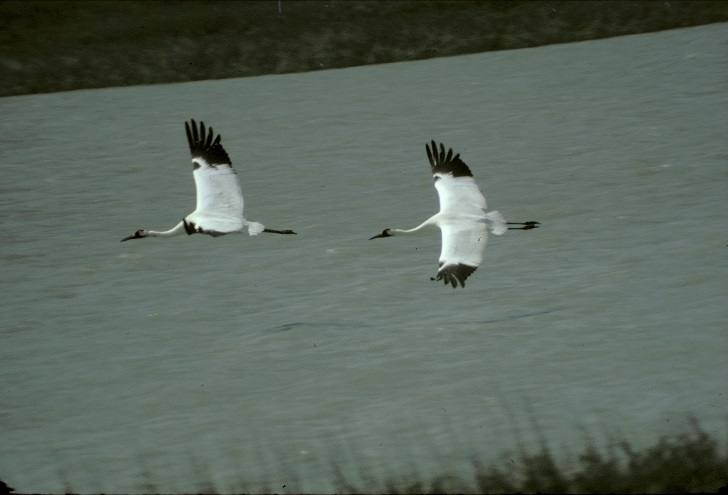
Last winter, twenty-three out of two hundred and seventy whooping cranes died after a decline in blue crab and wolfberries, two of the crane’s main food sources.

Tom Stehn is the whooping crane coordinator for the U.S. Fish and Wildlife Services. He says the decline is linked to two sources: drought and diversion of Texas rivers.

The human consumption of water has been increasing annually as the population of South Texas grows. This is a very critical issue for the bays that in some way we need to figure out a mechanism so sufficient freshwater inflows reach the bays to keep them productive.

Stehn says the fate of the whooping crane could rest in the hands of Texans.

There are management actions that people will have to do such as conserve water. And those are the choices that Texans have to make.

And many new threats are coming onto the scene.

As issues get worse for the whooping cranes, inflow issues, housing development issues, wind energy development, possibly taking away habitat from the cranes in migration. There’s a lot of threats out there right now, so I’m really leery of how the whooping cranes are going to do in the future.

The good news is there are sixty-one nesting pairs of cranes, which make some researchers hopeful that the population will increase next year.

That’s our show…with research and writing help from Gretchen Mahan. For Texas Parks and Wildlife I’m

 
icon for podpress  Troubled Waters: Whooping Cranes: Play Now | Play in Popup | Download

Endangered Species: Houston Toad

Friday, September 25th, 2009

Passport to Texas from Texas Parks and Wildlife

[Call of the Houston toad]

That sound is the Houston toad. And it’s become a very rare sound over the past two decades. Years of drought and habitat destruction have diminished the Houston toad population to only a few hundred.

Michael Forstner is a professor at Texas State University. And through the Texas Parks and Wildlife Landowner Incentive Program (L.I.P.), he’s working with private landowners in Bastrop County to restore habitat for the Houston toad.

Most of the people in Bastrop want to live in Bastrop County because it looks a certain way. And if it keeps looking like the lost pines, we keep the toad.

So what do these “lost pines” look like?

Imagine a cathedral forest. Most of the habitat that we find Houston toads doing the best in, whatever that means for its current levels, are gallery forests. Those are the forests that you see in the images for computer desktop wallpapers. Those are large-trunked trees with open space beneath them.

By planting the fast-growing loblolly pine trees, a habitat can be restored in about twenty years.

So if current efforts are successful, Forstner says the Houston toad population could make a comeback.

The best thing about the Houston toad is they make 6,000 eggs at a time. Those babies just need a place to grow up.

That’s our show…with research and writing help from Gretchen Mahan. You can find more information on passporttotexas.org. For Texas Parks and Wildlife, I’m Cecilia Nasti.

 
icon for podpress  Endangered Species: Houston Toad: Play Now | Play in Popup | Download

Kerr Wildlife Management Area

Monday, June 29th, 2009

Passport to Texas from Texas Parks and Wildlife and the Sport Fish and Wildlife Restoration Program

The Hill Country is the crown jewel of Texas. And the Kerr Wildlife Management Area teaches landowners how to keep it polished.

We’re a 65-hundred acre wildlife research and demonstration area for the Edward’s plateau ecological area. And it serves as our experiment station for private landowners to come out and find out more about the basic tools of wildlife management.

Donnie Frels is the area manager. While wildlife species at the Kerr WMA are typical for the region, plant diversity is unique by Hill Country standards.

We keep animal numbers in check, and we make sure that we maintain our grazing animals within the carrying capacity of the range, and our plant species and diversity reflect that now.

Research on the site also protects three endangered species: the golden-cheeked warbler, black-capped vireos and the tobusch fishhook cactus.

And we do surveys for all three of these species; and our management program benefits not only white-tailed deer but those endangered species as well.

The site is open to the public for wildlife viewing during daylight hours when public hunting is not underway, and offers a driving tour brochure for those visiting the site. Learn more at passporttotexas.org.

That’s out show… made possible by a grant from the Sport Fish and Wildlife Restoration program… For Texas Parks and Wildlife…I’m Cecilia Nasti.
 
icon for podpress  Kerr Wildlife Management Area: Play Now | Play in Popup | Download

Endangered Ocelots, 2

Friday, June 12th, 2009

Passport to Texas from Texas Parks and Wildlife and the Wildlife Restoration Program

Texas is the only US state with suitable Ocelot habitat.

The habitat that ocelots use is extremely dense brush. The type of brush that not only can you not see through it, you can’t walk through it.

Dr. Michael Tewes (two-ES) researches wild cats with the Caesar Kleberg Wildlife Research Institute.

The main problem for ocelots now is, like many other endangered species, the lack of suitable habitat. There are less than 100 of them remaining in Texas and less than 1% of Texas has that very special habitat or cover type that they use. And since most of Texas is owned and managed by private landowners and ranchers, it is in their ability to protect the habitat that is vital to the recovery of ocelots.

Fewer ocelots mean less genetic diversity.

When the populations are as small as they are in Southern Texas, almost any kind of a wildlife population will start to decrease genetic diversity and tend to go towards extinction. We have been working on revising the recovery plan and, although it’s not finalized, translocation is suggested as a tool. The genetic diversity is much greater in Mexico than it is in Texas. And by bringing them into Texas it would help alleviate some of the problems that come with genetic erosion.

That’s our show… with research and writing help from Sarah Loden… and sponsored by the Wildlife Restoration program…working to restore critical habitat for endangered species like the ocelot.

For Texas Parks and Wildlife…I’m Cecilia Nasti.
 
icon for podpress  Endangered Ocelots, 2: Play Now | Play in Popup | Download