Archive for the 'Conservation' Category

The Women Who Saved Migratory Birds

Thursday, July 9th, 2015
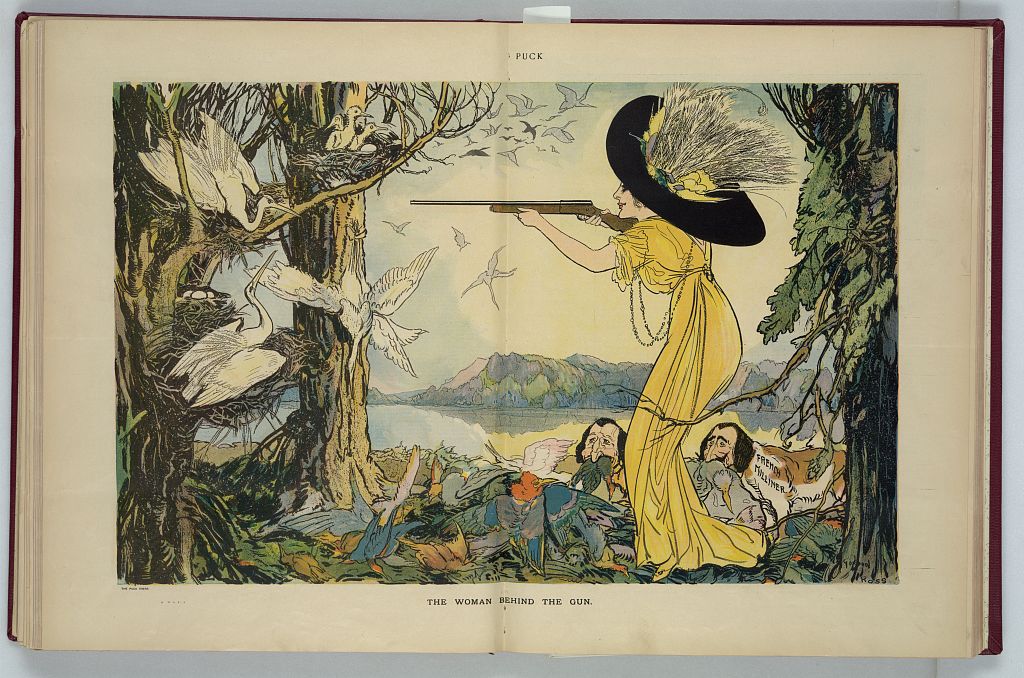
The woman behind the gun, by Gordon Ross, 1873-1946, artist. Library of Congress.

The woman behind the gun, by Gordon Ross, 1873-1946, artist. Library of Congress.


This is Passport to Texas

At the turn of the 20th century fashionable women wore hats decorated with feathers, wings and even entire taxidermied birds.

08- What began to happen was, a huge amount of hunting of specific migratory birds for their plumes–and their plumes only.

Urban Wildlife biologist, Kelly Simon, says unregulated market hunting to meet the demand led to destruction of whole bird breeding colonies.

13- And people began to realize that the effect of this unregulated taking of wildlife was putting a lot of pressure on the natural populations of these animals. So, they were declining at an alarming rate.

In 1896, after reading an article describing the plume trade, Boston socialite Harriet Hemenway, convinced women of social standing to stop wearing feathered hats, and to join the society for the protection of birds. Their efforts led to The Migratory Bird Act of 1918, which outlawed market hunting and interstate transport of birds.

09- We decided it was important for us to have wildlife as a resource that was available to everyone: to feed their families, to enjoy, to watch.

Other conservation laws joined the Migratory Bird Act, including the Pittman-Robertson Act of 1937, whereby hunters asked Congress to impose an excise tax on the sale of firearms and ammunition products to help fund wildlife conservation in the US.

For Texas Parks and Wildlife…I’m Cecilia Nasti.

Changing Face of Conservation

Wednesday, July 8th, 2015
Photo courtesy NPR: David J. Phillip (right)/LM Otero (left)/AP

Photo courtesy NPR: David J. Phillip (right)/LM Otero (left)/AP

This is Passport to Texas

We use the word conservation, but what does it mean?

09—Really, what we’re talking about, is managing our habitat, and our wildlife—our natural resources—to fit the goals that we have for our ecosystems.

That’s urban wildlife biologist, Kelly Simon.

13— Environment is never static. It’s never still; it’s always in motion. In conservation what we try to do is guide that motion of the habitat in the best possibly way—based on what we know.

We know that “changing times” inform where we choose live and how we interact with the natural world.

18— Things have changed an awful lot since may the 1800s to now. Used to we were a very rural society; most people lived out in the country on the land, and a few people lived in the cities. And now, it’s completely flip-flopped, and we’ve got almost all the people living in cities, and very few people living right there on the land.

As rural residents we intuitively knew the value of resources like game animals, and how to take what we needed while maintaining the natural balance. In the late 19TH and early 20th Century, as farm clothes gave way to fashion trends, wildlife landed in the cross hairs, thus threatening some species.

06— Back in the early 1900s it was very fashionable for women to have these grandiose plumes in their hats.

How procurement of those plumes from migratory birds led to collaborative conservation efforts.

For Texas Parks and Wildlife…I’m Cecilia Nasti.
Lone Star Land Steward: Rancho ZunZun

Monday, June 29th, 2015


This is Passport to Texas

Roxanne and Elvis Hernandez live in Bastrop County and turned their 53 acre Rancho ZunZun into a thriving wildlife habitat with enhanced Houston Toad protection.

10-Roxanne and Elvis, they are so passionate about their land stewardship ont heir property for all wildlife species–not just the Houston Toad.

Their hard work earned them a Lone Star Land Steward Regional award for the Lost Pines ecosystem. Wildlife biologist, Meredith Longoria, provides the couple with technical assistance.

15-They have taken leaps and bounds since they started through the landowner Incentive Program, including: native grass plating, and pine reforestation, and prescribed burning. They’ve utilized just about every tool they’ve learned about on their property.

The Lone Star Land Steward awards honor landowners who preserve our natural heritage. The Hernandez’s bought their land in 2004, and began restoration work.

25– We planted 35-hundred trees the year right before the drought. Here, this whole area was filled with cedars–you couldn’t even walk through here–and we had that removed and cleared, and did the prescribed burn back in 2012. Yeah, you can still see all the burn scars on the trees. For our wildlife management, we provide supplemental shelter, which are the brush piles; we have five nest boxes, which are frequented by bluebirds. We have a bat box.

They said they’ve seen all wildlife populations on the ranch flourish. Learn more about the Lone Star Land Steward Program on the Texas Parks and Wildlife Website.

For Texas Parks and Wildlife…I’m Cecilia Nasti.

Improving River Flows for Paddlefish and Beyond

Thursday, June 25th, 2015
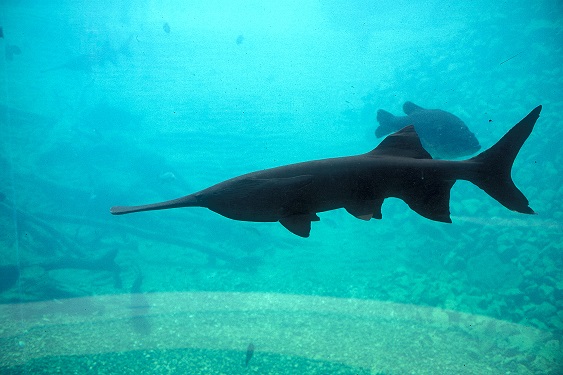
Paddlefish

Paddlefish

This is Passport to Texas

The batteries in the radio transmitters used to track 47 paddlefish reintroduced to Caddo Lake more than a year ago are fading.

06—We’re still tracking some paddlefish, but we know this is about the time we’re not going to be able to track ‘em anymore.

Native to Caddo, paddlefish disappeared following construction of a dam upstream at Lake of the Pines in the late 1950s.

Tim Bister, with Inland Fisheries, says early data suggest changes Texas Parks and Wildlife and partners made to simulate natural river flows and spawning habitat, kept the rare fish in the Big Cyprus Bayou and Caddo Lake system.

21—Having the opportunity to restore a native fish into the system, is certainly a good idea. But, to tie it into more of these natural river flows, and the idea that not just paddlefish—but
many other species—need natural river flows and appropriate spawning habitat, it’s going to benefit those things for rivers in Texas.

Bister says while they’ll continue monitoring paddlefish, the ongoing work is more expansive.

12— We will always be trying to do something in the Big Cyprus Bayou / Caddo Lake system to maintain quality river flow and quality habitat, and to monitor the fish populations.

The Wildlife and Sportfish Restoration Program supports our series.

For Texas Parks and Wildlife…I’m Cecilia Nasti.

Revisiting Paddlefish in Big Cypress Bayou

Wednesday, June 24th, 2015
Paddlefish at hatchery, photo courtesy of US Fish and Wildlife Service

Paddlefish at hatchery, photo courtesy of US Fish and Wildlife Service


This is Passport to Texas

Paddlefish, once abundant in the Big Cypress Bayou and Caddo Lake, started disappearing following construction of a dam at Lake of the Pines in the late 1950s.

07- So, basically, it took away the flows that the paddlefish need, and it took away their spawning substrate; eventually paddlefish just went away.

Inland fisheries’ Tim Bister says in spring 2014 a broad coalition of non-profits, landowners, and government agencies, reintroduced paddlefish into the system. But they first made improvements to benefit the rare species, including development of natural water releases upstream from Lake of the Pines, and gravel bar spawning areas.

14-We stocked 47 paddlefish, a year and a half old, between two and three feet long. And each were implanted with a radio transmitter, with a specific radio frequency that could be identified by a radio receiver.

Researchers tracked the paddlefish to see whether they would swim downstream over the spillway at Caddo Lake, and into Louisiana.

12-[If they did], they wouldn’t be able to swim back upstream because of that barrier. So, we wanted to make sure, by tracking these paddlefish, to see if they’re going to stay in the system. And after a year, I’m happy to say, that no fish were seen going over the spillway.

The radio transmitter batteries are fading, but the data collected so far is promising. Until the paddlefish reach reproductive maturity, we won’t know if we’ll see a self-sustaining population in Big Cypress Bayou and Caddo Lake.

The Wildlife and Sport Fish Supports our series.

For Texas Parks and Wildlife…I’m Cecilia Nasti.