Archive for the 'Conservation' Category

Monarch Week: Monitoring Milkweeds

Wednesday, January 7th, 2015
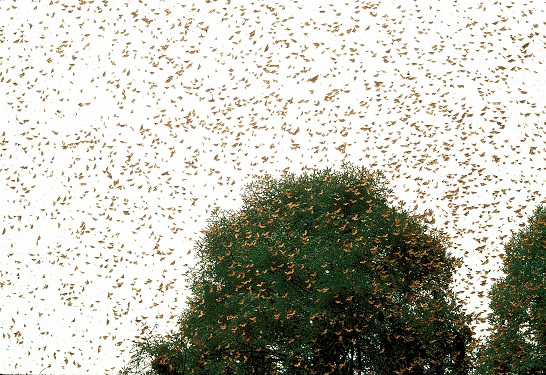
 

Monarchs at their overwintering site in Mexico.

Monarchs at their overwintering site in Mexico.


This is Passport to Texas

You’ll document milkweed species as a volunteer with the Texas Milkweeds and Monarch Citizen Science project.

07— What this project is addressing is, this widespread decline in availability in milkweed plants.

Monarch butterflies, also in decline, depend on these plants, says Ben Hutchins, Texas Parks and Wildlife’s invertebrate biologist.

12— There are a couple of different genera; these genera are used by monarch caterpillars. And those caterpillars only feed on these milkweed species.

No matter where you live in Texas, you’ll find milkweeds; when you do, share your observations at iNaturalist.org.

31— Wherever you happen to see a milkweed, we ask that you take your phone or take a camera, and snap a picture. When you upload that picture, then, onto the website, there are a couple of questions that we have: where were you, when did you make this observation, was it out in a park or was it in a garden, and also – how many were there? Just a rough estimate. And finally, did you notice any monarchs using that plant. Make the observation whenever you see the plant; but, if there are monarchs using it, we would be interested to know that.

Find a milkweed identification guide on the Texas Parks and Wildlife website. Tomorrow – questions researchers hope this project answers.

For Texas Parks and Wildlife…I’m Cecilia Nasti.
Monarch Week: Milkweed and Monarchs

Tuesday, January 6th, 2015


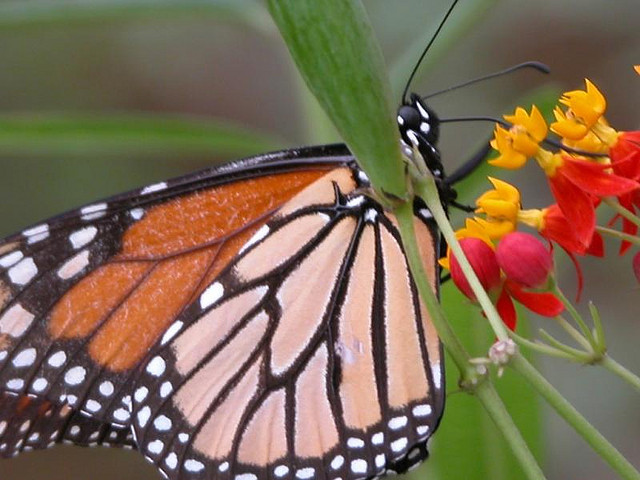
Monarch on milkweed plant.

Monarch on milkweed plant.


This is Passport to Texas

Why are monarch butterflies declining?

06— The current thought is that it is actually several different factors that are contributing to the decline that we’re seeing.

Ben Hutchins is Texas Parks and Wildlife’s invertebrate biologist. Deforestation of the species’ winter roosts in Mexico, unusually cold winters, and prolonged drought along their migratory path, all have negative effects.

13— And then, finally, what this project is addressing is this widespread decline in availability of milkweed plants. That’s due to a couple things: predominantly increased use of certain herbicides.

Texas Milkweeds and Monarchs is a new citizen science project where folks keep an eye out for the state’s 38 different species of milkweeds –vital to the monarch’s lifecycle – and then then share their observations on the website iNaturalist.org.

21— We have experts that are going to be looking at these observations and identifying those. We’re also working on a guide to Texas milkweeds, and that guide is going to be freely available online. It’s going to have pictures of all of the different species of milkweeds, distribution maps—so you know if you’re in the right part of the state—and also some of the key characteristics.

How you can get involved helping monarchs – that’s tomorrow.

For Texas Parks and Wildlife…I’m Cecilia Nasti.
Monarch Week: The Value of Monarch Butterflies

Monday, January 5th, 2015


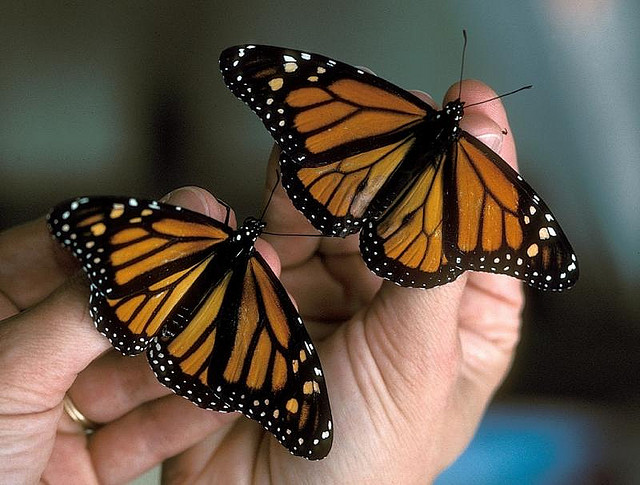
Monarch butterflies on hand.

Monarch butterflies on hand.


This is Passport to Texas

The gorgeous monarch butterfly is on the decline; efforts are afoot to conserve them. Yet, they’re not great pollinators, or a significant food source for other critters, so is being pretty reason enough to keep them around?

11—I think it’s important not to de-emphasize how important this is. If you’re ever out on a Texas river in the fall, and you have hundreds or thousands of monarchs coming through – that’s a fabulous natural phenomenon.

Ben Hutchins makes a good point. He is Texas Parks and Wildlife’s invertebrate biologist, and says the insects have a practical value in Mexico where they overwinter.

06— Overwintering monarchs are a really important source of economic income as tourists come from around the world to see them.

Conserving monarchs also benefits other Texas species.

30—Monarch conservation, benefits a whole suite of other species. So, for example, if you’re managing a landscape to benefit monarchs, you’re also going to be benefitting many other pollinators. They also benefit a host of larger species. For example, if you’re managing habitat – keeping it open as a prairie or savannah – that’s going to be benefitting upland bird species like quail; so there’s really an economic incentive of for being conscious of monarchs when we’re managing landscapes.

Tomorrow: a new citizen science project to help monarchs.

Funding provided in part by Ram Trucks. Guts. Glory. Ram

For Texas Parks and Wildlife…I’m Cecilia Nasti.
TPW TV: Sinking the Kinta

Friday, December 26th, 2014

This is Passport to Texas

The Gulf of Mexico has a lot going for it; but one thing it lacks is substrate. Substrate is hard material on which an organism can live and grow. That’s where this guy comes in.

05—[I’m] Dale Shivley; I’m the program leader for the artificial reef program for Texas Parks and Wildlife

Travel to the gulf with Shively and his crew this week on the TPW TV Series, as they “near shore” reef a 155 foot decommissioned freighter called the Kinta in 77 feet of water 8 miles off the coast of Corpus Christi.

13—Basically, what we have is a huge piece of metal that will benefit the local environment. Marine organisms will begin to grow on it; fish will be attracted to it immediately; it’s been cleaned of environmental hazards and is ready to go. [ambience]

On this TV segment, witness the hulking ship begin its new life on the gulf floor, where it will improve angling and diving opportunities. Brooke Shipley-Lozano, a marine biologist with Parks and Wildlife was at the reefing, and explains what will happen to the freighter.

19— So, the water will start coming in at the stern. And then gradually the water will fill up the ballast tanks one by one from the stern to the fore, and the rear of the ship should h it the bottom, and then eventually the bow will follow suit, and it will land perfectly upright and everyone will celebrate…

Will there be celebrating? Find when you watch the segment Sinking the Kinta S the week of December 28 on the TPW PBS TV Series. Check your local listings.

The Wildlife and Sport Fish Restoration program supports our series.

For Texas Parks and Wildlife…I’m Cecilia Nasti.

Wildlife: Whooping Cranes in Texas

Thursday, December 25th, 2014


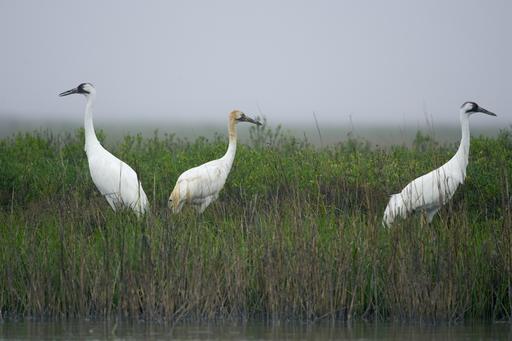
Whooping Cranes in Texas.

Whooping Cranes in Texas.


This is Passport to Texas

Former Parks and Wildlife biologist, Leeann Linam, has a long history with Whooping Cranes.

11— [chuckles] well, I may age myself here, but we moved to the Aransas National Wildlife Refuge when I was 12. And so I guess that means about 40 years or so I’ve been involved with whooping cranes.

Whoopers winter at the refuge, where Leeann’s father worked for the US Fish and Wildlife Service. After a low of 15 birds, and more than 70 years of conservation, we only reached 300 members in the migrating flock in 2013.

24 – Part of it is the nature of the animal, itself. Whooping cranes are one of these birds designed to be around for a long time. They live 25 to 30 years and more (in captivity). They don’t reproduce until they’re four or five years old; they usually only raise one chick successfully per year. So it just takes a while. You just have to be patient and provide the right conditions for a long time and then the numbers start to add up.

As their population increases and becomes more widespread, maintaining an accurate tally of the birds becomes a challenge. Whoopers are moving farther up the coast away from their traditional wetland habitat.

07 – Some of the rice country in Horton County and most interestingly, in Central Texas, we’ve had some whooping cranes wintering in Williamson County.

The Wildlife and sport fish restoration program supports our series and funds rainbow trout stocking in Texas…

For Texas Parks and Wildlife…I’m Cecilia Nasti.