Archive for the 'Conservation' Category

Hunt: Antlers, Horns and Habitat

Thursday, December 11th, 2014
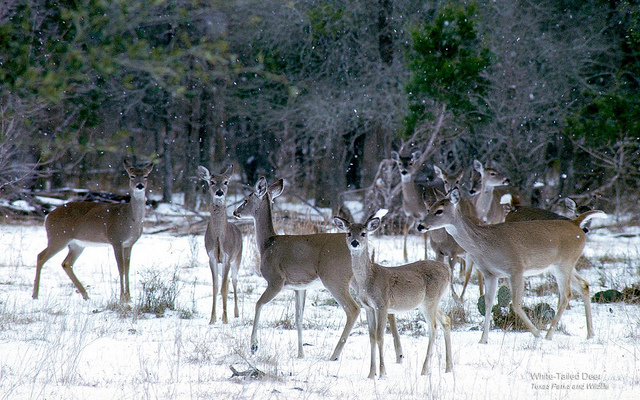
 

Whitetail deer in snow.

Whitetail deer in snow.


This is Passport to Texas

Hunting is about more than trophies. It’s about creating healthy habitat.

05—That’s exactly right. And our tagline at TBGA [Texas Big Game Awards] is Hunting equals Habitat.

Justin Dreibelbis is Hunting Heritage Program Director at the Texas Wildlife Association, which coordinates the Texas Big Game Awards, or TBGA.

25— Those big deer are not an accident. They are a direct response to the habitat that they were grown on. And that’s why we celebrate antlers and horns at Texas Big Game Awards. Not because it’s some big trophy and that’s what’s important. We celebrate antlers and horns because we recognize that’s a direct result of the habitat that that animal was raised on – and that’s what we’re trying to get back to. It’s all about habitat and our hunting heritage.

The TBGA is currently accepting entries of white-tailed and mule deer, pronghorn antelope, Desert Bighorn Sheep and javelina. Find a list of certified volunteer scorers at texasbiggameawards.org.

18—Contact them and they’ll get the animal scored for you. You fill out the form and send it in to us – it’s completely free. If it’s a youth or first harvest category, you don’t even have to contact a scorer. All you have to do is go to texasbiggameawards.org, print out a copy of the youth and first harvest form, fill it out and send it in. And that’s all there is to it.

Deadline for entries if February 15, 2015. Three Regional Sportsman’s Celebration banquets will be held to honor winners and program participants. Find more information at texasbiggameawards.org.

The Wildlife and Sport Fish Restoration Program supports our series.

For Texas Parks and Wildlife…I’m Cecilia Nasti.
Birding: Finding a Christmas Bird Count Near You

Thursday, December 4th, 2014


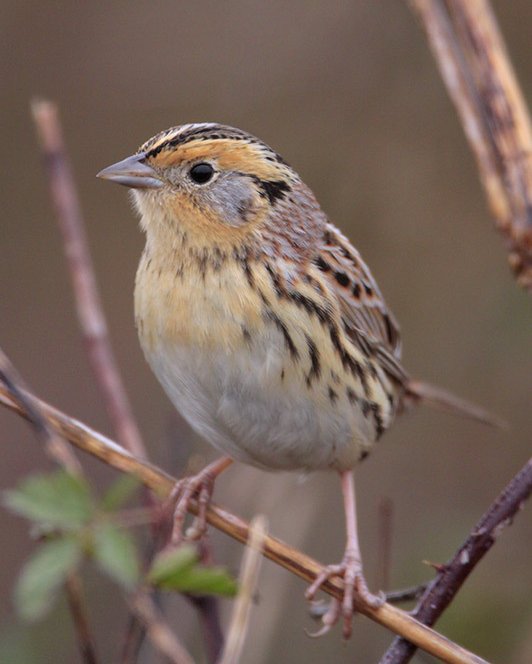
Le Conte's Sparrow,  image by Greg Lavaty, from www.audubon.org

Le Conte’s Sparrow, image by Greg Lavaty, from www.audubon.org


This is Passport to Texas

Counting birds at dawn during the Christmas Bird Count guarantees you’ll see lots of them. Yet, a big bunch of birds can lead to confusion.

04—Especially if you get into a big flock of robins or grackles; you just have to start estimating numbers. But, it’s really fun when you start getting big numbers of species. You know, you’ve only been out for an hour and you already have 30 species of birds; that’s really fun.

Cliff Shackelford is a non-game ornithologist with Texas Parks and Wildlife. This year’s count is December 14 through January 5.

07—There are over a hundred Christmas Bird Counts in Texas; so, chances are there’s one in existence in your area.

Counts take place inside 15-mile radius circles. Cliff says the best way to find a nearby count is online.

09—Search for Christmas Bird Counts in Texas, and figure out which one is nearest you. Also, you’ll see who the compiler is, and you can get phone number or email and start coordinating with that person.

Compilers act as “captains” of their circles, and relay data from the count back to Audubon, which analyzes it. Birders of all skill levels are welcome.

23—And what they’ll do [if you’re a novice] is stick you with some seasoned vets, and that’s really good because you learn a lot when you’re out in the field with someone whose been doing this awhile. So you go out with this team of observers and you basically beat the bushes and try to see as much as you can see. It’s a lot of fun.

The data volunteers collect help researchers better understand trends as they relate to our feathered friends.

For Texas Parks and Wildlife…I’m Cecilia Nasti.
Birding: Making Birds Count

Wednesday, December 3rd, 2014


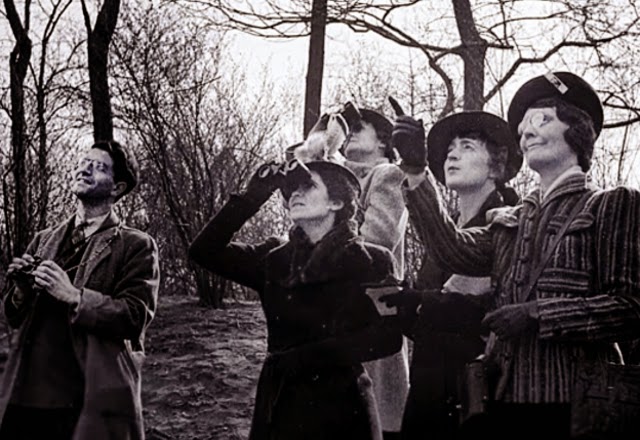
Christmas Bird Count -- the early years.

Christmas Bird Count — the early years.


This is Passport to Texas

The name “Christmas Bird Count” is a bit of a misnomer.

04—It doesn’t happen on Christmas Day. It happens in a period around Christmas.

That period is December 14th through January 5th. And it’s when volunteers go into the field to count birds.

04— You just have to pick a day in that three week period to do the count.

Cliff Shackelford is a non-game ornithologist with Texas Parks and Wildlife. Volunteers count birds in teams within a 15-mile radius circle with oversight by a count compiler who rules the roost.

11—And those people [compilers] decide on a day, and they divvy up the pie of where these teams can go look for birds in this fixed radius circle, and you count birds within that circle.

The time-frame for the count is 24 hours – midnight to midnight. You might wonder “who” takes the early shift.

10—A lot of people want to know about owls [for example]; so, they get up early. Three A.M., maybe, and go listen for owls. And that’s pretty valuable. But, most people do just the daylight hours.

Cliff recommends the earliest daylight: dawn.

12—That’s when you get the best bird diversity at dawn. Everybody’s waking up: singing, calling and foraging and activity is the greatest right at dawn. Because, birds have slept all night and they’re hungry for something to eat.

Compilers collect the volunteer’s data and submit it to Audubon, which analyzes it.

Find more information about the Christmas Bird Count at passporttotexas.org.

For Texas Parks and Wildlife…I’m Cecilia Nasti.
Birding: Evolution of the Christmas Bird Count

Tuesday, December 2nd, 2014
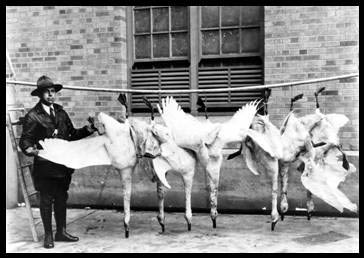
Inauspicious beginning to the Christmas Bird Count, image from http://www.islandguardian.com

Side Hunt participant, image from http://www.islandguardian.com

This is Passport to Texas

In the 1800s, an annual competition called The Side Hunt pitted teams of hunters against one another to see who could bag the most feathered and furry things. With growing conservation consciousness, the Side Hunt evolved into The Christmas Bird Census in 1900, and eventually into the Christmas Bird Count – where the only thing people kill nowadays is a thermos of coffee.

11—We’re now in the 115th year, which makes it the longest running citizen science project in the world. Which is pretty impressive, and it started right here in the US.

Cliff Shackelford is a non-game ornithologist with Texas Parks and Wildlife.

06—You go out into a fixed area and count birds. And the neat thing is, if you stick with that area like you should, and you do it for 10, 20, 30, 40 years…you start seeing trends.

Trend spotting is the true value of the bird count.

26—Those counts that are very old, that have forty plus years of data, we can start seeing things. And we are. We’re seeing things like the American Tree Sparrow is not coming down to Texas much anymore. I don’t think they’re rare, they just don’t need to come all the way south for –maybe –climate change. Maybe it’s not so cold up north; they don’t need to come down. That’s the beauty of the Christmas Bird Count – you can look at it continentally… and see where the changes are in the bird life.

For Texas Parks and Wildlife…I’m Cecilia Nasti.
Conservation: Dogs Sniff Out Invasive Weeds

Wednesday, November 12th, 2014
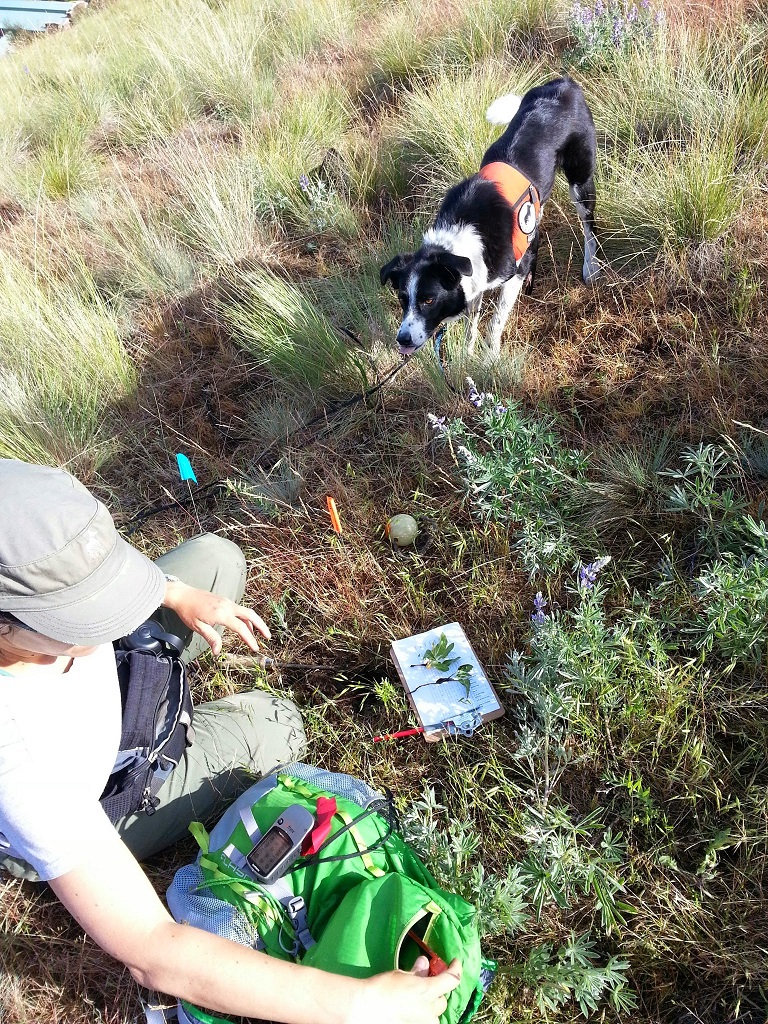
Dog finds invasive weed.

Dalit Guisco and Seamus finding Dyers woad (an invasive plant from Eurasia) in Montana.


This is Passport to Texas

Using their keen sense of smell (often to locate scat), trained conservation detection dogs assist with monitoring endangered wildlife, defining wildlife corridors and helping to eradicate invasive species.

06—Almost all of our work is in partnerships with non-profits, or agencies or sometimes universities.

Pete Coppolillo is Executive Director of Working Dogs for Conservation in Montana.

13—It’s really cost effective because you can find information about a lot of animals without having to fly a helicopter around and dart them and capture them and do things like that.

Lab analysis costs are decreasing, too, making it easier to obtain more information from scats. Yet, some successes have nothing to do with wildlife.

29—I’ll give you one example: there’s a weed here in Montana called dyers woad that has infested large parts of Utah, and then it appeared here. For a long time, the expectation was we’ll never get rid of it [because one plant can set 10,000 seeds]. Because dogs are so good at finding it, and because they can find it before it flowers or sets seed, we are close to eradicating that plant in a place called Mount Sentinel. You know, it’s a really powerful, scientifically rigorous tool, and it opens the door to doing things we hadn’t dreamed of.

You can learn more about conservation detection dogs, and see pictures of the dogs, Working Dogs for Conservation.

For Texas Parks and Wildlife…I’m Cecilia Nasti.
