Archive for the 'Fishing' Category

Conservation: Funding Conservation in Texas

Wednesday, August 7th, 2013

Mason Mountain WMA

Mason Mountain WMA


This is Passport to Texas

To legally hunt and fish in Texas, you need a license; and the money you spend on them supports habitat conservation and game management. That’s win-win, says Tom Newton, who oversees licensing at Parks and Wildlife.

15— The revenue that we get from the licenses goes a long ways to supporting the operations of fishery programs and wildlife programs that help preserve what you’re harvesting. So, it all goes back in to the hunting and fishing activities for our customers.

Recreational anglers and hunters may begin renewing their licenses as early as August 15…and there’s a variety from which to choose.

27— There’s different categories of fishing: freshwater, saltwater, all water. Hunting – you can get your basic deer hunting license; or you can add endorsements to it to hunt migratory birds. We have different combination licenses tailored to those different activities – they just group them in packages – but the best license that we have is the super combo, which includes all activity – all bird hunting all deer hunting, all types of fishing…and it’s the best bargain for the price of 68 bucks.

Some changes may be ahead for a certain group of licensees. Learn more tomorrow.

The Wildlife and Sport Fish Restoration program supports our series and provides funding for private lands and public hunting programs in Texas.

For Texas Parks and Wildlife…I’m Cecilia Nasti.

Fisheries: Galveston Bay Estuary

Thursday, August 1st, 2013

Galveston Bay Estuary Teaming with Life, Image © Gary Seloff

Galveston Bay Estuary Teaming with Life, Image © Gary Seloff


This is Passport to Texas

If you’re looking for a way to cap off your summer or kick off your fall, a fishing trip to the coast may satisfy that craving.

04— Fishing is phenomenal on the Texas coast in the late summer and early fall.

Bill Balboa is a fisheries biologist for the Galveston Bay system – a great place, he says, to cast a line.

18— It’s the largest estuary on the Texas coast, and we have a real diversity of fish species; they run anywhere from blue catfish, which are freshwater species – because there’s a lot of river flows into the bay – all the way to spotted sea trout, tarpon, red drum, black drum, and the other saltwater species you see farther down the coast. So, it’s a very diverse environment.

Here’s the best part: you’re not going to need a boat to get the most out of a fishing trip to the Texas coast.

17— Absolutely not. And that’s a really good point, because in the summertime and the early fall, there’s a lot of really good fishing all up and down the Texas coast – specifically on the beach. Prevailing winds that blow all spring and summer calm down a bit, and so the water along the beachfront improves, and the fishing is phenomenal.

Bill Balboa says fishing in the bays is like opening packages at Christmas – you never know what you’ll find. Everything you need to know to fish in Texas is at the Texas Parks and Wildlife website.

Support provided by Ram Trucks. Doing what’s right and good regardless of the degree of difficulty — takes guts. Those are the people who build Ram trucks. RAM. For Texas Parks and Wildlife…I’m Cecilia Nasti.
Fish/Conservation: Value of Artificial Reefs

Tuesday, July 23rd, 2013

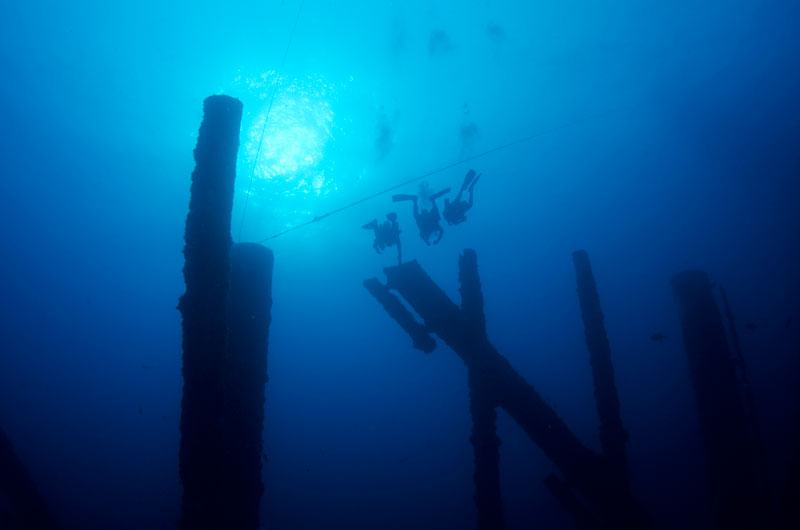
Divers exploring artificial reef in Texas Gulf

Divers exploring artificial reef in Texas Gulf


This is Passport to Texas

We call outdated oil rigs, decommissioned ships and other materials placed in the Gulf of Mexico (where they become marine habitat) artificial reefs.

06— Smaller type of organisms will attach to that and begin the basics of a food web.

Dale Shively oversees the Artificial Reef program for Texas Parks and Wildlife. Small marine organisms — which are always in the gulf, but diffuse — become concentrated on reefed materials, which in turn attract a variety of fish species.

06— So, you’re basically giving the marine environment a base, or foundation to get started on.

Artificial reefs – in federal and state waters – create improved angling and diving opportunities; that brings dollars to coastal communities.

13—By creating artificial reefs, we’ve helped to increase those populations of marine life, and basically give divers and anglers more opportunities to experience those types of things out in the gulf.

These man made reefs will last for many decades, enhancing the ecosystem and angling for generations to come.

11— Unless they’re a migratory species, once fish and marine life have acclimated to that area, and start to reproduce, then they’ll stay there and will spend most of their life in that one particular area.

The Sport Fish restoration program supports our series and is funded by your purchase of fishing equipment and motorboat fuel.

For Texas Parks and Wildlife…I’m Cecilia Nasti.
Fish/Conservation: Artificial Reef Program

Monday, July 22nd, 2013

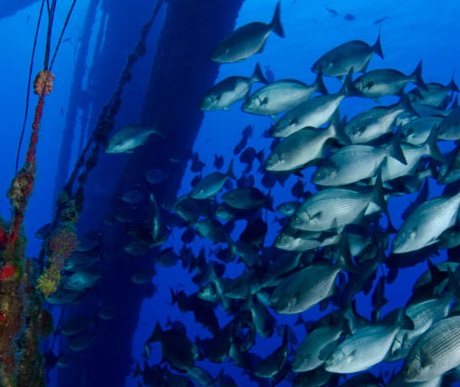
Fish inhabit reefed oil platform.

Fish inhabit reefed oil platform.


This is Passport to Texas

All year long we’re highlighting milestones achieved by Texas Parks and Wildlife during its 50 year history as an agency. Today, we recognize the Artificial Reef Program.

09— The program officially started in 1989 when the Texas Legislature tasked Parks and Wildlife to preserve marine life out in the gulf of Mexico.

Program leader, Dale Shively, says the Artificial Reef program started in earnest following approval of its management plan in1990.

14—An artificial reef is an environment where we take man made materials like concrete and steel, ships and oil platforms…and position those within a reef area to mimic a natural reef environment.

Artificial reefs provide hard substrate otherwise lacking in the gulf. The materials immediately attract marine life.

16—In most cases, marine organisms will attach and create an ecosystem within a few days. In some cases such as oil platforms, those platforms have been out there for thirty some years. So, they’re pretty well covered with marine life before we do anything to them.

Artificial reefing benefits sport fishing and the Texas economy – that’s tomorrow.

The Sport Fish restoration program supports our series and is funded by your purchase of fishing equipment and motorboat fuel.

For Texas Parks and Wildlife…I’m Cecilia Nasti.
Nature: The Value of Sargassum

Friday, July 5th, 2013

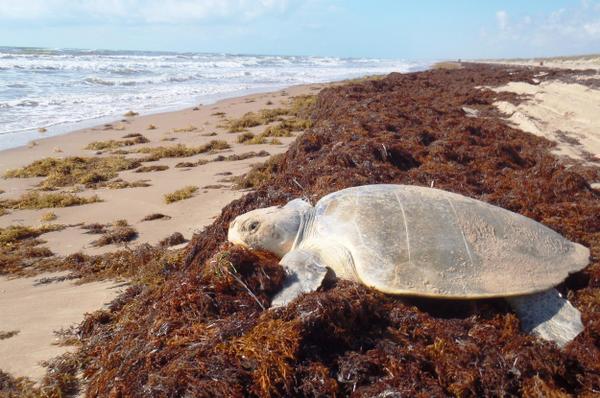
Kemp's Ridley resting on Sargassum; Image © Joseph Scarola

Kemp’s Ridley resting on Sargassum; Image © Joseph Scarola


This is Passport to Texas

The arrival of brown colored algae, called sargassum, to Texas beaches is nearly as predictable as the return of the swallows to Capistrano, but not as welcome.

07 – It shows up on the beach, late spring through early summer, and it can be a nuisance to your average partygoer.

Paul Hammerschmidt, with Coastal Fisheries, says tons of it washes up on the Texas coast from the North Atlantic, hindering beachgoer access to the water. Yet, sargassum is far from being a mere nuisance. It provides habitat for other living things.

13 – There are many animals that only live in the sargassum weed in the Sargasso Sea. It also is a nursery area for a whole lot of game fish like Mahi Mahi, Marlin, Sailfish, that type of thing.

On shore, Hammerschmidt says beachcombers discover shells and sea beans in the slimy tangle, as well as live animals. Cities and counties that obtain permits may move the seaweed to help rebuild sand dunes. If you get a hankering to bring home some Sargassum, it does make a good garden fertilizer – with one caveat.

07 – One thing you really do have to do is rinse the saltwater off of it. You don’t want that saltwater in your garden; that’s just not healthy for your garden.

The Wildlife and Sport Fish Restoration program supports our series, and funds the work of saltwater fisheries in Texas.

For Texas Parks and Wildlife…I’m Cecilia Nasti.
