Archive for the 'Hunting' Category

Hunting/Food: Hunters for the Hungry

Thursday, November 28th, 2013
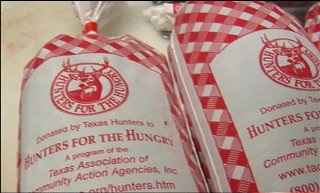
Ground venison Hunters for the Hungry Program

Ground venison Hunters for the Hungry Program


This is Passport to Texas

Venison is quality protein; and hunters help get it onto the tables of deserving families when they donate deer to Hunters for the Hungry.

09—Once it’s [the deer] donated, the meat is used by food pantries, food banks, and other food assistance providers, which serve their local communities.

Anitra Hendricks oversees the program. Hunters may donate their legally tagged, field-dressed deer by bringing it to participating meat processors. Find a list of processors on the Hunters for the Hungry website.

24—Once they locate a processor, then basically it’s just a matter of harvesting the deer, making sure that they get it cleaned out. The processor will handle everything else. There is a reduced processing fee for those who donate to the program. They pay the fee, they do receive a receipt for a possible tax deduction. The meat processor will grind the meat, package it, and then from there it goes to the food assistance provider
.

The Panhandle, far west Texas and the Rio Grande Valley have the fewest donations due to low processor participation. Without nearby participating processors, hunters don’t have an easy way to donate. Anitra is always on the lookout for more processors.

08— The have to be willing to keep some minimal book-keeping as far as tracking donations and reporting that to us at the end of the season.

The Wildlife and Sport Fish restoration program supports our series … For Texas Parks and Wildlife…I’m Cecilia Nasti.
Hunting/Food: Proper Handling of Game

Wednesday, November 27th, 2013

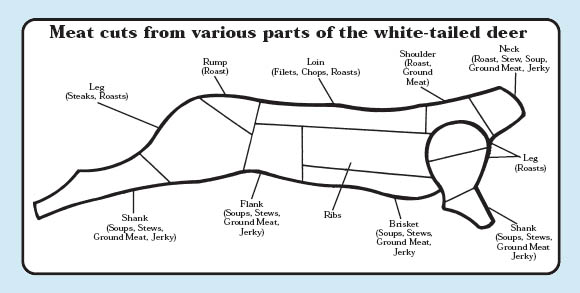
Cuts of venison, image from www.chefdepot.net

Cuts of venison, image from www.chefdepot.net


This is Passport to Texas

When handled correctly in the field and kitchen, venison can be tastier than domestically raised meat. The key is to keep it cool and dry immediately after harvest.

15—And then, the real poetry begins in the aging of that meat. If you can hang that meat for three to six days, some of the enzymes in the meat start to break it down, and you really get that tender, good tasting, concentrated flavor.

Lee Smith is a hunter and home cook from Austin, Texas. To store fresh venison, Smith recommends vacuum sealers, which keep meat usable for up to a year when frozen. And when you’re ready for it, Smith says – simple preparations are best.

23—You’re legally – depending upon what county you’re hunting in – able to take five deer in Texas. And that can be a lot of meat. So, I can understand after a while, how you might want to change it up and have a little horseradish sauce, or some kind of port reduction with some mushrooms. But, I want to taste the meat; I don’t want to throw a heavy sauce on it. In fact, tonight, we’re having venison fajitas.

Lee Smith says he usually marinates venison back strap briefly in olive oil and soy sauce, grills it, and ends up with something the whole family enjoys.

Find wild game recipes on the Texas Parks and Wildlife website.

For Texas Parks and Wildlife…I’m Cecilia Nasti.
Hunting/Food: Field Dressing Harvested Game

Tuesday, November 26th, 2013

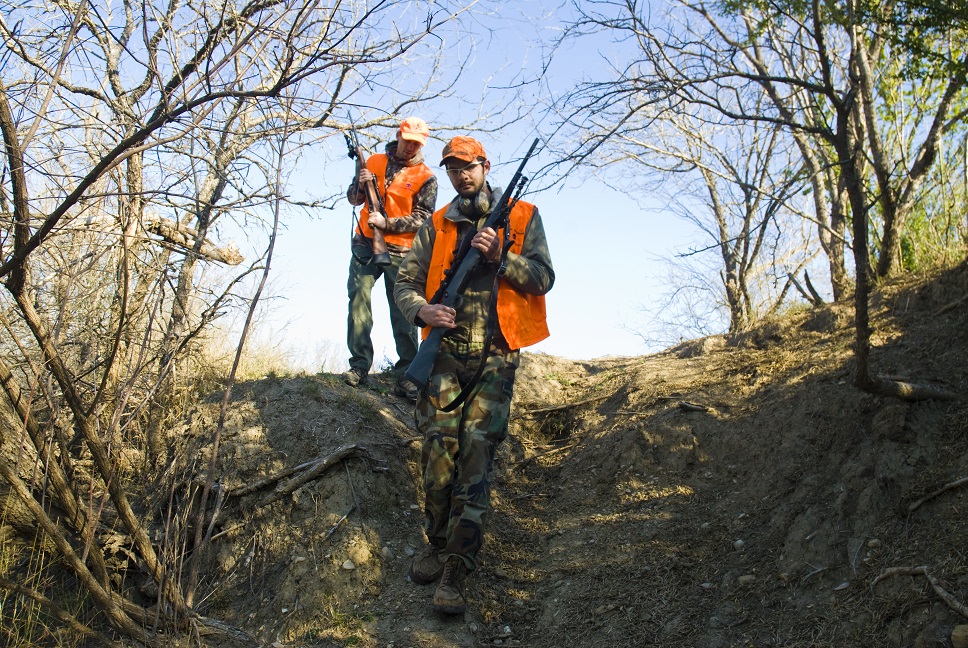
Preparing to field dress a deer.

Preparing to field dress a deer.


This is Passport to Texas

Lee Smith started hunting when he was 7 years old. Now in his mid-fifties, this Austin resident and home cook, says he hunts for meat not trophies.

06—Once you’ve pulled the trigger and you’ve got an animal down, the work really begins.

Field dressing, which involves removing the animal’s internal organs, can be a race against the clock—due to spoilage—says Smith.

24—Meat spoils due to three things: heat, moisture and dirt. Getting those internal organs out is going to immediately start to let that carcass cool. Second thing is: the skin. Taking that skin off is going to get that animal cooler, and also allow it to dry quicker. Once you’ve got it back [to camp], and taken the skin off, you rinse out the interior chest cavity, and get it into that cooler.

If you’re hunting on public land, or there isn’t a walk-in cooler at your lease, after field dressing and skinning the animal, quarter it.

13—That’s taking off the four quarters, the two backstraps, and the rear legs. That’s what you are legally bound to take. If you don’t take that, you can be ticketed for waste of game.

Put the quarters into tall kitchen garbage bags, and then into coolers with ice. How to handle game at home – that’s tomorrow.

For Texas Parks and Wildlife…I’m Cecilia Nasti.
Hunting: Hunters as Conservationists

Monday, November 4th, 2013

Deer hunters in the field.

Deer hunters in the field.


This is Passport to Texas

Hunting is not only a tradition in Texas—it is also a commitment to wildlife conservation.

16—Hunters started to see declines in certain game species populations and habitat. And realized if they want to enjoy perusing game (it doesn’t even have be for harvest), just if they want to see that perpetuated so their kids, and future generations can enjoy that, they realized they needed to protect it.

Alan Cain, Texas whitetail deer program leader, says in the early 20th century, hunters chose to conserve wildlife through taxation.

22—In 1937, you had the Sport Fish and Wildlife Restoration Act – called the Pittman-Robertson Act – [signed into law]. Basically it’s a user pay system where the hunters said, ‘okay, we’re going to tax ourselves to help pay for wildlife conservation.’ And that’s been a huge success. In my opinion, that’s why North America has the best wildlife management conservation model in the world – because hunters pay for that.

Hunters pay with the licenses they buy, and the excise taxes levied on firearms, ammunition and other equipment, which goes directly to fund conservation.

11— And then the second part of that is that hunters not only play a role in funding conservation that benefits everybody, but they also play a role in managing deer populations out there.

By removing deer from the landscape, they help keep habitat in balance for all wildlife.

The Wildlife and Sport Fish Restoration Program supports our series and funds whitetail research in Texas.

For Texas Parks and Wildlife…I’m Cecilia Nasti.

Hunting: 2013-14 Deer Season Forecast

Friday, November 1st, 2013

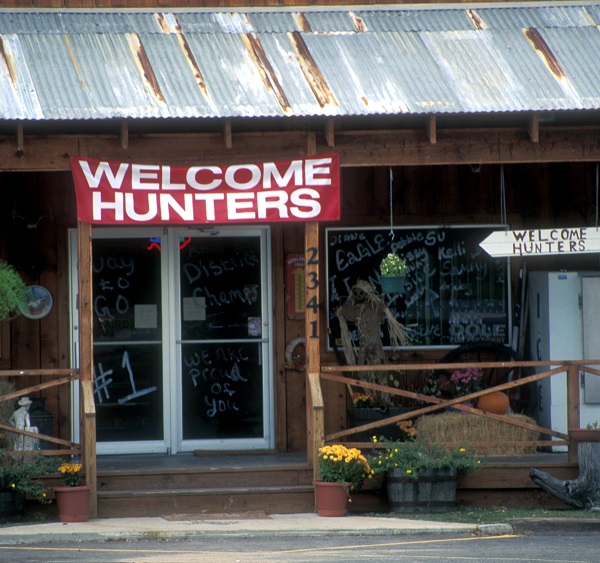
Hunting provides economic opportunity in small Texas towns.

Hunting provides economic opportunity in small Texas towns.


This is Passport to Texas

The first weekend in November is typically opening weekend of deer season in Texas.

04—This year, 2013 the deer hunting prospects look really good.

Alan Cain is Texas whitetail deer program leader at Parks and Wildlife.

11—The reports I’m hearing from landowners out there across the state is that the deer fat, are in good body condition, and antler quality appears to be pretty good. So hunters should have a good opportunity out there.

September and October brought rainfall across the state, which could make deer hunting more of a challenge.

36—That’s going to cause things to green up, obviously. So, the deer may not be hitting the corn feeder because they have not seen some of this green stuff in a couple of months. And so, they may go out there and find some tender weeds to chew on, or some brush out there, or the different browse, shrub top species; they’ll eat on those and may not come to that corn feeder where hunters traditionally sit.

Alan Cain says don’t lose heart – the deer are there – you’ll need to change your hunting strategy to bag them.

11—You want to sit on a trail that’s leading from a bedding to a feeding area. Or, look for locations where deer are concentrating; maybe it’s where the oaks are dropping lots of acorns. So, I suspect deer will be on those, too.

The Wildlife and Sport Fish Restoration program Supports our series…For Texas Parks and Wildlife…I’m Cecilia Nasti.