Archive for the 'Shows' Category

Rainbow Trout: a Winter Angling Treat

Wednesday, December 28th, 2016
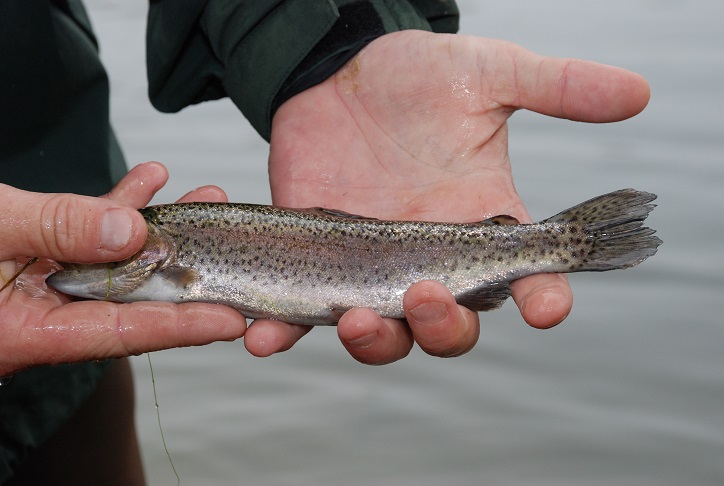
Rainbow trout in hand.

Rainbow trout in hand.

This is Passport to Texas

If you’re an angler who likes to eat what you catch, then now’s the time to reel in a rainbow trout.

We stock them at a catchable and eatable size. They are good fighting fish; they’re relatively easy to catch. We usually stock them in smaller bodies of water, so they’re a good fishing, catching opportunity and good eating opportunity as well.

Carl Kittel is a program director for Inland Fisheries, and oversees winter trout stocking in Texas, which began this month.

We’ve been stocking [rainbow] trout around Texas for almost 40 years. One interesting note about trout is that we often say there are no established populations of trout in Texas, but actually, way out west in the Davis Mountains there’s a small, tiny stream at high enough elevation that there is a reproducing population of rainbow trout.

That’s why we stock them in winter; most of Texas is too hot for the. Inland fisheries will distribute more than 290-thousand rainbows in 150 locations.

And we have a special program; we actually stock somewhat larger trout in urban areas in our Neighborhood Fishin’ Program. And that’s something that you can specifically look for on our web page.

With the winter holidays here, it’s is a great time go fishing with the kids. Find the stocking schedule on the Texas Parks and Wildlife website.

The Sport fish restoration program supports our series and funds rainbow trout stocking in Texas…

For Texas Parks and Wildlife…I’m Cecilia Nasti.
Stocking Rainbow Trout into Area Fishing Holes

Tuesday, December 27th, 2016
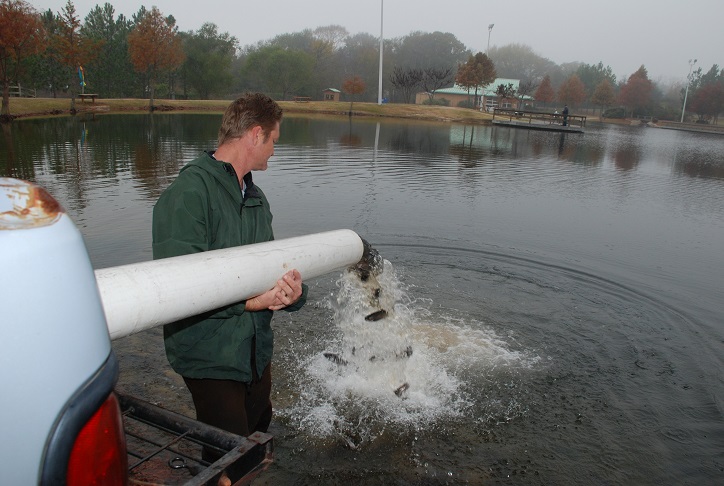
Stocking rainbow trout. image by Larry Hodge.

Stocking rainbow trout. image by Larry Hodge.

This is Passport to Texas

It’s the holiday season; what better way to celebrate than with rainbows – rainbow trout, that is.

We do winter stockings when the water temperatures permit it, to provide an opportunity for anglers to catch trout in Texas. It’s a species of fish that anglers wouldn’t catch otherwise, so we stock them, and we intend them all to be caught out during the season.

Carl Kittel (kitl) is a program director for Inland Fisheries. Thanks to good rainfall throughout most of the state, access to waterbodies.

This year, things are pretty well back to normal. Looks like our normal level of stocking will happen.

Kittel says the agency will stock about 150 sites around the state, distributing more than 290-thousand rainbow trout. The fish will be divided among the various locations, including urban neighborhood fishin’ holes.

We publish a schedule on the Texas parks and Wildlife Department web page. Look for the winter trout stocking link.

Carl Kittel says we stock rainbows in winter because these fish cannot survive our hot summers. So, when you reel one in this winter, take it home and eat it.

The Sport fish restoration program supports our series and helps to fund rainbow trout stocking in Texas…

We record our series at The Block House in Austin, Texas and Joel Block engineers our program.

For Texas Parks and Wildlife…I’m Cecilia Nasti.
Processing What You Hunt

Thursday, December 22nd, 2016
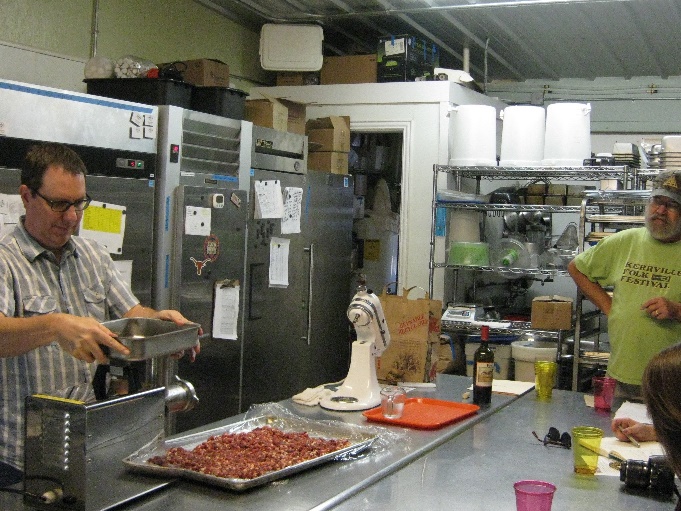
Making sausage in the Feral Austin Commercial Kitchen.

Making sausage in the Feral Austin Commercial Kitchen.

This is Passport to Texas

Chris Houston of Austin is a hunter and home cook; he butchers and processes what he harvests; but that’s not always been practical.

We have a decent sized [kitchen] counter space, but certainly a limited area and limited equipment.

Hunters, says Houston, go to processors because of limited workspace, equipment, and a lack experience. He adds processors are decent folks who provide a good service – but he still wonders what comes back to him.

Am I getting back my animal in the sausage? Am I getting all the meat that I had taken in there?

Houston taught himself to butcher and process, and excels at it now. To empower others to do the same, he offers a fully equipped commercial kitchen and his knowledge as Feral Kitchen, a wild food workspace.

Butchering and sausage-making tends to feel complicated. However, it can be really simplified. And so, we really want to pass on that education and that confidence to others. We’ve been offering some classes on general game butchering, and some other classes on sausage-making to kind of help people take that step in the learning curve to doing it themselves. And, really, to just try and simplify the entire process.

Learn more about butchering and processing wild game on the Texas Parks and Wildlife website.

That’s our show… For Texas Parks and Wildlife…I’m Cecilia Nasti.
Economics of Hunting

Wednesday, December 21st, 2016
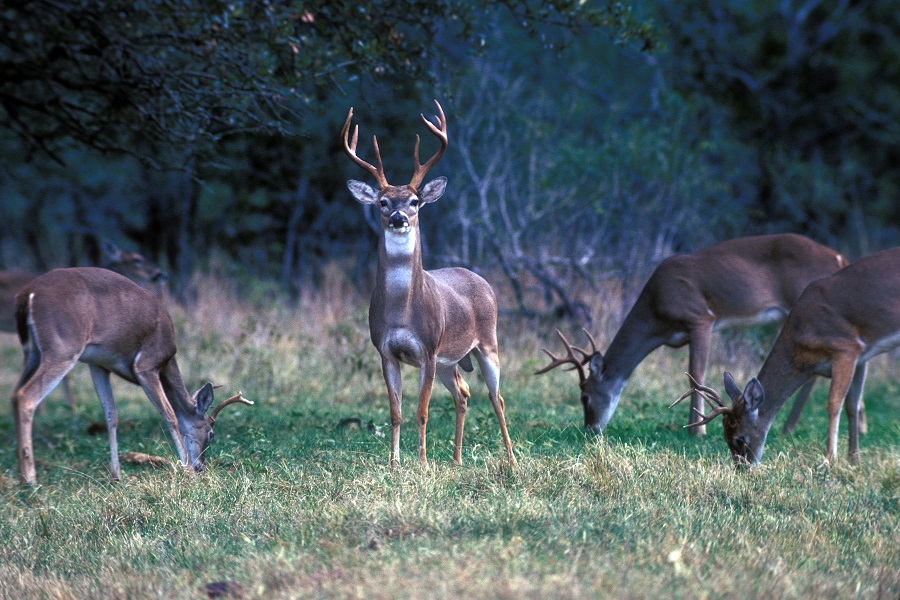
Hunting big bucks (and other game) means big bucks for Texas.

Hunting big bucks (and other game) means big bucks for Texas.

This is Passport to Texas

If you haven’t been deer hunting yet, according to wildlife biologist Alan Cain, you have a good season ahead of you.

Hunters can expect a great season this year. The deer population—we estimate—around four-million white-tailed deer.

Cain is white-tail program leader for Texas Parks and Wildlife. Because of well-timed rainfall this year, habitat in Central and South Texas is in great shape, and sets the stage for prime white-tail hunting. Out west, that region’s habitat and wildlife benefited from rainfall as well.

Hunters that are out in West Texas pursuing mule deer and pronghorn will have an excellent year.

And who else will have an excellent year? The small towns whose economies depend on hunting and hunters.

Deer hunting in Texas is a thriving industry, and it brings in about two billion dollars to the state’s economy. And it really helps the rural towns out there where deer hunting is a big part of their everyday life.

Download the Texas Outdoor Annual APP onto your smart phone. Before going on your hunt. It will help you find hunting season dates and bag limits for your county and a whole lot more. Find it on the Texas Parks and Wildlife website.

The Wildlife restoration program supports our series.

For Texas Parks and Wildlife…I’m Cecilia Nasti.
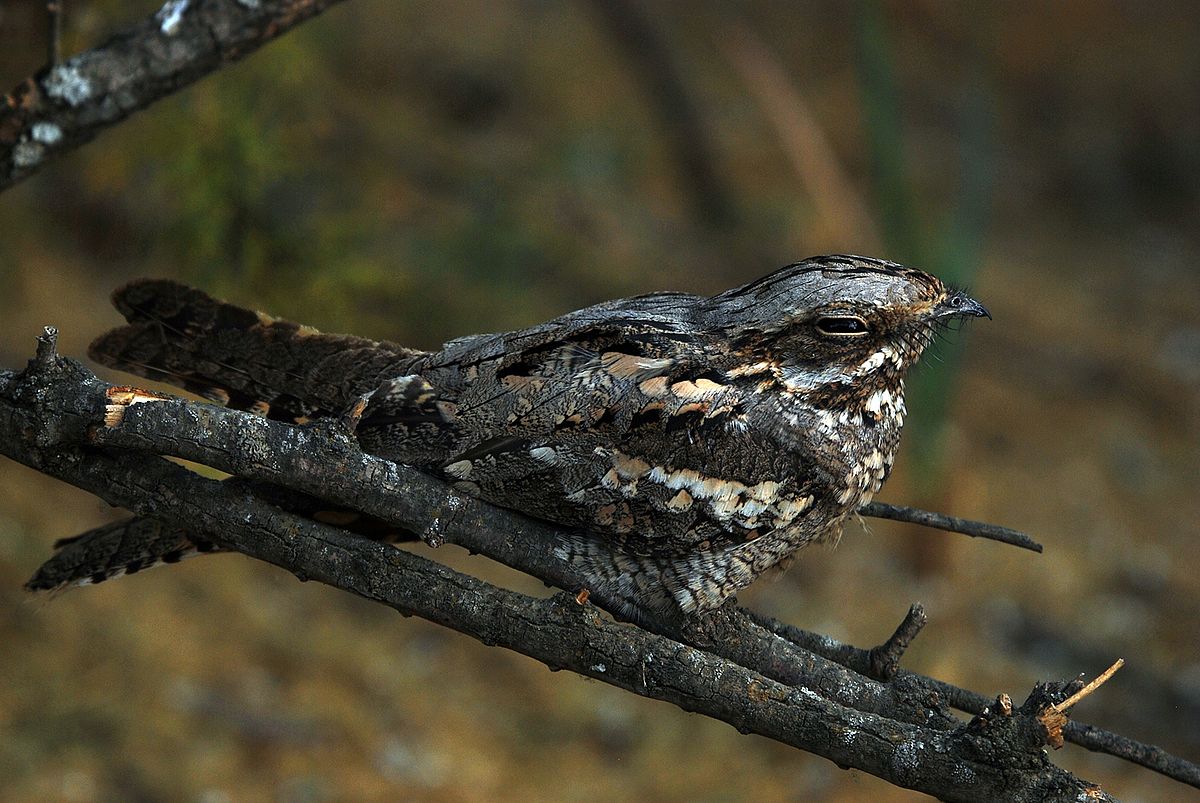
When a Bird is a Nightjar

Tuesday, December 20th, 2016
Image of Nightjar by Dûrzan Cîrano, Creative Commons

Image of Nightjar by Dûrzan Cîrano, Creative Commons

This is Passport to Texas

Just as purple martins and barn swallows keep insects in check during the day, birds known as nightjars eat bugs that take flight at night.

The graveyard shift is when these birds are active. They sleep all day, and they have super big eyes for night vision. And they’re looking for nocturnal insects—mainly moths.

Texas Parks and Wildlife ornithologist, Cliff Shackelford says it’s not uncommon to confuse the calls of two of these nighttime nibblers: the whip-poor-will and the Chuck Will’s Widow.

The essayists and naturalists of 100 years ago—they would always talk about the whip-poor-will, because they were up in the Northeast US where the whip-poor-will is common.  But here in the south and Texas, the dominant bird we have singing is the Chuck Wills Widow. So, if you hear a night bird singing on your property in the warmer months—that’s going to be a Chuck Will’s Widow.

That’s not to say the whip-poor-will doesn’t make an appearance in parts of Texas.

Whip-poor-wills do migrate through the eastern third of Texas—the Eastern Whip-poor-will. And that’s going to be a march-April thing. And they sing very briefly as they head north.

So as you dream of spring and summer, make room in your thoughts for nightjars and their melodious music.

The Wildlife Restoration program supports our show.

For Texas Parks and Wildlife…I’m Cecilia Nasti.
