Archive for the 'Shows' Category

Restoring Oyster Habitat After Ike

Tuesday, June 23rd, 2015
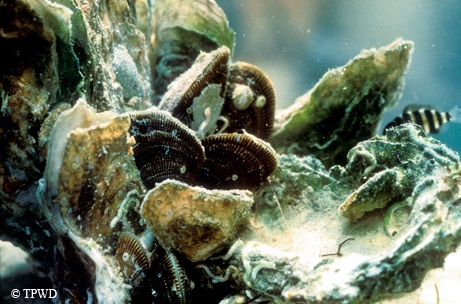
Oyster Bed

Oyster Bed


This is Passport to Texas

Texas lost 8-thousand acres of submerged oyster habitat when Hurricane Ike blew into the gulf in 2008. Some reefs will restore naturally; other will receive some help.

24- We are trying to accelerate that that recovery effort by putting some the materials down to allow new oysters to settle on. We also worked closely with the commercial industry and got them involved in pulling their dredges up with bags off of them across some of these reefs that were marginally covered up, and to pull the shell back to the surface to provide that substrate for young oysters to attach to and start growing.

Lance Robinson is with coastal fisheries. Ike pushed saltwater and debris 15-20 miles inland, which decimated saltmarsh habitat — habitat that’s a marine nursery for sport and commercial species. Restoration work is ongoing.

12-And it took several weeks just for heavy equipment to get into the marshes to remove the mountains of debris before we could get in and assess what the other impacts were. And at that point it was just gut-wrenching.

As bad as the damage after Ike, Robinsons says it could
have been worse.

13-Both from a human impact and a natural resource impact had the storm tracked a little bit farther to the north. It would have brought the eye farther into the bay, and we would have seen a much more devastating impact.

The Wildlife and Sport Fish Restoration project supports our series.

For Texas Parks and Wildlife…I’m Cecilia Nasti.
Hidden Damage from Hurricane Ike

Monday, June 22nd, 2015
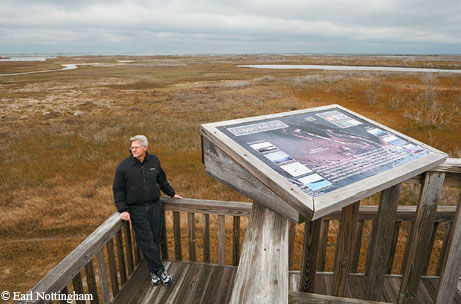
Galveston Island.  Steve Alexander, president of Galveston Island SP friends group.

Galveston Island. Steve Alexander, president of Galveston Island SP friends group.


This is Passport to Texas

Few will forget the images from 2008 of the devastation to Galveston Island by Hurricane Ike. Yet, there is Ike caused damage we cannot see.

06- The losses of some of the invaluable habitat associated with Galveston Bay.

Including submerged oyster habitat. Lance Robinson is with coastal fisheries. The hurricane deposited sediment on top of 8-thousand acres of oyster reefs in Galveston Bay. That’s nearly half of the consolidated oyster habitat within the system.

24-That is a huge loss of a valuable resource. Not only from the commercial fishing aspect to it, but for the ecosystem services that they provide that a lot of people don’t really recognize or really see. Such as: water filtration, providing habitat for other fish and crabs and other organisms that are associated with structures. Sort of like an oasis in a desert.

A single adult oyster filters water at a rate of about 50 gallons a day, improving ecosystem water quality.

10-The waste water treatment plants within Houston filter the same amount of water as a hundred and thirty acres of oyster reef; we lost 8-thousand acres of those reefs.

Restoring the reefs–that’s tomorrow.

The Wildlife and Sport Fish Restoration project supports our series, and funds diverse conservation projects in Texas.

For Texas Parks and Wildlife…I’m Cecilia Nasti.
Outdoors with Dad on Father’s Day

Wednesday, June 17th, 2015
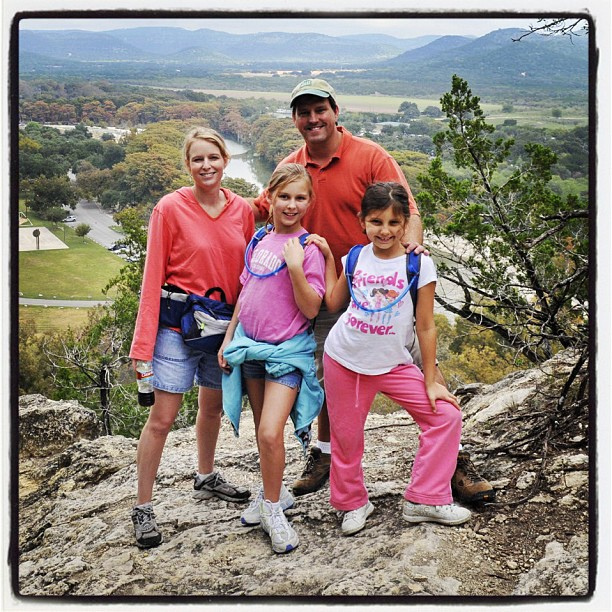
Enjoying the Texas Hill Country.

Enjoying the Texas Hill Country.


This is Passport to Texas

Spend time with Dad outdoors this Father’s Day, June 21.

03-You never know what’s going to happen outside; it’s the wide open spaces.

Ernie Gammage is former Outreach and Education Director for Parks and Wildlife.

10-One of the things that I remember from my childhood is having the opportunity to fish with my dad. And it’s just such a quiet, special time. I mean, I can still visually see everything that we did back then.

Sharing the outdoors with dad on his special day will make lifelong memories.

08-A lot of the distractions of the work-day world, family obligations, and so forth are put aside and it’s just you and somebody that you love, somebody that you respect.

As we like to say: Life’s Better Outside.

12-I think spending time outdoors with your son or your daughter, or whoever it is, is an opportunity, especially for fathers that already spend time in the outdoors, to pass on some of the things they love and value to their kids.

That’s our show, which I dedicate to the memory of my father who during summers when mom worked weeknights, cobbled together picnic meals from leftovers, then loaded his 7 rambunctious kids and a couple of bikes into a station wagon–that had seen better days–and took us to the nearby forest preserve for al fresco dining and exploration. Thanks, Dad.

Funding provided in part by Ram Trucks. Guts. Glory. Ram

For Texas Parks and Wildlife…I’m Cecilia Nasti.
Vultures: Nature’s Clean Up Crew

Tuesday, June 16th, 2015
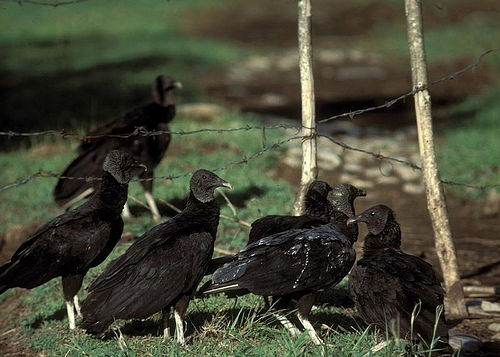
Black vultures shown use their sense of sight to find their meals, whereas turkey vultures use their sense of smell.

Black vultures (shown) use their sense of sight to find their meals,
whereas turkey vultures use their sense of smell.


This is Passport to Texas

Vultures get a bad rap: maybe it’s because they aren’t “pretty birds”, or because they eat road kill. Texas Parks and Wildlife non-
game Ornithologist, Cliff Shackelford, says they deserve our respect as they are a helpful, interesting species.

15-Vultures have a role to play, what we call “ecosystem services”. These are benefits to us; it’s unfortunate that our
cars hit animals, but think about what’s left behind. The vultures are cleaning up all the mess and we have to commend
them for that.

How do vultures eat decaying carcasses and not get sick?

08- Vultures don’t get sick because they have certain bacteria and other flora in their guts that help them break down these
carcasses.

Although a migratory species, vultures live year-round in Texas. When road kill freezes up north, those vultures
travel south.

10- Because of our location, we not only host a lot more vultures in the winter season, we see a lot more passing
through in the spring and fall migration.

Vultures are social birds and roost together, preferring tall structures that allow an easy entrance and exit.

09-They like cell phone towers, rocky outcrops and ridges, an old tree that’s standing up really high. They like the tallest roof
in the area.

Yet, they nest on the ground under fallen trees, and are excellent parents. Now that you’re better acquainted, we
hope you’ll view vultures in a new light.

For Texas Parks and Wildlife…I’m Cecilia Nasti.
Texas Vultures

Monday, June 15th, 2015
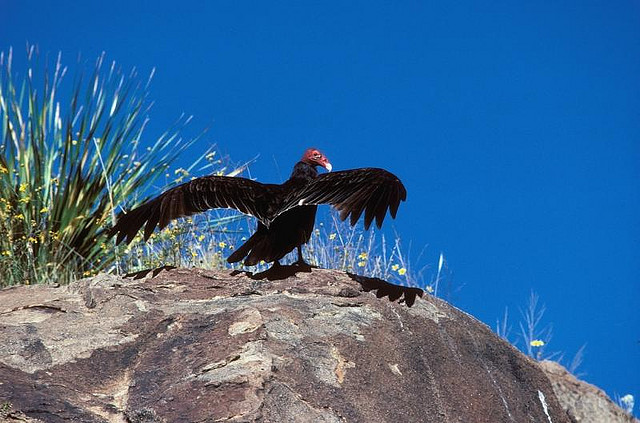
Turkey Vulture

Turkey Vulture: “I’m king of the world!”


This is Passport to Texas

Some people call them buzzards, but Cliff Shackelford says the correct ornithological name for the large black birds that dine on road kill is: vulture.

03–We have the turkey vulture and the black vulture.

Shackelford is a non-game ornithologist with Texas Parks and Wildlife.

11- And the best way to tell them apart when they’re perched and sitting on that dead deer carcass on the roadside, is: look at the color of the head on the adults. The black vulture has a gray head and the turkey vulture, a red head.

Vultures circle high above the land in search of a meal.

21- The turkey vulture uses the sense of smell, and they’ll smell their prey. The black vulture, though, uses sight, they’ll look for prey, but they’ll also cheat. They’ll also look for where the turkey vultures are circling–[and decide] I’m going to bump in line. And with their numbers, usually the black vulture can overcome the turkey vulture and get the first little bites.

Other interesting facts: vultures defecate on their legs to cool off–using evaporative cooling; and, when threatened, they vomit.

15-This is a defensive mechanism. They don’t have fangs like a rattlesnake; they don’t have claws like a bobcat. So, their best defense is to throw up what’s in their stomach that was lying on the road for the last three days. And guess what? You’re going to turn away; it’s a great defense.

We learn more about this big bird tomorrow.

For Texas Parks and Wildlife…I’m Cecilia Nasti.
