Archive for the 'Shows' Category

Hunting: Kenneth Garcia’s Grand Slam Ram

Wednesday, August 15th, 2012

Bighorn Sheep

Kenneth Garcia with his Bighorn Sheep


This is Passport to Texas

For 12 years Kenneth Garcia entered Big Time Texas Hunts, hoping for a chance to win the grand slam: a package of four guided big game hunts including whitetail, mule deer, pronghorn and big horn sheep. And in 2010 – he did.

11— I’ve hunted mule deer and whitetail – I’ve never hunted pronghorn. But, when I knew that I had that sheep hunt in that package, that was – to me –the cream cheese icing on the carrot cake.

Hunters pay a $9-dollar fee online or $10-dollars at a license retailer to enter the contest—and there are more hunts than just the grand slam. Money raised goes to conservation project in Texas. It can take more than a year to complete all the hunts in the grand slam package. Kenneth finished this past March with a bang… and a bighorn.

25— Our idea the first day was to look at everything and make decisions on what we were going to go hunt. Well, we crawled and walked about 300 yards, and all of a sudden they walked right over to us. Of course, we got to looking at them real close, and found the ram that I eventually shot — that same evening he presented me an opportunity and I took him Oh, about oh just probably ten minutes to five o’clock that evening.

The ram he harvested made the record books.

08— He has been accepted by Boone and Crockett for their all time record book. He came in at 171 and three eighths inches.

Find information on this year’s Big Time Texas Hunts on the Texas parks and Wildlife website.

The Wildlife and sport fish restoration program supports our series and celebrates 75 years of funding diverse conservation projects throughout Texas… For Texas Parks and Wildlife…I’m Cecilia Nasti.
Conservation: Endangered Sea Turtles

Tuesday, August 14th, 2012

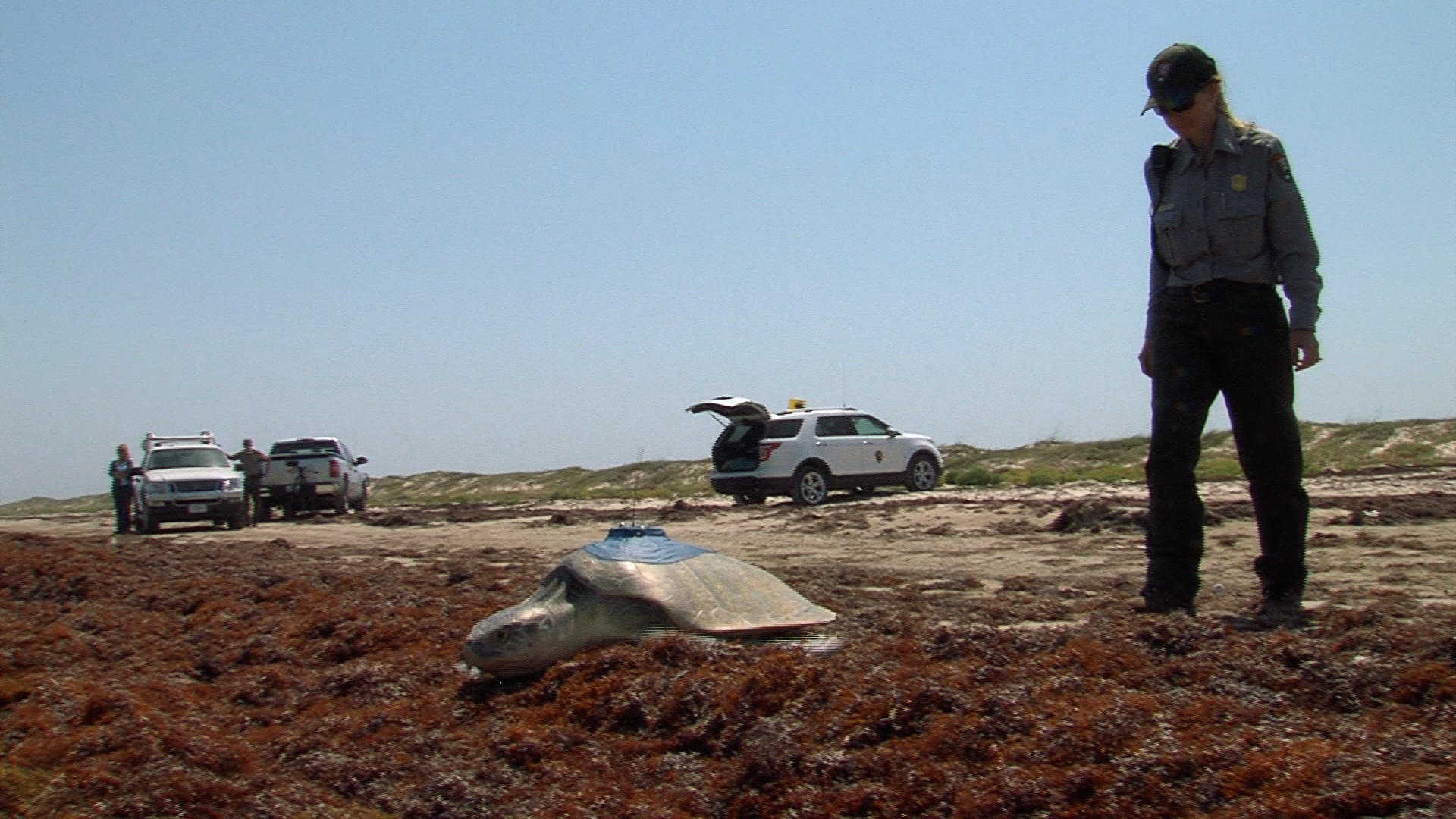
Donna Shaver Releasing Ridley Turtle With Satellite Transmitter

Donna Shaver Releasing Ridley Turtle With Satellite Transmitter


This is Passport to Texas

The Kemps’ Ridley may be the best known—and most threatened—sea turtle that occurs along the Texas coast, but it’s not the only one.

19—The ones that we hear most commonly about are the Kemp’s Ridley, and the green sea turtle—the green sea turtle is threatened in Texas and the populations are increasing. Also in Texas, there’s the Loggerhead, that’s a threatened species. What we hear about less are both endangered turtles: The Hawksbill and the Leatherback.

Dr. Donna Shaver is with the US National Park Service at Padre Island National Seashore. She says if you ever see stranded or nesting sea turtles, report your observation to officials.

17—Many of our entrances to beach access roads, signs are posted that have a telephone number to call. And then once they call, they will receive a recorded message that will tell them the proper contact number for the particular geographic area where they are located.

The number to call is 1-866-TURTLE5…And if you come across a nesting female…

17—Stay back from the nesting turtle until she’s dug her hole with her rear flippers and is remaining mostly motionless and laying eggs. At that time, without touching the turtle, look for any tags, and without piercing anything into the sand, put a designating market next to where the turtle laid her eggs.

The number to call if you find a nesting female is 1-866-turtle5.

The Wildlife and sport fish restoration program supports our series and celebrates 75 years of funding diverse conservation projects throughout Texas…

For Texas Parks and Wildlife…I’m Cecilia Nasti.

State Parks: South Padre Sea Turtle Release

Monday, August 13th, 2012

Kemps' Ridley Sea Turtle Release

Kemps’ Ridley Sea Turtle Release


This is Passport to Texas

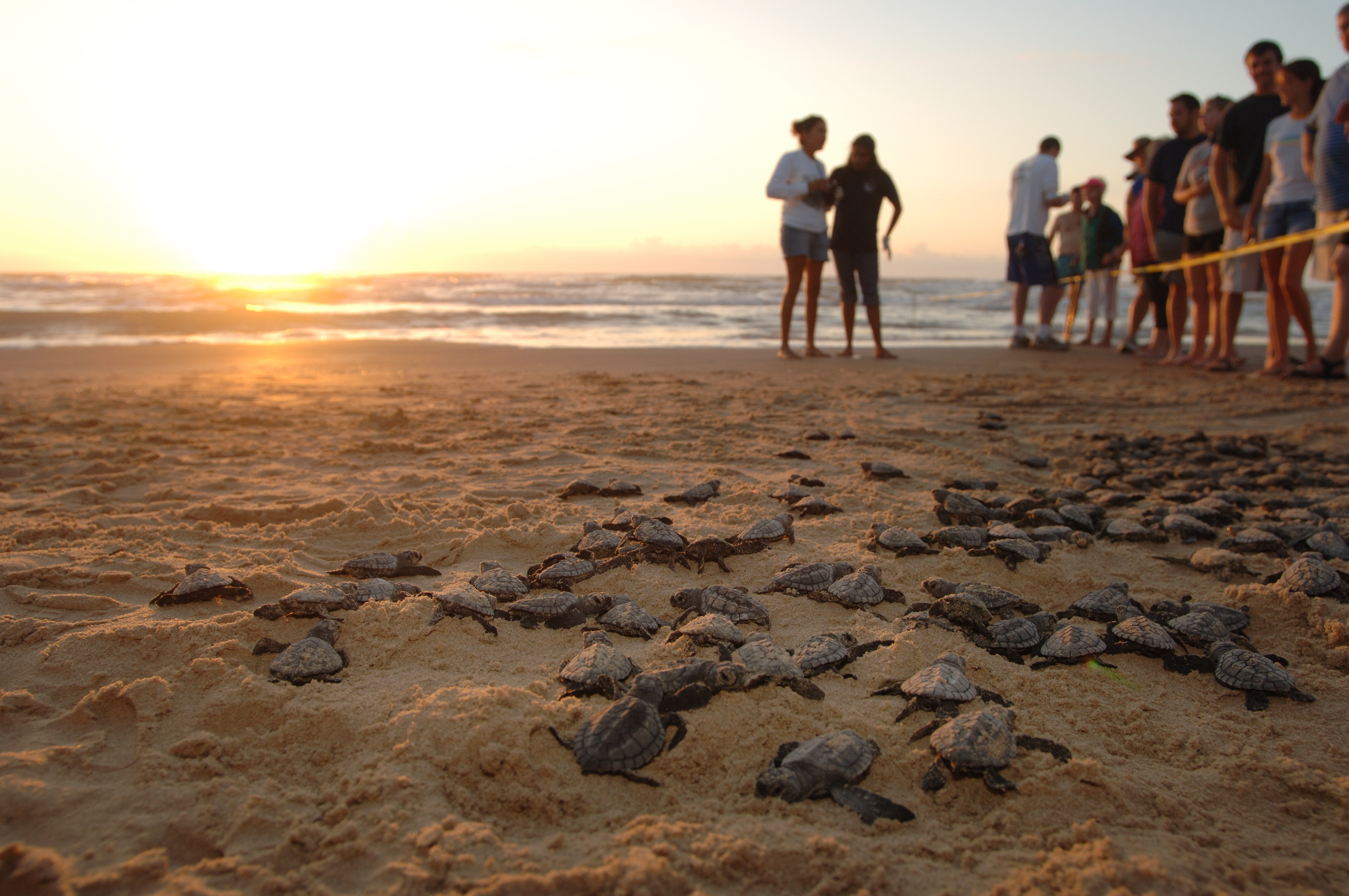
All species of sea turtles are endangered: and none more than the Kemp’s Ridley. Our state park guide Bryan Frazier was on South Padre Island recently and witnessed the release of some Kemp’s hatchlings.

54— Sea Turtle, Inc., which is a partner with TPW and the National Park service..they do such fantastic down on South Padre Island and the Gulf of Mexico in rescuing, rehabilitating and releasing sea turtles back into the wild. And while I was down there on vacation they just happened to be having a hatchling release: 89 baby Kemp’s Ridley sea turtles, which are critically endangered. And I got to photograph that release back into the Gulf of Mexico. It was a profound experience. The whole summertime is the time when those hatchlings come out of the eggs and are released back into the Gulf, and so it’s still a time to do that, and they’re open to the public. If people will visit Sea Turtle, Inc. Like them on Facebook, or call them while they’re down there on South Padre island, they can witness this as well. And the work that’s going on there is impacting things all the way down into the interior of Mexico and the Mexican coast. Follow them and us on Facebook and see the incredible story that the sea turtles have to tell, and how relevant that is to all of our efforts here in Texas.

Thanks Bryan

That’s our show for today…with funding provided by Chevrolet, supporting outdoor recreation in Texas; because there’s life to be done.

For Texas Parks and Wildlife I’m Cecilia Nasti.

Wildlife: Bumblebee Watching

Friday, August 10th, 2012

Map of Bumblebees Historic Range in Texas

Map of Bumblebees’ Historic Range in Texas


This is Passport to Texas

Do you like the idea of bird watching, but don’t have the time or patience to learn about every bird out there? Maybe you should try bumblebee watching, instead.

12— Bumblebees could be a new kind of hobby for folks. Birdwatchers have to learn hundreds of birds. There are only nine bumblebees [species] in Texas. And so it’s just a matter of learning their color patterns.

Michael Warriner is an invertebrate biologist with Texas Parks and Wildlife, and curates the website texasbumblebees.com.

18— In Texas, we have nine bumblebee species. And, fortunately, bumblebees are large bees; they’re pretty noticeable because they have a pattern of black and yellow. But, each one of the nine differs a little bit in terms of how much yellow they have on – let’s say – on the front part of their body versus the rear….

More than a pleasant hobby, tracking these insects – and reporting back to biologists like Michael Warriner – can provide needed information about the status of bumblebees in Texas. What you may not know is …these native bees are facing threats.

16—They’ve lost habitat. Pesticide use is another concern. And also, there’s been the importation of bumblebees from Europe into this country, which has brought in parasites and diseases that may be impacting them. So, there’s a lot of concern how they’re faring in North America.

Find a chart on bumblebee identification and where to report your sightings, when you visit Michael Warriner’s website: Texasbumblebees.com.

For Texas Parks and Wildlife, I’m Cecilia Nasti.

Wildlife: Texas Bumblebee Bye-bye

Thursday, August 9th, 2012

Courtesy Jessica Womack, via www.texasbumblebees.com

Courtesy Jessica Womack, via www.texasbumblebees.com


This is Passport to Texas

[SFX—buzzing]

Bumblebees are the bomb—or per their genus: bombus. Texas has nine native species of this big, slow-flying, black and yellow insect. They’re effective pollinators of our native plant species, and many food crops, too.

But as summer wanes, so do the bumblebees.

18— At the end of the summer, the queen that started the colony gives birth to new queens. The old queen dies and all her workers die. But the new queens mate, find a hole in the ground, spend the winter there, come back out in the spring, and she starts a whole new colony.

That’s a lot of work for one bee…Michael Warriner… an invertebrate biologist with Texas Parks and Wildlife… tells us how she does it.

36— In early spring—February and March—the new queen comes out, and she’s foraging. [She] finds a nest site, and she starts making what’s called a “honey pot.” It’s a little waxen thimble, and she fills that with food. Then she accumulates pollen and makes a big pollen ball. Then she lays eggs, and she stays there [tending to the nest and larvae tht hatch]. And those are her first workers. Once her first worker daughters mature, she stays there [in the nest] full time—her main business is laying eggs. But, getting started is pretty much all on her: getting all the food and having the reserves to stay put and raise that first batch [of young].

Learn more about Texas Bumblebees at Michael Warriner’s website: Texasbumblebees.com.

For Texas Parks and Wildlife, I’m Cecilia Nasti.
