Archive for the 'Shows' Category

“Misplaced” Wildlife, 2

Wednesday, June 20th, 2012


This is Passport to Texas

If you live in an area where urban life and wildlife intersect, you may find baby animals—like birds or fawns—in the open, and believe they need your help. But as biologist Wendy Connally says: not everything is as it seems.

15—Maybe the baby bird is learning to fly, or maybe it’s about to be fed by a parent. Or, maybe fawns are placed there by the parents, and left for some time while the parents go forage and feed so that they can keep up their strength to raise that baby to full size.

Wendy recommends giving these babies a wide berth so their parents feel safe returning to them. But there’s another reason to keep your distance.

17— It’s especially important for animals that might be preyed upon by predators with teeth and a good sense of smell, that we don’t put our scent next to something that we’re trying to protect. Because those predators can smell that scent and it makes them very curious.

Predator curiosity may spell danger for baby animals. If you do come across a baby or adult animal that is clearly injured, contact a wildlife rehabilitator.

15— We have a list on our website of wildlife rehabilitators that have been permitted by Texas parks and Wildlife department. Typically those rehabilitators are focused around urban areas where we do see that interaction between wildlife and people more often.

That’s our show for today…The Wildlife and Sport Fish Restoration program supports our series and funds conservation projects in Texas.

For Texas Parks and Wildlife…I’m Cecilia Nasti.
“Misplaced” Wildlife, 1

Tuesday, June 19th, 2012


This is Passport to Texas

If biologist Wendy Connally has one piece of advice to share when it comes to finding wildlife in unexpected places, it would be this:

15—In those instances, unless the animals is physically wounded, bleeding, broken…it’s really best to keep your distance, maintain some peace and quiet, and allow that animal to be.

Animals rely on instinct…instincts, which at times, may place them in jeopardy, such as when crossing busy roadways for migration or seeking a mate. That’s when humans want to “help.”

19— For instance, if you see turtles crossing the road—don’t put yourself in harm’s way. Pull over on the shoulder of the road if it’s a safe and legal place to be. You can put your flashers on; that creates an awareness for people to slow down. People may see that turtle crossing the road and get the idea that you are trying to do your part.

Some people insist on taking a hands on approach when it comes to aiding wildlife, such as turtles, that appear to be at risk. If you must, Wendy Connally says: do so thoughtfully and safely.

13— Pay very close attention to where it was pointed, and where it was headed. And then you could pick it up and safely transport it just to the other side of the road, and then let it find its bearings and continue its path; and then wash your hands (laughs).

We’ll have more about “misplaced” wildlife tomorrow.

The Wildlife and Sport Fish Restoration program supports our series and funds conservation projects in Texas.

For Texas Parks and Wildlife…I’m Cecilia Nasti.

State Parks: Grants for Historic Structures

Friday, June 15th, 2012


This is Passport to Texas

After being part of the worst wildlife in Texas History, Bastrop State Park is open to the public. More than that, though, it has received a 25-thousand dollar grant to study the effects of wildland fire damage on historic structures. Our state park guide Bryan Frazier has details.

51—Our wildland fire team at Texas Parks and Wildlife and the other volunteers made a valiant effort to save all of the CCC built structures except for one small overlook structure. And the national park service awarded a grant to Texas Parks and Wildlife to study the long term effects of what wildland fire does or can do to these historic structures. We were only one of 11 recipients nationwide for this. And it will serve as a model for other areas of the country that are either in wildfire zones or that have been affected by wildfires. Even though these structures were saved at Bastrop State Park, those flames came within feet of it. So, they want to really look and do a long term study: was there any damage that we can’t see right off the bat, and how can we use that information to help other places.

Thanks Bryan

That’s our show for today…with funding provided by Chevrolet, supporting outdoor recreation in Texas; because there’s life to be done.

For Texas Parks and Wildlife I’m Cecilia Nasti.

Camp Cuisine: Dutch Oven Cooking, 2

Thursday, June 14th, 2012


This is Passport to Texas

Cast iron is a durable metal with an outstanding capacity to hold and transfer heat. No wonder it’s used to make Dutch ovens.

07—A Dutch oven is a cast iron pot that pioneers used to cook their meals in over an open fire.

Tim Spice is manager of boater education at TPW and an accomplished Dutch oven cook.

07—I’ve done some stuffed Cornish game hens and quiche. Whatever you can bake in your oven you can bake in a Dutch oven.

For the new Dutch oven enthusiast, Tim recommends starting with a foolproof recipe.

17—Stews are easy. Liquid recipes are forgiving in a Dutch oven. So, I just tell people to start with that. Pick a great beef stew or a chicken stew and go after it. Vegetables, stock and the meat of your choice – and just let it cook away. And you’ll have a great meal in a short period of time.

If you’re worried about using your Dutch oven for the first time in the wide open spaces, Tim says to do a test run in your home oven.

16—If I want to try something on a fire, I’ll get my Dutch oven out and I’ll cook it in my oven so I don’t have to worry about temperature control. I can focus on recipe adjustment. Let’s face it, when you’re out in the woods, camping – you’re trying to have a good time –you don’t have a full kitchen behind you. So, that’s what I do. I use it a lot.

That’s our show for today… For Texas Parks and Wildlife…I’m Cecilia Nasti

Camp Cuisine: Dutch Oven Cooking, 1

Wednesday, June 13th, 2012

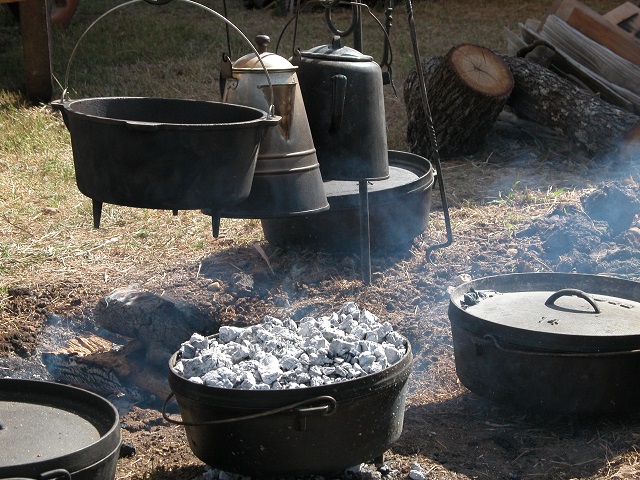
Dutch oven cooking at the campsite.

Dutch oven cooking at the campsite.


This is Passport to Texas

If your meal planning includes al fresco dining…a Dutch oven will make cooking up tasty treats a snap.

06—And you can cook anything that you would at home, on a fire, outdoors, while you’re camping with your family or friends.

Dutch oven enthusiast, Tim Spice, heads up boater safety at Parks and Wildlife. In use since the 1700s, Dutch ovens are made of cast iron.

10—Today the Dutch oven has legs on the bottom and a rim on the lid so that you can put coals under it and on top of it and cook as you would in your oven at home.

The key to Dutch oven cooking success is temperature control.

22—You hold your hand six inches above the coals…thousand one…thousand two….thousand three…if you have to pull your hand away sooner because it’s uncomfortable from the heat – it’s hotter than three-fifty. If you can hold your hand longer than three seconds, it’s colder than three-fifty. And, since most food is cooked at three hundred and fifty degrees in the oven, that’s where you’ll want to start gauging your heat.

Tim says the best way to learn how to Dutch oven cook is to just do it.

12—Don’t be intimidated by that Dutch oven. Grab one and take it home and practice. And then, take your folks out to the state park and spend the day and have a great meal at the end of a great day outdoors.

That’s our show for today… For Texas Parks and Wildlife…I’m Cecilia Nasti.