Archive for the 'Research' Category

Research | Hunting: Reporting Banded Doves

Tuesday, September 2nd, 2014
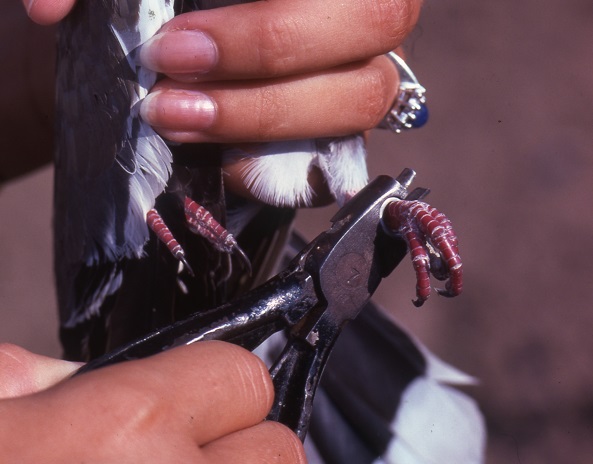
Banding a dove.

Banding a dove.


This is Passport to Texas

An important game bird in Texas, the mourning dove (although there are other dove species in Texas) is the subject of a nationwide banding program. By crimping tiny silver bands around their legs, biologists track the harvest rates of these birds.

08—We’ll also determine survival rates, where they go, when they get there, and when they leave. And all kinds of good information.

Jay Roberson… wildlife research supervisor at Parks and Wildlife…says the bands are small, but packed with information.

13—And it has the toll free number on it that people can call. And a nine digit number and the office location of the bird banding lab in Laurel Maryland.

Newer bands even have a website where hunters can report their findings. Roberson asks dove hunters to examine their harvest for leg bands. The information on the bands hunters supply is invaluable when managing the species.

19—All the work we put in on banding doves is for naught, if they’re not reported by hunters or people who find them. And, it’s very important that hunters check their birds that they bag – make sure that their birds are banded. If they are, we ask they report the number to the toll-free number: 1-800-327-BAND.

Find more information about reporting dove data when you visit the Texas Parks and Wildlife website.

Our show’s receives support from the Wildlife and Sport Fish Restoration Program, which provides funding for the Private Lands and Public Hunting Programs.

For Texas Parks and Wildlife…I’m Cecilia Nasti.
Wildlife Research: Banding Mourning Doves

Monday, September 1st, 2014

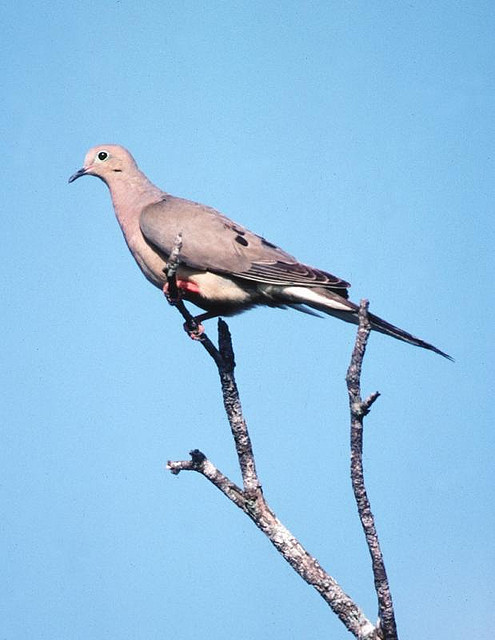
Mourning dove in Texas

Mourning dove in Texas


This is Passport to Texas

Mourning doves are the focus of an ongoing, nationwide banding study.

17—We’re banding mourning doves to determine harvest rates or percent of fall population taken by hunters. We’ll also determine survival rates, and where they go, and when they get there and when they leave.

Jay Roberson, wildlife research supervisor, said returned bands also help estimate population size – which ties directly into the national harvest strategy. He invited me to observe as he banded doves.

07—And we’re going to go and take some birds out of the traps and see what we’ve got and put the right band on the correct leg.

The trapped bird flapped excitedly as we approached. Jay covered the cage with an old blanket to calm the animal. Taking it from its cage, he brought it to a picnic table for banding with a small silver ring that fit easily around the bird’s leg.

14—Those are the bands for the adults and the unknown age birds. Now I slip the open band in the pliers over the lower leg. And now I’m going to crimp that pliers down until it closes.

After Jay determined the animal’s age, he transcribed the number of the band, the date and location into a book, and then released the bird.

If you harvest a banded mourning dove, report it by calling the number on the band. The Wildlife and Sport Fish Restoration Program program supports our show and provides funding for the Private Lands and Public Hunting Program.

For Texas Parks and Wildlife…I’m Cecilia Nasti

Wildlife: White Nose Syndrome on the Move

Thursday, August 28th, 2014

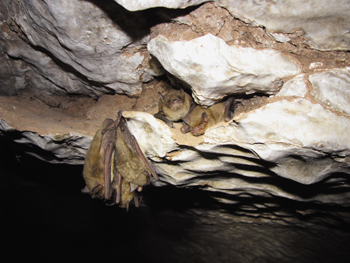
Bats in a cave.

Bats in a cave. Photo © Merlin D. Tuttle, Bat Conservation International, www.batcon.org


This is Passport to Texas

First discovered in 2006 / 2007 in upstate New York, white nose syndrome—a fungus that afflicts cave-hibernating bats—has killed an estimated 6 million animals thus far.

09—Texas is home to 32 species of bats; 18 of which are known to roost in some way, and many of those hibernate.

Texas Parks and Wildlife mammalogist, Jonah Evans says Texas bats are currently disease free, but not home free. Take migratory Mexican freetail bats, for example.

32— There is concern that they could act as a vector for the disease. So, if they get exposed to it – maybe they’re carrying it – and then they migrate down into Central and South America, and they expose a lot of other migratory bats that could then bring the disease into the western portion of the United States. So, it’s a lot of speculation, but there’s some concern that Texas could be a gateway from the eastern part of the US to the western if it gets into the migratory bats and then they expose a lot of the hibernating bats in the west.

Something that’s not speculation is how humans spread the disease from cave to cave, and how they can protect against it. That’s tomorrow.

The Wildlife and Sport Fish Restoration program supports our series… and receives funds from your purchase of fishing and hunting equipment and motor boat fuel.

For Texas Parks and Wildlife, I’m Cecilia Nasti.

Wildlife: White Nose Syndrome Update

Wednesday, August 27th, 2014

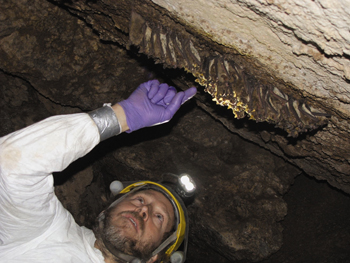
Checking caves for White Nose Syndrome

Checking caves for White Nose Syndrome, Photo © Mylea Bayless, Bat Conservation International, www.batcon.org


This is Passport to Texas

North America’s bats are dying off at an alarming rate.

06—The current estimate is more than 5.7 million bats have been killed by white nose syndrome.
Texas Parks and Wildlife mammalogist, Jonah Evans, says it’s been spreading south and west.

12— The closest [to Texas] it’s been confirmed is in Mississippi. And it does continue to be found further and further west – closer to Texas. So, we’re very concerned that it could get here.

Researchers thought they’d discovered the fungus in an Oklahoma bat colony in 2010; additional testing proved the sample similar, yet unrelated and non-lethal.

05—That is a huge relief, because that was next door, and we were just terrified that it was coming.

White Nose Syndrome, which forms a fungal mat over the faces of hibernating bats, thrives in cooler climates. This makes Texas officials hopeful state bat colonies will remain unaffected; nevertheless, they will remain vigilant.

11—The place that we’ve identified as most likely to be susceptible to white nose syndrome is up in the Panhandle, where there’s a fair
number of hibernating bats, and it gets cold.

How the white nose fungus moves from one area to another, and what we can do to slow its progress. That’s tomorrow.

The Wildlife and Sport Fish Restoration program supports our series… and receives funds from your purchase of fishing and hunting equipment and motor boat fuel.

For Texas Parks and Wildlife, I’m Cecilia Nasti.

Wildlife: New Theories about Alligators

Wednesday, May 14th, 2014

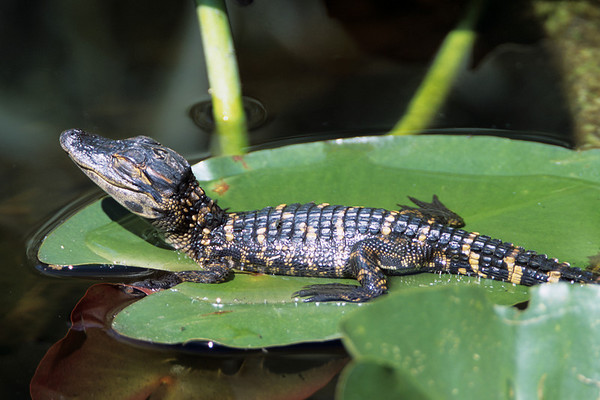
American alligator, image courtesy of www.exploreitnature.com

American alligator, image courtesy of www.exploreitnature.com


This is Passport to Texas

Drought affects different species in different ways. In the case of the American Alligator, recent dry conditions have affected this once-threatened species’ reproduction.

15— What we found was the size of the clutch of eggs – or the number of eggs in the clutch – that females lay doesn’t change during drought years. But, the number of hatchlings that are produced from a clutch of eggs decreases substantially.

Cord Eversole is a graduate student at A&M-Kingsville and a research assistant at Caesar Kleberg Wildlife Research Institute. He studies gators.

12— We thought that what we were going to end up finding was during these drought years the clutch size would decrease, but the number of alligators produced from the clutch would stay constant across the years. We found the opposite.

He said turning old theories inside out is exciting.

26— The exciting thing about alligator research in general is that — believe it or not –there’s been very few studies conducted on them throughout their range, but more specifically in Texas, there’s only been a handful of studies conducted in the state. And so, a lot of the information we gather from my study and studies that are coming up in the future, they’re going to produce brand new information, put new twists on old thoughts of how things work with alligators in general.

The more we understand environmental effects on species like the American Alligator, the better able we are to manage them.

The Wildlife and Sport Fish Restoration program supports our series and funds diverse conservation projects throughout Texas.

For Texas Parks and Wildlife, I’m Cecilia Nasti.