Archive for the 'Wildlife' Category

How Venomous Snakes Help Humans

Wednesday, April 13th, 2016
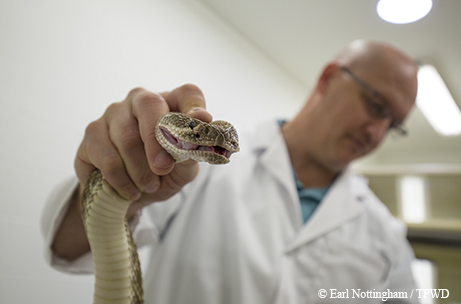
Venomous Snake.

Extracting venom at the John C. Perez Serpentarium at Texas A&M- Kingsville, TX

This is Passport to Texas

The National Natural Toxins Research Center in Kingsville, part of the Texas A & M system, houses 450 venomous snakes from around the world in its Serpentarium, from which they collect venom for research.

This center really is sort of a hidden gem in the A & M System, and in the state. It’s doing great work; it’s something that Texans should be proud of.

Reeve Hamilton works for the A & M System. Researchers at the lab do their own research, such as work on a universal anti-venom; they also share venom with fellow researchers worldwide.

Other researchers elsewhere will get in touch with them and say we really need this for our research, can you get it to us? And they’ll freeze it and ship it off. They’re doing their own research, but they’re also enabling the research of others.

Pharmaceuticals to treat heart attacks, strokes, and to prevent the metastasizing of tumors have come from venom research. Reeve Hamilton hopes that by understanding how venomous snakes help humans…

You know, you come across a snake, maybe you might change your appreciation of the animals a little bit.

Read about the Natural Toxins Research Center in the April issue of Texas Parks and Wildlife magazine.

For Texas Parks and Wildlife…I’m Cecilia Nasti
Masters of Deception

Friday, April 1st, 2016
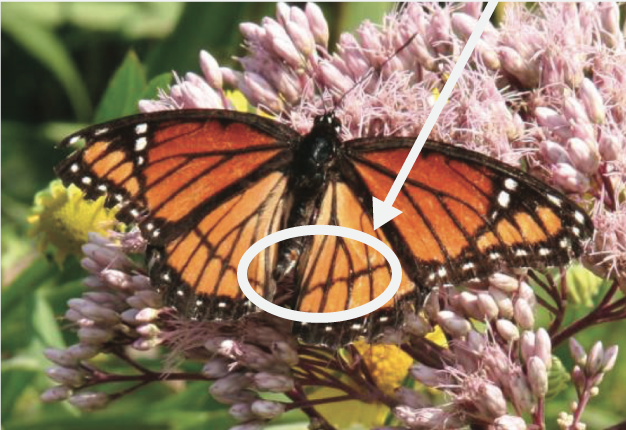
Adult viceroy butterflies have a solid black line on the hind-wings.

Adult viceroy butterflies have a solid black line on the hind-wings.


This is Passport to Texas

In nature, deception can mean the difference between life and death for certain species; animals use camouflage and mimicry to fool predators and prey alike.

Stick insects look like slim twigs and-when among the branches of woody plants-go largely undetected by rodents, bats, and birds that would make a meal of them.

Eastern screech owls use cryptic coloration to blend into their surroundings. When perched in trees their feathers resemble bark; their prey may not notice them until it’s too late to elude capture.

By mimicking the color and pattern of the Monarch butterfly which is poisonous if eaten, the Viceroy butterfly manages to stay off the menu of species that
would otherwise make a snack of it.

Southern flounder, a species of flatfish, are predatory animals. Their coloring is similar to the gulf floor where they lay in wait unnoticed for potential prey-which they ambush once spotted.

A whitetail fawn’s spots help to camouflage it from predators. It works best when they are in a wooded setting, as their reddish coat with white spots resembles
dappled sunlight on the forest floor.

Even though in the human world deception seems like a cheap trick, in the natural world, it’s just the trick some animals need to survive.

For Texas Parks and Wildlife … I’m Cecilia Nasti

Calling Critters at Night

Thursday, March 31st, 2016
Tree limbs.

You never know what you might see in the treetops at night.

This is Passport to Texas

Wildlife viewing at night presents a challenge. Yet, some species become more vocal when the sun sets, and will “talk to you” and even come into view if you know how to speak their language. State park interpreter, Kelly Lauderdale, has a few tips for enticing wildlife to come out of the shadows.

There are apps you can download for free or for minimal cost – like Audubon Reptiles. I use it for my night hikes to play those calls and to identify those different calls. Visitors can easily use those themselves. And this is what I do on my hike: I play the call, and do it for a little while and see if anything answers. If using a recorded call – and animals might call back – but does that ever draw the animals to you? And if it does, what should you do? I have had success with calling in an eastern screech owl. So, I play the call, it answers back, and it comes in. If you’re lucky you may be able to see the full owl sitting up in the tree talking to you. In that case – enjoy it! Don’t shine your flashlight up and blind him or her. Just sit and listen and enjoy and then go on.

State parks frequently offer guided night hikes. Find one near you on the Texas Parks and Wildlife website.

For Texas Parks and Wildlife, I’m Cecilia Nasti.

Hikes After Dark

Wednesday, March 30th, 2016
Night Hike

Night Hike

This is Passport to Texas

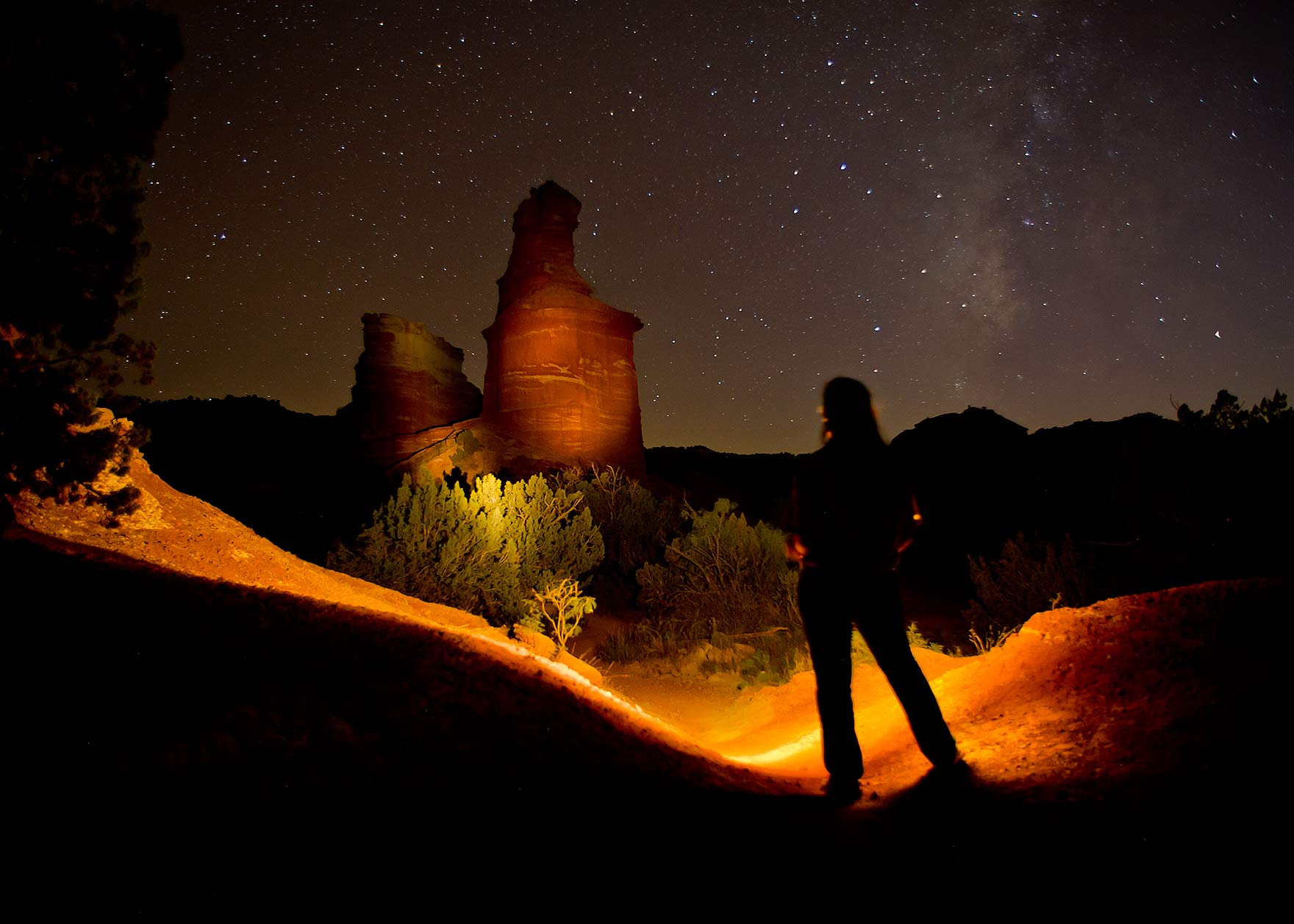
Don’t let the dark keep you indoors. With a flashlight, a friend, and a little daring, a night hike in a state park can be exhilarating.

One thing that’s really kind of fun, too, is to not use your flashlight.

When we spoke, Kelley Lauderdale was an interpretive specialist at Ray Roberts Lake State Park north of Denton.

If you let your eyes adjust to the dark and the moonlight, you’d be surprised at how well you can actually see. And sometimes when you do it that way, it really reveals a whole new wilderness. You see a lot more than when you get this tunnel vision with the flashlight and only see what’s illuminated.

Kelly recommended hiking with others on familiar trails, and to be prepared to experience wildlife by ear.

There are lots of amphibians that are active at night. And that’s one of the really fun things to listen for, because they’re pretty easy to hear. And oftentimes, once you learn to identify the sound of an amphibian, you’ll say: “Hey! That’s what I’ve been hearing all this time? I know that!”

Frogs and toads aren’t the only animals active at night.

There are owls that are active. Eastern screech owls are very nocturnal. Another bird that a lot of people hear at night is the Chuck Wills Widow; and they’ll sing and call all night long. Sometimes campers get a little bit tired of it if it’s really close to their campsite.

So step outside when the sun sets and get an earful of wildlife.

For Texas Parks and Wildlife, I’m Cecilia Nasti.

Citizen Scientists Take Biological Inventories

Monday, March 21st, 2016
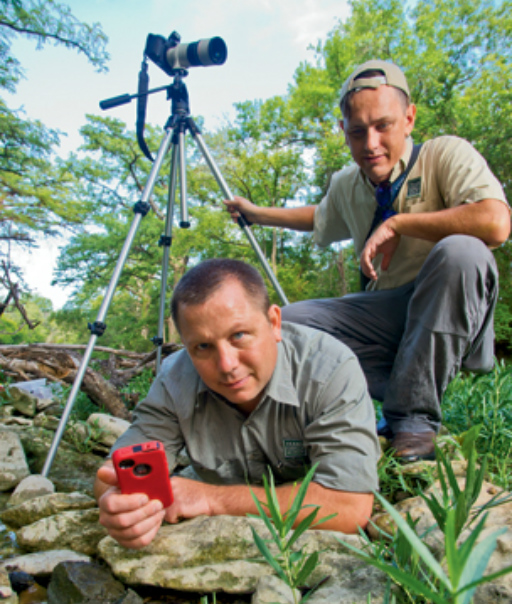
Getting up close and personal with Texas critters.

Getting up close and personal with Texas critters.


This is Passport to Texas

With the help of biological inventory teams of citizen scientists, Texas Parks and Wildlife monitors plants… herps…

Which are the amphibians and reptiles…

…birds and invertebrates…

…and that would mainly be: butterflies, dragonflies, beetles, bumblebees and such….

…in Texas’ 8 wildlife districts; Biologist Marsha May oversees the program. She says she’s recruiting experts statewide to join these monitoring teams.

Mostly, we’re looking at hobbyists; people who have joined herp societies. They know their herps. As well as birders. There’re people involved in Audubon Society that know their birds. So those are the types of people [as well as those with expertise in native plants and invertebrates] that we’re looking for, for these projects.

These biological inventory teams will monitor species on private land.

So, my plan is to start with organizing teams throughout the state. And once we get good, solid teams in place, then we’re going to go out there and open it up to the landowners, and let them know that these teams are available to come and do surveys on their property.

Knowing what’s on the land helps landowners become better stewards. Find out how to volunteer when you log visit the Nature Trackers page on the TPW website.

Funding provided in part by Ram Trucks. Guts. Glory. Ram For Texas Parks and Wildlife…I’m Cecilia Nasti.