Archive for the 'Wildlife' Category

Wildlife: Good Snakes, Bad Choices

Monday, November 17th, 2014
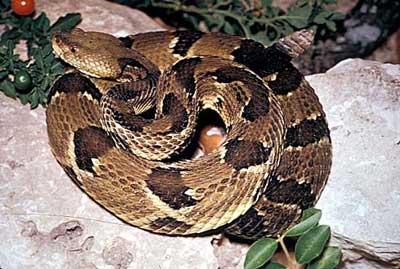
Timber rattlesnake

Timber rattlesnake

This is Passport to Texas

Have you noticed fall seems to bring with it small snakes?

04— Snake encounters may increase, although those animals are usually juveniles.

Late summer and early fall snakes hatch and feed before finding a place to hibernate, says TPW herpetologist Andy Gluesenkamp. Young snakes can make bad choices when it comes to where they spend the winter.

14—They may confuse a concrete floored garage, or someone’s limestone front porch with a bluff or a crevice that they can hang out in. And that’s where we wind up with these unwanted snake encounters in neighborhoods.

I told Andy that a rat snake lives under my house.

08—Cecilia, I’ll point out – it’s one thing to have a rat snake under your house, it’s another thing to have a skunk. So, I’ll take the snake over the skunk any day.

I have skunks, too. Andy Gluesenkamp says snakes near the front door or in the garage will find a new place to live on their own. But what if they get into the house?

11—The best advice I can give is a broom and a bucket. There’s no need to hurt the snake. They’re generally not difficult to collect if you just scoop them into a bucket and put them outside. They don’t want to be in your house.

The Wildlife and Sport Fish Restoration program supports our series and is funded by your purchase of fishing and hunting equipment and motorboat fuel.

For Texas Parks and Wildlife…I’m Cecilia Nasti.
Conservation: Dogs Sniff Out Invasive Weeds

Wednesday, November 12th, 2014
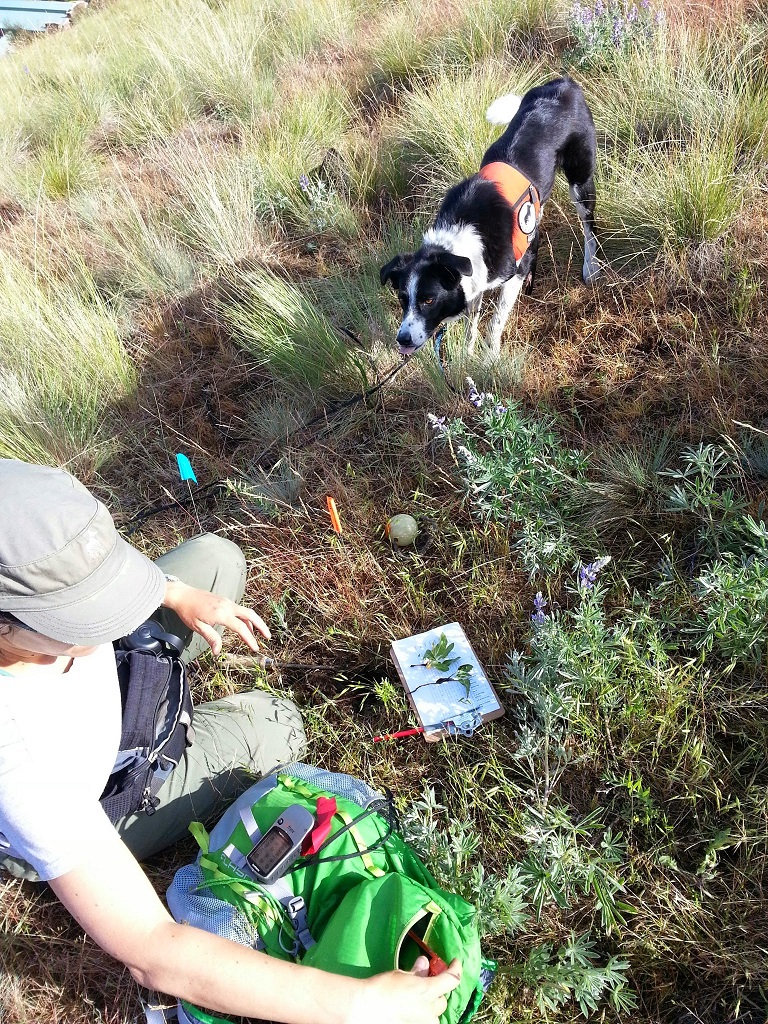
Dog finds invasive weed.

Dalit Guisco and Seamus finding Dyers woad (an invasive plant from Eurasia) in Montana.


This is Passport to Texas

Using their keen sense of smell (often to locate scat), trained conservation detection dogs assist with monitoring endangered wildlife, defining wildlife corridors and helping to eradicate invasive species.

06—Almost all of our work is in partnerships with non-profits, or agencies or sometimes universities.

Pete Coppolillo is Executive Director of Working Dogs for Conservation in Montana.

13—It’s really cost effective because you can find information about a lot of animals without having to fly a helicopter around and dart them and capture them and do things like that.

Lab analysis costs are decreasing, too, making it easier to obtain more information from scats. Yet, some successes have nothing to do with wildlife.

29—I’ll give you one example: there’s a weed here in Montana called dyers woad that has infested large parts of Utah, and then it appeared here. For a long time, the expectation was we’ll never get rid of it [because one plant can set 10,000 seeds]. Because dogs are so good at finding it, and because they can find it before it flowers or sets seed, we are close to eradicating that plant in a place called Mount Sentinel. You know, it’s a really powerful, scientifically rigorous tool, and it opens the door to doing things we hadn’t dreamed of.

You can learn more about conservation detection dogs, and see pictures of the dogs, Working Dogs for Conservation.

For Texas Parks and Wildlife…I’m Cecilia Nasti.
Conservation: Conservation Detection Dogs

Monday, November 10th, 2014
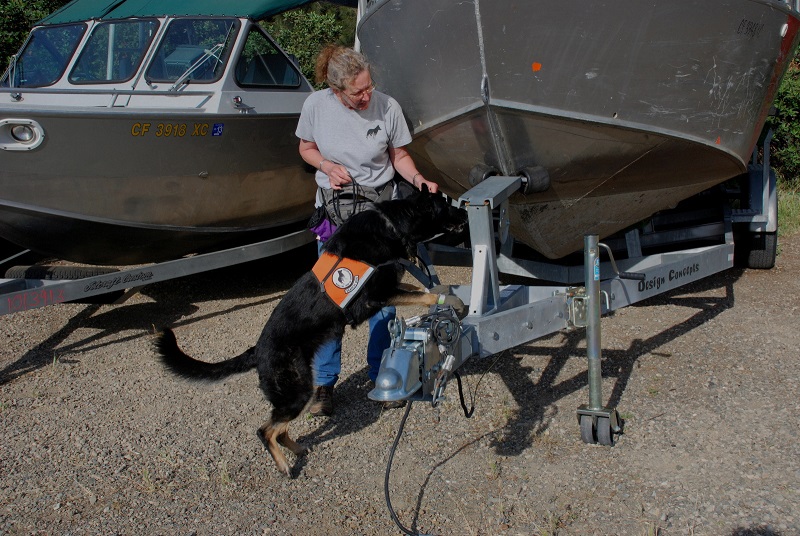
Alice Whitelaw and Tia, inspecting boats for zebra mussels in California

Alice Whitelaw and Tia, inspecting boats for zebra mussels in California


This is Passport to Texas

Most dogs like to work. And Pete Coppolillo is hiring. He is Executive Director of Working Dogs for Conservation in Bozeman, Montana. Since the mid-1990s, his organization’s trained dogs as a non-invasive alternative method for collecting data on hard to find wildlife.

05—By non-invasive, I mean we don’t have to capture them, we don’t have to handle them, we don’t even have to see them.

Then, just how are researchers using dogs?

06—So, the idea is we train a dog to find their scat, usually, which to non-biologists is a polite word for poop.

By detecting scat, the dogs help researchers determine the range, sex, and diet (among other things) of certain wildlife species. Pete said they first trained dogs to sniff out grizzly bear and wolf scat, but didn’t stop there.

28—Dogs can do everything from scat to live animal work to invasive weeds. Even invertebrates, like Emerald Ash Borer; they can find their larvae or their eggs. And, [we] even [use the dogs to detect] aquatic invasives like zebra and quagga mussels – to inspect boats. Because, the mussels can be in cracks, or inside, where a visual inspection can’t see them. Or the dogs can even detect the veligers, which are microscopic larvae that we can’t see.

Not all dogs are suited to this work. Learn more about these dogs at Working Dogs for Conservation.

More on that tomorrow. The Wildlife and Sport Fish Restoration program supports our series and funds diverse conservation projects in Texas.

For Texas Parks and Wildlife…I’m Cecilia Nasti.
Conservation: Money for Quail

Thursday, November 6th, 2014

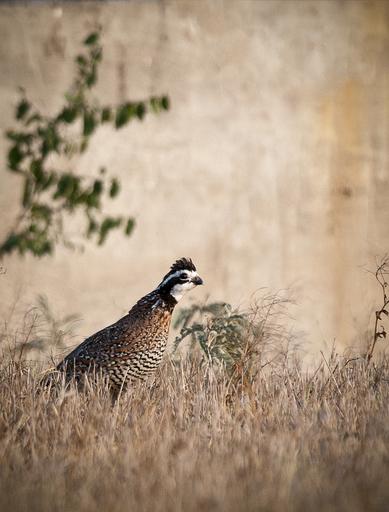
Bobwhite quail in Texas

Bobwhite quail in Texas


This is Passport to Texas

There’s new hope for bobwhite quail.

13—Four million dollars of the upland game bird stamp fund was authorized by the legislature this past session to specifically go towards further developing this concept of focus areas for bobwhite quail and grassland birds.

The “focus area” concept is one TPW upland game bird program leader, Robert Perez, has worked on for years.

08—Well, a focus area is an intensive effort within a small area to demonstrate that quail restoration can be successful.

Most focus areas are east of the I-35: places where quail are gone, said Perez, but they haven’t been gone long.

23— One of our focus areas in the Columbus-Seely area, southeast Texas. Another is the Navarro-Ellis area, along the I-35 corridor where Waxahachie is. Another is West of Dallas a good ways over towards Wichita Falls, around Clay County and south. So these are the front lines of bobwhite decline; birds are still around, but they’re noticeably rarer.

The agency awarded 15 grants, with two more in process, to nonprofits, universities and others for grassland restoration. Grantees will use the $4 million dollars over a two year grant period.

19—But that doesn’t mean that the project is over at the end of two years. Because the impacts – when you start to turn the dirt or manipulate habitat – those effects go on for years. And so what’s most important is to continue to monitor – think of the future beyond those two years – to really understand and paint a good picture of what the impacts are of these types of manipulations.

Find quail information on the Texas Parks and Wildlife website. The Wildlife and Sport Fish Restoration Program supports our series.

For Texas Parks and Wildlife…I’m Cecilia Nasti.
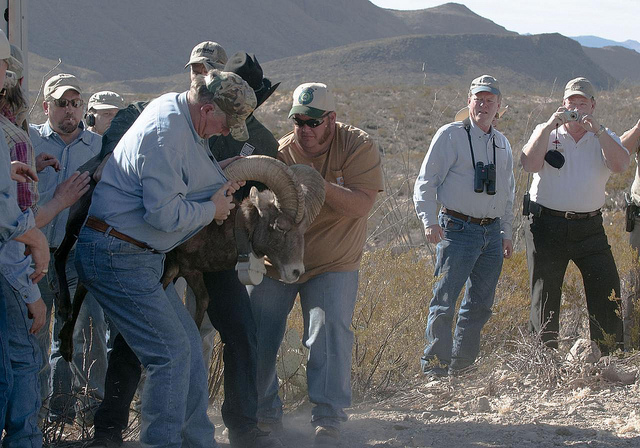
People: New TPWD Vet Finds His Footing

Friday, October 10th, 2014

Wrestling with bighorn sheep

Desert Bighorn Sheep translocation project.


This is Passport to Texas

Before Bob Dittmar joined Texas Parks and Wildlife this year as its first-ever staff veterinarian, he was in private practice in Kerrville. In his new position, he’s learning to shift focus from domestic animals and livestock to wildlife.

09—The challenge is that it’s a different situation than private practice. There’s going to be a learning curve for me just to fit into Parks and Wildlife.

He’s no stranger to the agency, though, having assisted with projects including the translocation of desert bighorn sheep and pronghorn antelope. He expects his work will be as varied as the state, itself, and include the collection and analysis of data, as well as hands on work with wildlife.

22—I’ll be working more hands on, and we’ll be looking into whatever situation might occur [among the state’s wildlife], and I’ll continue to work with the capture and translocation projects with the Bighorn Sheep and Pronghorn antelope. And there may be other things that we do as well. As time goes on we may look into more and more research projects in the wild that would involve more hands on work with other species.

Learn more about Texas wildlife and how it’s managed, when you log onto the Texas parks and Wildlife website.

The Wildlife and Sport Fish Restoration program supports our series and funds its work through your purchase of hunting and fishing equipment and motorboat fuel.

For Texas Parks and Wildlife…I’m Cecilia Nasti.
