Archive for the 'Wildlife' Category

Conservation: Love Lives of Frogs and Toads

Friday, June 7th, 2013
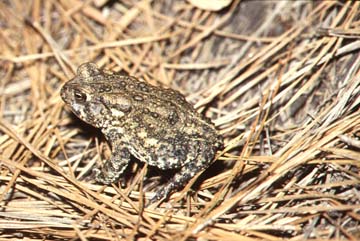
Houston Toad Tadpoles, Image by Earl Nottingham, © Texas Parks and Wildlife Department

Houston Toad, © Texas Parks and Wildlife Department


This is Passport to Texas

04 –Amphibians are a remarkably unique life form.

Texas State University Biologist Dr. Mike Forstner says in case you ever wondered how amphibians, romance one another, he can help.

22 — Amphibian or amphibios is a two-stage life. Those dual lives reflect water and land. When we think about the mating process or the management of the toad we have to take both in account the water and the land. All frogs and toads call. They make a unique advertisement call.

You have probably heard male leopard frogs and bullfrogs, for example, advertising their interest in meeting members of the opposite sex, without even realizing it. And if you were to find yourself in Central Texas, traveling through Bastrop…

10 –… further into the forest in Bastrop, we begin to hear a high-pitched trills that lasts a long time, up to 15 seconds for the Houston toad.

Those calls allow the females to recognize the correct male for their species, and since the fire, we are beginning to hear a few more of these calls.

10 –And the females will hop toward the male call that they think is the most attractive. So there is female choice- not very different from what happened in the human world.

That’s our show for today…with funding provided by Chevrolet, supporting outdoor recreation in Texas; because there’s life to be done.

For Texas Parks and Wildlife…I’m Cecilia Nasti.
Conservation: Houston Toad Recovery, 2

Thursday, June 6th, 2013

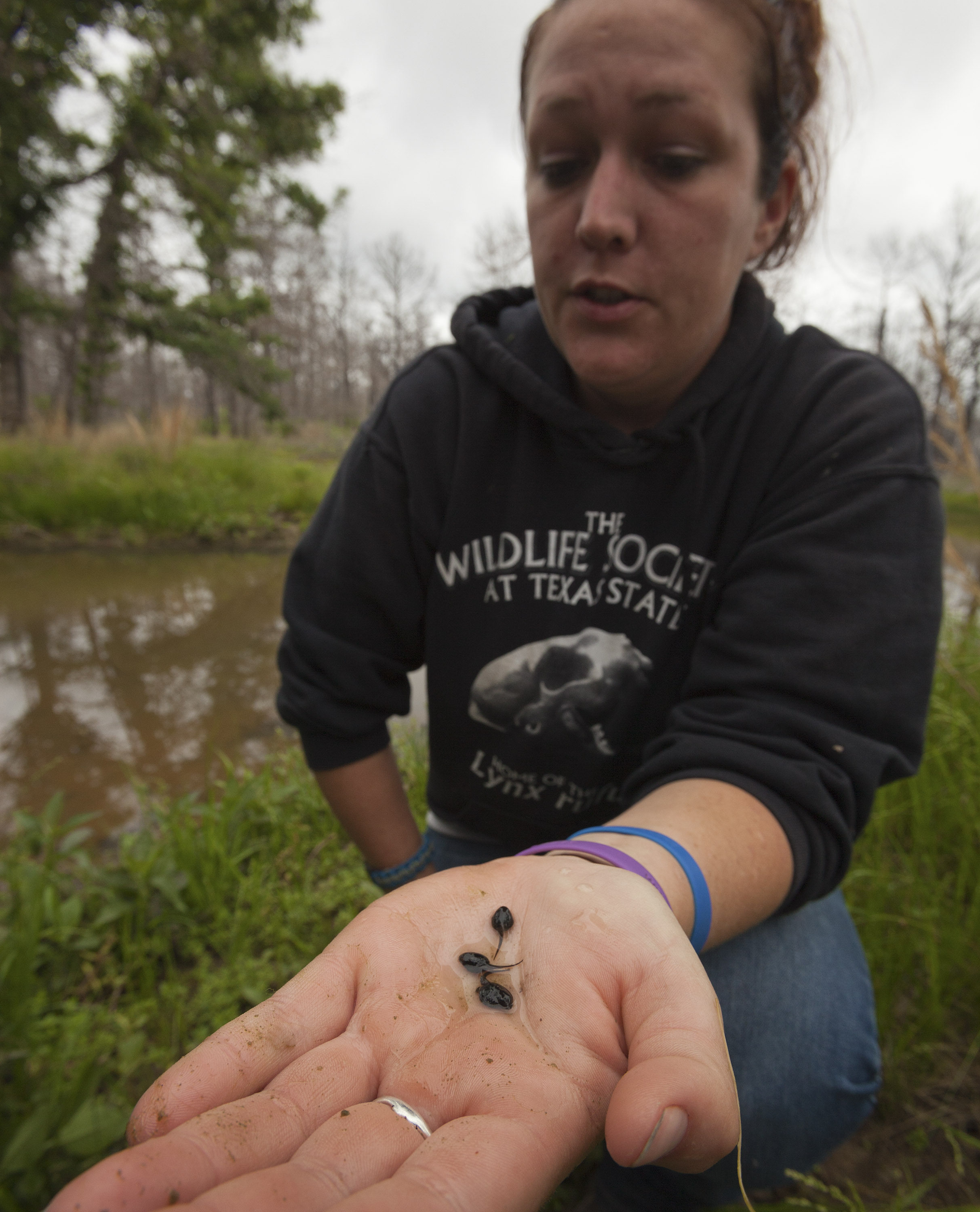
Houston Toad Tadpoles, Image by Earl Nottingham, © Texas Parks and Wildlife Department

Houston Toad Tadpoles, Image by Earl Nottingham, © Texas Parks and Wildlife Department


This is Passport to Texas

Recent drought and wildfires could have spelled the end for the endangered Houston Toad, which exists in and around Bastrop State Park.

05—A few months after the wildfire in Bastrop County, our surveys documented very few toads during that first breeding season.

This had wildlife biologists like Greg Creacy worried about the status of the remaining population. But a recent survey found more breeding toads than they had a right to expect after such devastation.

11— It’s puzzling, and we’re continuing to do research with collaborators like Texas State University. And we’re learning more about the species with every passing year, and we hope to have answers to those questions soon.

Using a “head start” program Creacy harvested egg strands from breeding areas – post fire – raised them to tadpole stage, then released them where they were found. While it gives them a higher survival rate…

27—We have noticed that the toads that we have found since the wildfire, typically do not weigh as much as they usually do. The eggs that they’re laying are smaller. So it appears that physiologically they’re not as in good health as they normally are. But you have hope that over time this will change? Yes. They’ve gone through a very difficult time with the drought and the subsequent wildfire, but we are optimistic things will be improving soon.

That’s our show. The Wildlife and Sport Fish Restoration program program supports our series, and is funded by your purchase of fishing & hunting equipment and motorboat fuel.

For Texas Parks and Wildlife…I’m Cecilia Nasti.

Conservation/Wildlife: Black Bears in Texas, 2

Friday, May 24th, 2013

Black Bear image by Alan Vernon

Black Bear image by Alan Vernon


This is Passport to Texas

The Louisiana Black bear is long gone from East Texas, although, small populations exist in its home state. Black bears we might see in NE Texas likely come from Oklahoma and Arkansas.

10- And they are not Louisiana bears. Bears in Oklahoma and Arkansas are probably the sub species Americana or just the plain American Black Bear.

But they’re welcome in Texas just the same, says Dave Holdermann, a wildlife diversity biologist in Tyler. TPW’s management goal is to manage natural re-colonization of the species in NE Texas.

15— And one of the things that we’re doing to support that approach is we monitor black bear sightings – mostly coming in from the public. And we monitor those very closely, and scour them very well, to be sure they are legitimate sightings.

Holdermann encourages the public to contact the wildlife division with black bear sightings at any of its regional offices.

27 — We look for and ask early in the interview [with the person], whether or not they have physical or photographic evidence. Beyond that, we look at details of the observation; how close was the person? What exactly did they see? How many bears were there? Give us the locality as close as you can. By the way, it wouldn’t necessarily have to be a photo of the bear. We might use hair as evidence, or a track.

Find more information about reporting your black bear sighting at passporttotexas.org: Call Dave Holderman with your black bear sighting at 903-566-1626 (ext. 209)

For Texas Parks and Wildlife…I’m Cecilia Nasti.

State Parks: Photography and Wildlife Viewing

Monday, March 4th, 2013

Photographing Texas Wildlife in State Parks

Photographing Texas Wildlife in State Parks


This is Passport to Texas

Make your wildlife viewing trip to a state park “picture perfect’ when you bring along a camera. Our State Park Guide, Bryan Frazier, offers tips on taking great shots.

60—If you’re a beginner, in particular, get a versatile lens – something that has some zoom capabilities, but also has some wide angle capabilities. If you’ve got one or two lenses that have some versatility it will save you on fatigue, and also keep you in the game where you can make some adjustments on the fly. Another one I like to tell people is to use a tripod or a monopod. And a lot of times these will double as a hiking stick. So using something as a stabilizer, like a monopod, will make a difference. The other thing – don’t ignore landscape shots. Sometimes the wildlife just doesn’t cooperate. So when you’re out in nature, look for the unique scenery. Look for the wildflowers; look for the colorful skies that can sometimes save a trip from a photography standpoint even if the wildlife doesn’t cooperate. Get kids involved in it – cameras these days are easy to use. You’ll want to take some extra batteries and extra memory cards. But, it’s a great way to engage the whole family in a memorable outdoor experience.

Thanks, Bryan.

That’s our show for today…with funding provided by Chevrolet, supporting outdoor recreation in Texas; because there’s life to be done.

For Texas Parks and Wildlife…I’m Cecilia Nasti.

Wildlife: Inventories and Surveys

Friday, February 15th, 2013

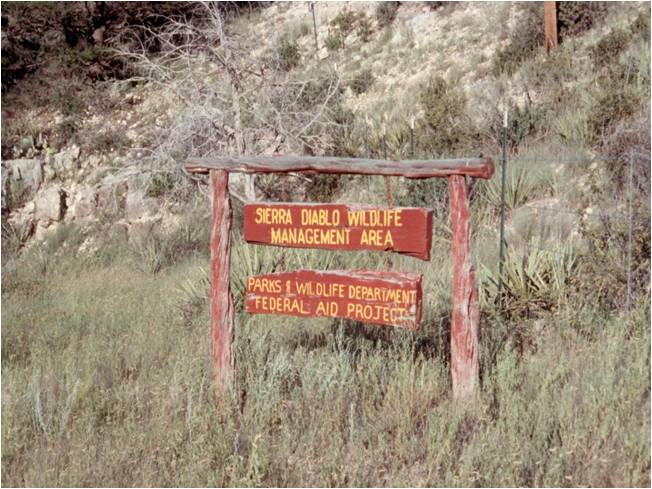
Sierra Diablo WMA, Image © Texas Parks and Wildlife Department

Sierra Diablo WMA, Image © Texas Parks and Wildlife Department


This is passport to Texas

Not all surveys are conducted over the telephone in the middle of your dinner hour. Baseline surveys conducted by wildlife biologists take place at wildlife management areas, over time.

13 – We conduct baseline inventories and surveys on the wildlife management areas, first of all so that we can understand and have a catalog of the different types of vegetation that grow there, the different types of animals that grow there, and what the habitat are that help support those animals.

Dennis Gissell is facilities coordinator for the state’s 49 Wildlife Management areas, or Wildlife management Areas.

10—After we do the baseline inventory we do regular follow-up monitoring of those populations to determine how they’re doing. And compare that to habitat conditions and what we can do to help make it better.

After the data is collected and analyzed, management recommendations for the Wildlife Management Areas are established and implemented. This type of active stewardship may include hunting to improve conditions.

14—Hunting provides a valuable tool in terms of population control for different wildlife species. Various game species can produce to the extent that their populations exceed the capacity of the habitat to support them. And so that’s why hunting is an important component.

That’s our show…funded by the Wildlife Restoration Program… helping to fund the operations and management of more than 49 wildlife management areas.

For Texas Parks and Wildlife…Cecilia Nasti