Archive for the 'Food' Category

Reel in a Rainbow Before They’re Gone

Thursday, January 18th, 2018
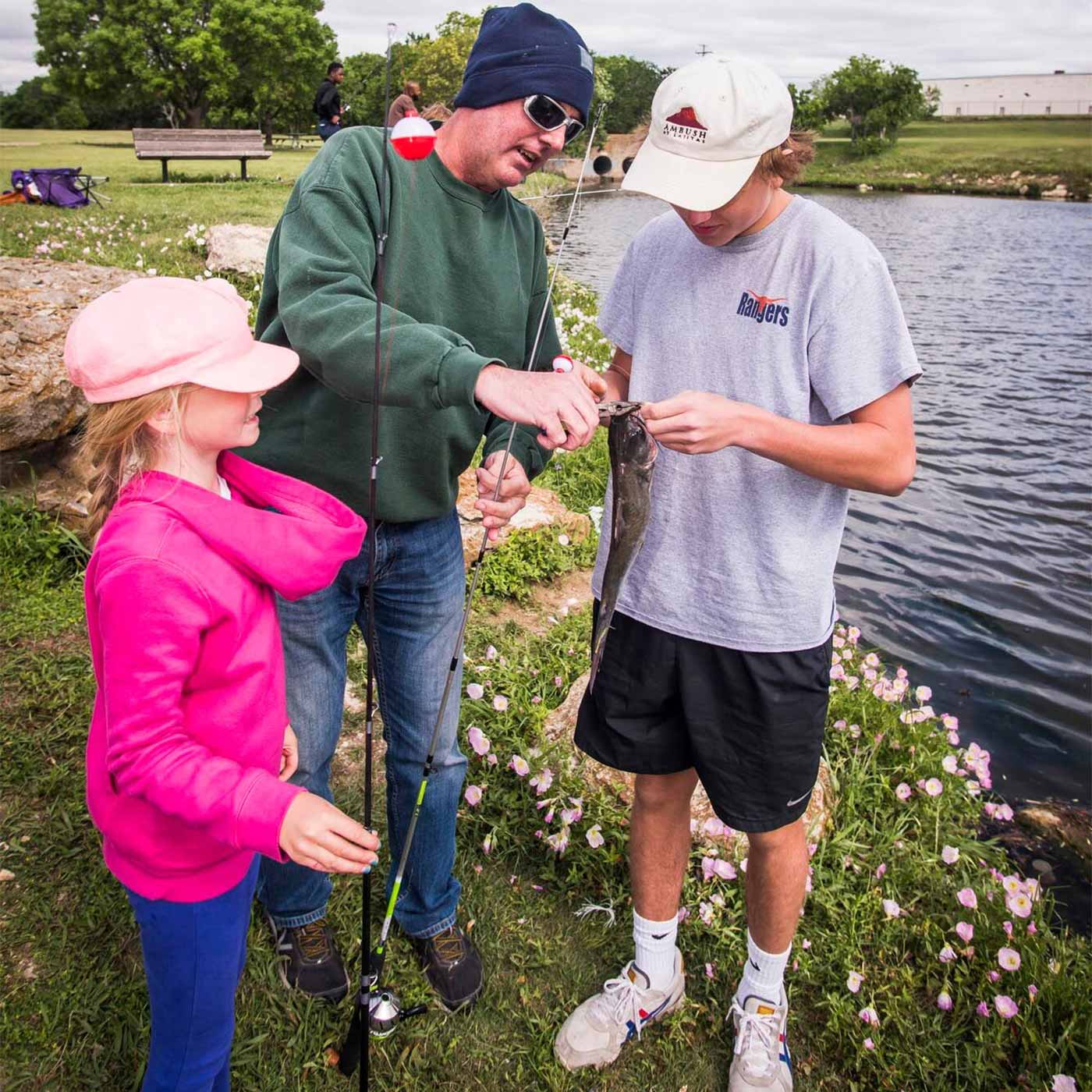
Take the kids fishing.

Take the kids fishing.

This is Passport to Texas

If you’re an angler who likes to eat what you catch, then now’s the time to reel in a rainbow trout.

We stock them at a catchable and eatable size. They are good fighting fish; they’re relatively easy to catch. We usually stock them in smaller bodies of water, so they’re a good fishing, catching opportunity and good eating opportunity as well.

Carl Kittel is a program director for Inland Fisheries, and oversees winter trout stocking in Texas, which began this month.

We’ve been stocking [rainbow] trout around Texas for almost 40 years. One interesting note about trout is that we often say there are no established populations of trout in Texas, but actually, way out west in the Davis Mountains there’s a small, tiny stream at high enough elevation that there is a reproducing population of rainbow trout.

That’s why we stock them in winter; most of Texas is too hot for the fish to survive. Inland fisheries will distribute more than 310-thousand rainbows in 160 locations.

And we have a special program; we actually stock somewhat larger trout in urban areas in our Neighborhood Fishin’ Program. And that’s something that you can specifically look for on our web page.

With the New Year here, it’s is a great time add fishing to your to-do list this year. Find the stocking schedule on the Texas Parks and Wildlife website.

The Sport fish restoration program supports our series and funds rainbow trout stocking in Texas…

For Texas Parks and Wildlife…I’m Cecilia Nasti.
Chasing Rainbows in Texas

Wednesday, January 17th, 2018
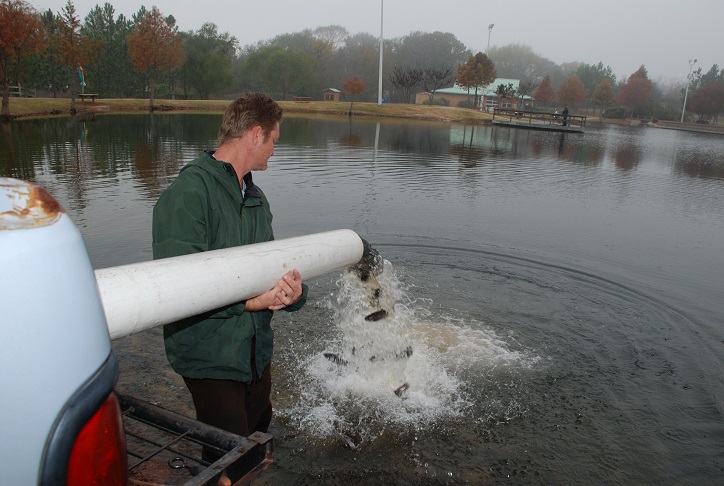
Stocking Rainbow trout. Photo by Larry Hodge.

Stocking Rainbow trout. Photo by Larry Hodge.

This is Passport to Texas

It’s the New year; what better way to celebrate than with rainbows – rainbow trout, that is.

We do winter stockings when the water temperatures permit it, to provide an opportunity for anglers to catch trout in Texas. It’s a species of fish that anglers wouldn’t catch otherwise, so we stock them, and we intend them all to be caught out during the season.

Carl Kittel is a program director for Inland Fisheries. Thanks to good rainfall throughout most of the state, we have fishing access to almost all waterbodies.

This year, things are pretty well back to normal. Looks like our normal level of stocking will happen.

Kittel says the agency will stock about 160 sites around the state, distributing more than 310-thousand rainbow trout. The fish will be divided among the various locations, including urban neighborhood fishin’ holes.

We publish a schedule on the Texas parks and Wildlife Department webpage. Look for the winter trout stocking link.

Carl Kittel says we stock rainbows in winter because these fish cannot survive our hot summers. So, when you reel one in this winter, take it home and eat it.

The Sport fish restoration program supports our series and helps to fund rainbow trout stocking in Texas

We record our series at The Block House in Austin, Texas and Joel Block engineers our program.

For Texas Parks and Wildlife…I’m Cecilia Nasti.
After the Shot: From Field to Kitchen

Tuesday, January 16th, 2018
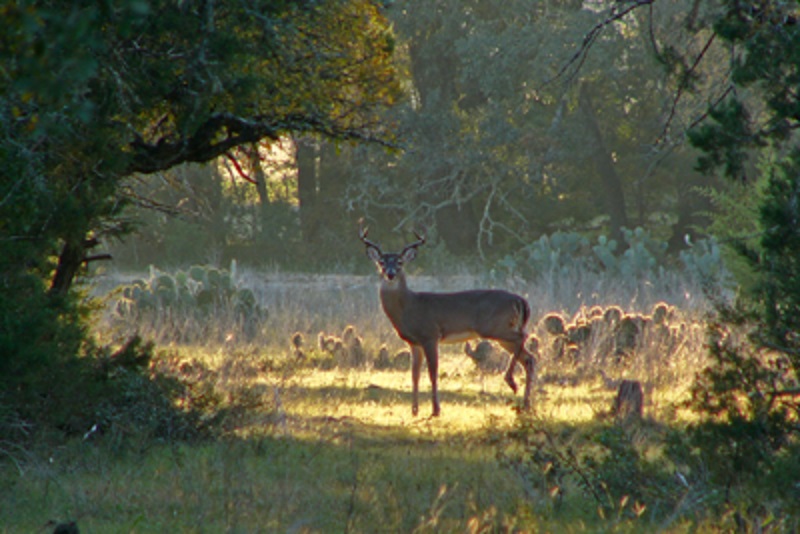
Whitetail in a clearing.

Whitetail in a clearing.

This is Passport to Texas

Handled correctly from field to kitchen, venison can be tastier than store bought meat. Keep it cool and dry immediately after harvest.

15—And then, the real poetry begins in the aging of that meat. If you can hang that meat for three to six days, some of the enzymes in the meat start to break it down, and you really get that tender, good tasting, concentrated flavor.

Austin resident, Lee Smith, is a hunter and home cook. He recommends vacuum sealing the meat to keep it usable for up to a year in the freezer. While you may wish to elevate a venison dish, Smith says, simple has its merits.

23—You’re legally – depending upon what county you’re hunting in – able to take five deer in Texas. And that can be a lot of meat. So, I can understand after a while, how you might want to change it up and have a little horseradish sauce, or some kind of port reduction with some mushrooms. But, I want to taste the meat; I don’t want to throw a heavy sauce on it. In fact, tonight, we’re having venison fajitas.

Lee Smith says he usually marinates venison back strap briefly in olive oil and soy sauce, grills it, and ends up with something the whole family enjoys.

For Texas Parks and Wildlife…I’m Cecilia Nasti.
Field Dressing Game

Monday, January 15th, 2018
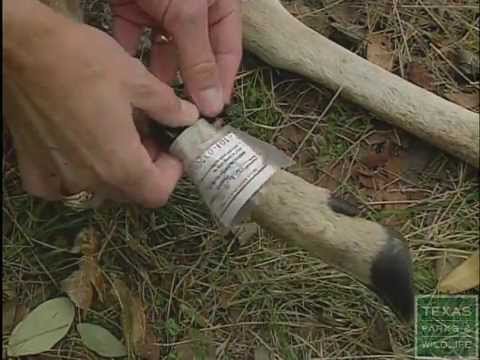
Tagging legally harvested deer.

Tagging legally harvested deer.

This is Passport to Texas

Lee Smith comes from a hunting family. This longtime Austin resident and avid home cook, says from the start, he’s hunted for meat not trophies.

Once you’ve pulled the trigger and you’ve got an animal down, the work really begins.

As soon as the animal’s down, the clock starts ticking; field dressing the animal is a race against spoilage.

Meat spoils due to three things: heat, moisture and dirt. Getting those internal organs out is going to immediately start to let that carcass cool. Second thing is: the skin. Taking that skin off is going to get that animal cooler, and also allow it to dry quicker. Once you’ve got it back [to camp], and taken the skin off, you rinse out the interior chest cavity, and get it into that cooler.

If you’re hunting on public land, or there’s no walk-in cooler at your lease, after field dressing and skinning the animal, quarter it.

That’s taking off the four quarters, the two backstraps, and the rear legs. That’s what you are legally bound to take. If you don’t take that, you can be ticketed for waste of game.

Put the quarters into tall kitchen garbage bags, and then into coolers with ice. How to handle game when you get it home – that’s tomorrow.

For Texas Parks and Wildlife…I’m Cecilia Nasti.
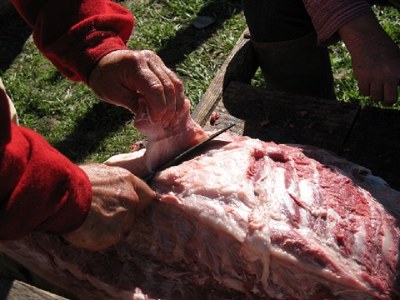
Hog Butchery Class Circa 1850s Texas

Monday, January 8th, 2018
Processing a hog as they would have done in 1850s Texas, at  Barrington Living History Farm

Processing a hog as they would have done in 1850s Texas, at Barrington Living History Farm

This is Passport to Texas

In 1850s Texas people raised and butchered their own animals. Pigs were a popular choice back then.

They reproduce quickly. They’re useful for eating your garbage, and then you eat them. In that way, it’s kind of a closed cycle of consumption—as a recycling source.

Barb King, is lead domestic interpreter at Barrington Living History Farm at Washington-on-the-Brazos State park and Historic Site. Before refrigeration, Texans butchered animals in cold months. January 13 & 14 farm staff will demonstrate the process. They’ll dispatch an animal before guests arrive, but visitors will see everything else beginning with evisceration…

That’s actually one of my favorite times to teach anatomy lessons, because [the pig’s organs] are very close to human structures. So, we can talk about different organs, what their use is….

Afterwards, Barb says, they divide the meat into cuts.

Then, on Sunday, we grind a lot of the meat; visitors can help with that. Then we end up curing the meat on Sunday, as well. So, we show people the start of the process, and then we have a lot of people who go home and end up trying their own charcuterie at home. Or, they already make sausage, and they just want to see the beginning of the process. You know: how do you start with it on the hoof?

The Whole Hog demonstration is Saturday and Sunday, January 13th & 14th at Barrington Living History Farm. The program is weather dependent, so call to confirm. Find details on the Texas Parks and Wildlife website.

That’s our show for today… Funding provided in part by Ram Trucks. Guts. Glory. Ram

For Texas Parks and Wildlife…I’m Cecilia Nasti.
