Archive for the 'Habitat' Category

Owl Nest Boxes

Tuesday, October 13th, 2015
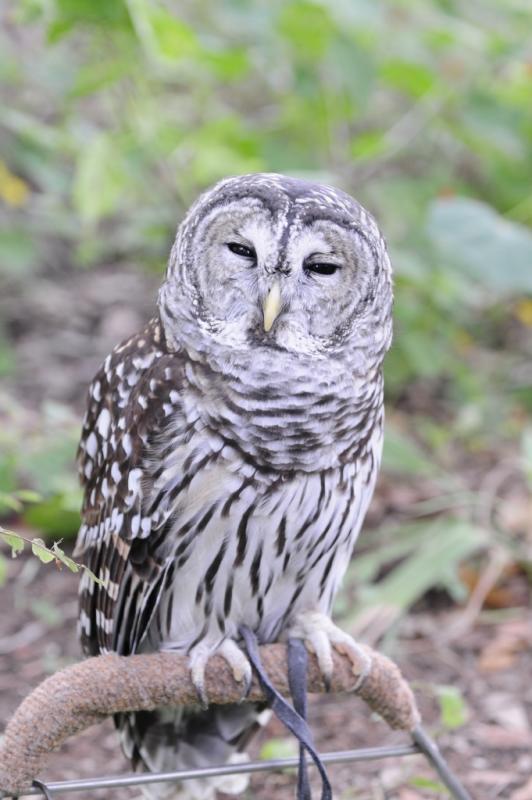
An owl waiting for his new home.

An owl waiting for his new home.


This is Passport to Texas

What would you call a wooden box intended for owls?

02- It would be called an owl box.

I really need to start making these questions harder. Ornithologist, Cliff Shackelford says man-made owl boxes are a “stand in” for what nature provides.

07-What these owls would do is look for a cavity in a tree–a hollow in a tree–and that’s what this box is replacing.

The Barn Owl and Eastern Screech Owl are two wide-ranging owl species in Texas, with different needs.

15- They use different size boxes. The Barn Owl is much larger than the Eastern Screech Owl. And you can go online on the Parks and Wildlife website; we have blueprints on how to make these boxes for these birds. Or you can just go online [to other sites] and find other blueprints and make them [the nest boxes] to your
liking.

Owls make some people nervous because they are raptors and have strong hooked beaks and sharp talons, but Cliff Shackelford says, fear not.

14-The good thing about owls: they’re good neighbors to have because they eat a lot of rodents. Screech Owls eat a lot of roaches. The wood roaches. The big ones that are outside. So, it’s good to have owls, because they’re keeping these things that we consider pests in check.

Cliff says owl boxes work best in areas where you have good tree cover. I have a link where you can find the measurements for nest boxes and bird houses
appropriate for common species at passporttotexas.org.

For Texas Parks and Wildlife, I’m Cecilia Nasti.
__________________________________________________

Dimensions for Owl Nest Boxes

Barn Owl
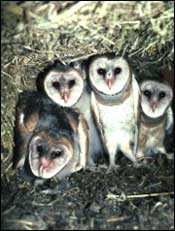
Baby owls in a nest box.

Baby Barn Owls.


Floor – 10 inches by 18 inches
Depth – 15 to 18 inches
Entrance height above floor – 4 inches
Entrance diameter – 6 inches
Recommended height above ground – 12 to 18 feet


Screech Owl
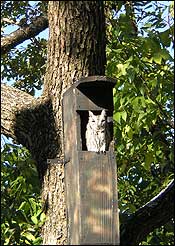
Screech Owl in a nest box hanging on tree.

Screech Owl in a nest box.


Floor – 8 inches by 8 inches
Depth – 12 to 15 inches
Entrance height above floor – 9 to 12 inches
Entrance diameter – 3 inches
Recommended height above ground – 10 to 30 feet
TPW TV: The Plant Guy, Jason Singhurst

Friday, August 28th, 2015
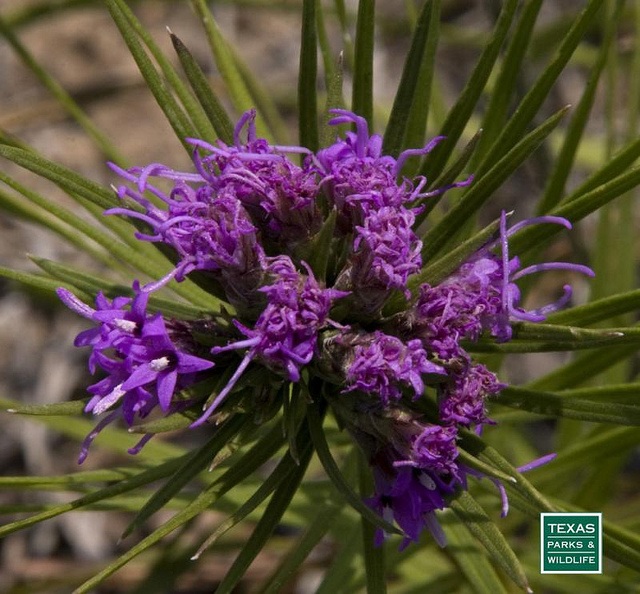
Gayfeather

Gayfeather


This is Passport to Texas

Jason Singhurst is a man outstanding in his field. In fact, he stands in lots of fields…and prairies. He’s a botanist with Texas Parks and Wildlife.

04-That is a Blazing Star of Kansas Gayfeather.

Jason is responsible for creating and updating the rare plant community list for the Texas conservation action plan.

03-[The] gamma grass–they’re in flower right now.

Jason has published over 90 articles on the plants of Texas, and has produced the largest data set on native prairies in America. He also works closely with
volunteers, like Katie Emde with the Native Plant Society of Houston.

10-It’s such a treat to go out with Jason in the field, because he knows so much; he’s so eager to teach and share his knowledge. And, it’s so much fun when he gets excited about plants.

Jason Singhurst has added to herbariums in Texas, won awards, and co-authored a book on rare Texas plants. But what give him the most pride?

07-Well, I think the one thing I’m most proud of is discoveries. I’ve actually found species that have never been described and have been able to publish on them. It makes me very happy.

Get to know more about Jason Singhurst and his work next week on a segment of the Texas Parks and Wildlife PBS TV show. Check local listings.

For Texas Parks and Wildlife, I’m Cecilia Nasti.

Lone Star Land Steward: Big Woods

Tuesday, August 18th, 2015


This is Passport to Texas

In 1995, Dr. Robert McFarlane bought 1,500 acres 90 miles southeast of Dallas along the Trinity River near where he hunted and fished as a kid. Since then he has
pieced together an additional 6,000 acres of river bottom, open marsh wetlands and upland hardwoods, which he named Big Woods.

08- I try to keep the Big Woods true to what I see as the laws of nature. It’s a place where you can go and be in the wild and see the animals and just be.

When Dr. McFarlane acquired the property, it was highly-fragmented and over-grazed. During the last 20 years, he’s walked the land daily, and worked tirelessly to improve aquatic and terrestrial resources.

07- We have 40 to 45 marshes, and over a hundred miles of roads. We plant about 50 food plots.

Dr. McFarlan’s effort to restore this area of the Trinity River is representative of what it means to be a good steward of the land, which may be why he won the 2015 Lone Star Land Steward Leopold Award.

15- When I started buying all this land, and I sold what stocks I owned, my friends thought I was crazy. And they were correct. I think this was a form of insanity, but I think it was a beautiful insanity, and I’m happy to have been crazy.

Learn more about the Lone Star Land Steward program and Dr. McFarlane’s contribution to habitat on the Texas Parks and Wildlife website.

The Wildlife Restoration Program supports our series.

For Texas Parks and Wildlife, I’m Cecilia Nasti.

Save Snags for Wildlife

Friday, July 31st, 2015
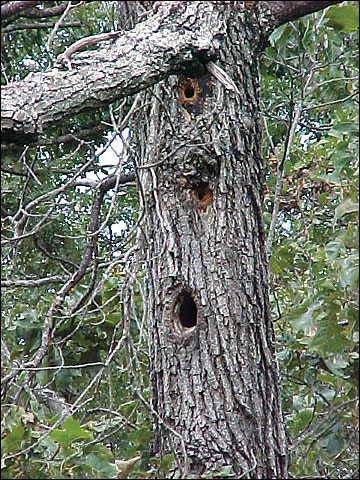
Dead standing tree, or snag, serves as habitat for wildlife. Image courtesy University of Missouri Extension.

Dead standing trees, or snags, serve as habitat for wildlife. Image courtesy University of Missouri Extension.


This is Passport to Texas

A snag is a standing, dead tree.

08— Most homeowners don’t like them because they can be a problem if it’s about to fall on the house, or the car, or the playscape.

Texas Parks and Wildlife ornithologist, Cliff Shackelford, recommends removing snags that pose risks to safety. However…

13— If that dead tree is not going to fall on anything—it’s full of life. It’s where the woodpeckers are feeding because there are beetles therein; it could be where the owl is going to perch that is going to eat the rodents on your property.

Cliff shares how he handled two dead trees in his yard.

17— We measured how far they were from falling on anything—like the house. So, one of them was 21 feet from the house; I made them cut it down to 19 feet. So, that way, if it fell over, it wasn’t going to be able to even jump that extra two feet and hit the house.

Cliff Shackelford says his reward for sparing the snag is great wildlife viewing and extra money in his pocket.

14— When we left that trunk of the three—that 19 feet—we saved money. Because, that’s the heaviest part of the tree to haul off. So, we saved several hundred dollars by just leaving that 19 foot of the trunk; and the wildlife love it.

Plus, he chipped the broken limbs, mixed them with horse manure, and once it aged, had garden mulch. Find more wildscaping tips on the Texas Parks and Wildlife website.

That’s our show…Funding provided in part by Ram Trucks. Guts. Glory. Ram

For Texas Parks and Wildlife…I’m Cecilia Nasti.

Giving Back to the Land

Friday, July 17th, 2015


This is Passport to Texas

One of Frank Gore’s earliest outdoor memories is of sleeping on the floor of a duck blind under his father’s coat when he was just 4 years old.

03- I come from a long family history of duck hunters.

The tradition continues with his kids and grand-kids on his Jackson County property, which he bought in 2007.

07- We wanted a place for the family to hunt. But, it became much more than that over time. It’s actually turned into a chance to give a bit back.

About 20 miles from Palacios, the Gore Family Farm is in the flyway; Mr. Gore converted it from rice and cattle production into wetlands and upland habitat; restoration work that earned him a Lone Star Land Steward Award.

16- In the cattle grazing days, they had planted Bermuda grass and it was pervasive; it was really detrimental to the native songbirds as well as the upland birds we were trying to foster on the place. So, we began the process of habitat restoration and rehabilitation.

In the end, landowners like Frank Gore preserve Texas– natural heritage for their descendants, and all Texans.

14- The main justification [of the restoration work] is so that my grand-kids will know what a covey of quail sound like calling each other in the morning. And, what it looks like to send up 300 ducks off of a pond, and watch ’em whirl around and come back in. And that’s something your money just can’t buy.

The Wildlife and Sport Fish Restoration Program supports our series.

For Texas Parks and Wildlife…I’m Cecilia Nasti.
