Archive for the 'Habitat' Category

Aquatic Invasives

Monday, May 11th, 2015
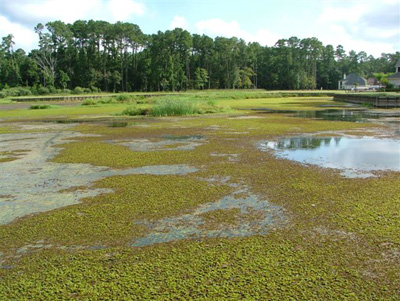
Giant Salvinia overtaking Lake Conroe

Giant Salvinia overtaking Lake Conroe

This is Passport to Texas

Giant Salvinia…tilapia…zebra mussels… are just three of the many non-native, invasive aquatic species threatening Texas rivers and lakes.

11-As a whole, anytime you get an invasive species into the state–whether it be a new one or one we are currently dealing with–they certainly cause a lot of economic as well as environmental negative impact.

Brian Van Zee is a TPW Inland Fisheries Regional Director.

15- When an invasive species gets introduced into a new system, they typically have very few predators or natural control mechanisms in place. So, they are able to take over and dominate those systems; that just creates a lot of problems for a lot of our native species.

Giant salvinia quickly creates huge, thick mats of vegetation on lakes, reducing light penetration that results in oxygen depletion; tilapia outcompete native fishes for food, thus threatening their populations; and zebra mussels adhere to municipal water intake pipes,
blocking water flow, and costing cities millions of dollars in repairs and maintenance.

05-We have seven lakes in the state that have confirmed zebra mussels in them.

Brian Van Zee returns tomorrow to talk about the latest zebra mussel infestation and how it happened. Learn more about aquatic invasives at www.texasinvasives.org.

The Sport Fish Restoration program supports our series and works to increase fishing and boating opportunities in Texas.

For Texas Parks and Wildlife…I’m Cecilia Nasti.
Texas Big Game Awards

Friday, May 1st, 2015
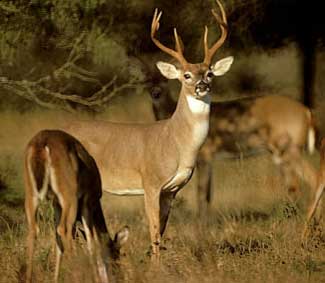
White-tailed buck

White-tailed buck

This is Passport to Texas

2015, marks the 24th year of Texas Big Game Awards.

17-Texas Big Game Awards started in 1991 as a partnership between Texas Wildlife Association and Texas Parks and Wildlife, as a means to document the great, big game resources that we have in the state. And also, to celebrate our hunting heritage and recognize young and new hunters.

Justin Dreibelbis is the new Private Lands and Public Hunting Program Director at Texas Parks and Wildlife Department. When we spoke, he was the Hunting Heritage Director at the Texas Wildlife Association. Texas hunters sent in their entries, which trained scorers evaluated using criteria specific to each region.

22- And then, we also have unscored categories, which are our youth division and our first harvest division. A youth division entry is any youth hunter who takes a native big game animal in the state. A first harvest division is for a person who take their first native big game animal in the state of Texas-whether they-re eight years old or 80 years old.

The Texas Big Game Awards recognizes large antlers with the understanding that they are a direct result of well-managed habitat, said Dreibelbis. Winners receive their awards at regional banquets. The first is May 16 for regions 5, 6 & 7 in Lufkin. Find additional information at texasbiggameawards.org

The Wildlife Restoration program supports our series.

For Texas Parks and Wildlife…I’m Cecilia Nasti.
Great Texas Birding Classic Underway

Friday, April 24th, 2015
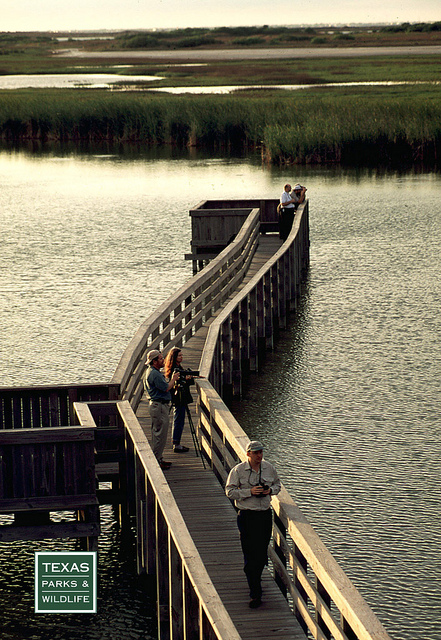
Coastal bird watchers

Coastal bird watchers


This is Passport to Texas

Any novice or seasoned birder worth their field guide comes to Texas for the Great Texas Birding Classic – a statewide bird watching tournament, April 15 to May 15.

08— It isn’t all about winning, it really is about fun. And I’m really happy to see that people are finally realizing this isn’t just
for hardcore birders.

Shelly Plante oversees Nature Tourism for Texas Parks and Wildlife. Don’t be surprised if during the tournament you see out of town birders roaming your communities.

38—We do see some traveling. We have a statewide weeklong tournament and there’s a statewide big day tournament. So, you can do 24 –hours and go wherever you want – from the Hill Country to the coast; you aren’t bounded by regional territory like you are in some of the other big day competitions. The statewide weeklong is six days of birding anywhere in the entire state. And so, we have a lot of teams doing that. Even though it’s a huge commitment, it’s a lot of fun. A lot of them go from west Texas, all the way down to south Texas, all the way to the upper Texas coast to the Pineywoods. So, they’re seeing 350 or more birds in a week; and, you can’t do that in a lot of states.
So, Texas is unique.

Winning teams choose where to direct funds for habitat conservation. Check out what the birders are seeing this year at birdingclassic.org.

That’s our show for today… Funding provided in part by Ram Trucks. Guts. Glory. Ram

For Texas Parks and Wildlife…I’m Cecilia Nasti.
Wildlife: The Birds and the Beans

Thursday, April 23rd, 2015
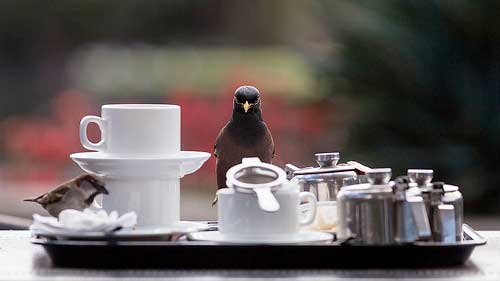
Birds and coffee, image from coffeekrave

Birds and coffee, image from coffeekrave


This is Passport to Texas

If you’re morning ritual includes savoring a cup of coffee, you might want to know what’s in your mug, and how it’s affecting birds.

04— We’re talking about shade grown coffee versus full sun coffee.

Cliff Shackelford is a non-game ornithologist with Parks and Wildlife. Farmers in Mexico, Central and South America who grow coffee in full sun replace migratory bird habitat with coffee shrubs, but not so when its shade grown.

07—They don’t eliminate all the native forest. They take out some of the forest, and plant the coffee within the forest.

Shade grown coffee tastes the same as sun grown, but is better for birds. The remnants of native forest that harbor coffee shrubs attract a variety of overwintering species.

13— This is important for us as Americans because a lot of these birds are backyard birds. If there’s a complete change of the vegetation that the birds are keying in on, then they are going to have to keep moving.

And that could affect what we end up seeing in our backyards in spring and summer. You can help migratory birds by drinking shade grown coffee.

06—We’re also calling it bird friendly coffee. And, even if you drink [bird friendly coffee] part of the time, it’s better than none
of the time.

Look for the bird friendly seal of approval on bags of coffee, or ask your barista if your hot beverage is made in the shade.

For Texas Parks and Wildlife…I’m Cecilia Nasti.
TPW Mag: Sharing Responsibility for Nature

Tuesday, April 14th, 2015
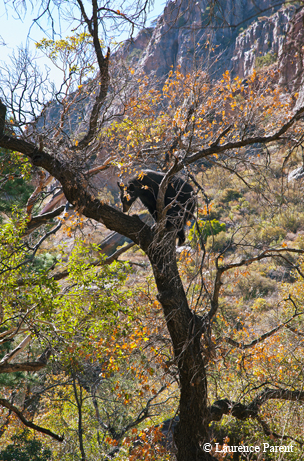
A black bear looks for a beehive in a tree in Big Bend's Chisos Mountains

A black bear looks for a beehive in a tree in Big Bend’s Chisos Mountains


This is Passport to Texas

The Chihuahuan desert ecosystem sprawls across Texas and Mexico, making the conservation of its flora and fauna a shared responsibility between the two nations. However, writer Melissa Gaskill says the conservation philosophies of the countries differ.

21—In this country, we form something like Big Bend National Park, and it’s just for the recreation and the wildlife, and people don’t live there. On the Mexican side, they have more of sort of what we would see as a conservation easement approach. Where an area is protected, but there are still homes and ranches and villages—life goes on—but they behave a little differently toward nature.

Gaskill wrote the article Nature Without Borders for the April issue of Texas Parks and Wildlife magazine. Although the US and Mexico share conservation challenges, they also share the successes.

31—One of the successes is black bears. They disappeared on this side back in the 1950s, but given the remoteness of the country on the Mexican side, they remained there, and once they started protecting them actively in Mexico, and we started having all these protected lands on this side that provided good habitat, the bears on their own, crossed the river and repopulated in the Big Bend area. And, they’re doing pretty well; they have the potential to spread elsewhere within Texas where there’s good habitat.

Learn more about the flora and fauna of this area of Texas when you read Melissa Gaskill’s article Nature Without Borders in the April issue of Texas Parks and Wildlife magazine.

The Wildlife and Sport Fish Restoration program supports our series.

For Texas Parks and Wildlife…I’m Cecilia Nasti.
