Archive for the 'howto' Category

Tips for Making Venison Sausage

Friday, November 26th, 2010
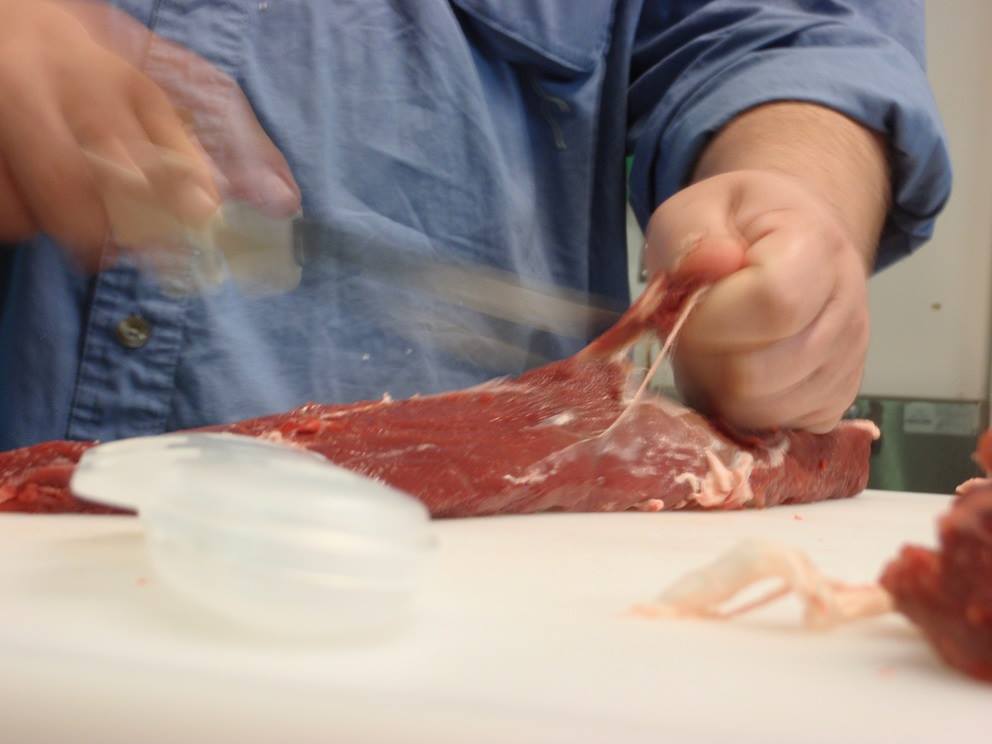
 

Processing venison at Feral Kitchen

Processing venison.

This is Passport to Texas

Sausage is an easy, tasty way to utilize the scraps and organ meat of large game animals like deer. The trick to making good sausage, says Jesse Griffiths, a hunter and chef who teaches people how to process and cook venison, is to keep everything cold—from the ingredients to the equipment.

You want the fat and the protein to remain separate, so when you mix it together, they’re going to bind together and form this cohesive mass; that’s going to greatly affect the texture of the sausage and keep the fat from leaking out of the sausage which is going to moisten the end product, and keep that venison really tender, and make the sausage a really nice texture—sliceable, and not crumbly or grainy.

And then, the one step in your recipe is where you put the chilled ground meat into your kitchen aide stand mixer, and mix it again with water. Could you explain why you do that?

You’ve got it ground to the point where you want it already. And now you want to bind those and make those stick together, like, literally become sticky. And by using the paddle attachment and by whipping it a little bit, you are creating a bind to the sausage, where the fat and the proteins are stuck together.

Cold water lowers the temperature and maintains the bind between the fat and the protein, and also reduces the likelihood of the fat separating out, and at the same time it distributes the flavorings—the salt and the seasons that are in the sausage—and makes them more homogeneous within the sausage.

We have a venison sausage recipe at www.passporttotexs.org. Our show receives support from the Sport Fish and Wildlife Restoration program, working to increase fishing and hunting opportunities in Texas.

For Texas Parks and Wildlife…I’m Cecilia Nasti.
___________________________________________________

Venison Jalapeno Summer Sausage
Chris Houston, Feral Austin

I make these into 1 lb logs using 1.5” fibrous casings, but it’s also fun to make larger ones that can be a real conversation piece at a party or bbq.  To take it up a notch, consider making your own mustard to accompany it.

Ingredients

  • 5 pounds meat – venison, feral hog, or a combination (at least 20% fat content – otherwise you’ll need to add fatback)
  • 2 tablespoons Kosher salt
  • 2 teaspoons cracked black pepper
  • 2 teaspoons mustard seed
  • 2 teaspoons garlic powder
  • 5 fresh jalapenos, seeded (unless you really like the heat)
  • 1 teaspoon Instacure #1

Directions

  1. Coarse grind the meat and fat through a ⅜” grinder plate.
  2. Grind half of the mixture through the same plate yet again.
  3. Stuff tightly into 1 ½” (or larger) Fibrous Casings
  4. Let cure in the refrigerator for 1-3 days then smoke until the internal temperature reaches 152 degrees.

I like to use hickory with this recipe, but oak works well too.

I start my smoker at 140-145 deg for 1 hour without water to dry the sausage.  Then add a water pan and smoke at 155 degrees for 1 hour.  Then increase the temperature to 175 until the internal temperature of the sausage reaches 152 degrees (about 2 hours).

No Waste Venison Cookery

Thursday, November 25th, 2010

This is Passport to Texas

By now many hunters have ventured into the field at least once to track and harvest deer; for most hunters, the act isn’t about bringing home a trophy—it’s about spending time in nature and bringing food home for the table. It’s also about developing a connection with the food they eat, which is something hard to do with plastic wrapped cuts of meat on Styrofoam trays, stamped with “sell by” dates.

Harvesting your own meat may not be easy, but you definitely know what you’re getting.

Jesse Griffiths is a hunter and chef, and teaches classes on processing and cooking venison. He says oftentimes hunters unnecessarily waste meat.

19—I don’t think that people are utilizing as much as they could or should, which is really why I wanted to put on this class. I wanted to show people how, because it’s just not in our culture anymore to know how to do that. So, it is by no fault of most hunters. I think that they would. I mean, don’t throw the liver away. Now, if you’re going to make 30 pounds of sausage, if you don’t like the taste of liver, put it in there and you’ll get the nutrition.

If in the past you’ve left sausage making to the processor, perhaps it’s time to make your own. Tomorrow, Chef Griffiths offers tips on doing just that.

06—You’ve got it ground to the point where you want it already, and now you want to bind those and make those stick together—like literally become sticky.

That’s our show…with support from the Sport Fish and Wildlife Restoration program, working to increase fishing and hunting opportunities in Texas.

For Texas Parks and Wildlife…I’m Cecilia Nasti.

Campfire Cooking

Wednesday, January 13th, 2010

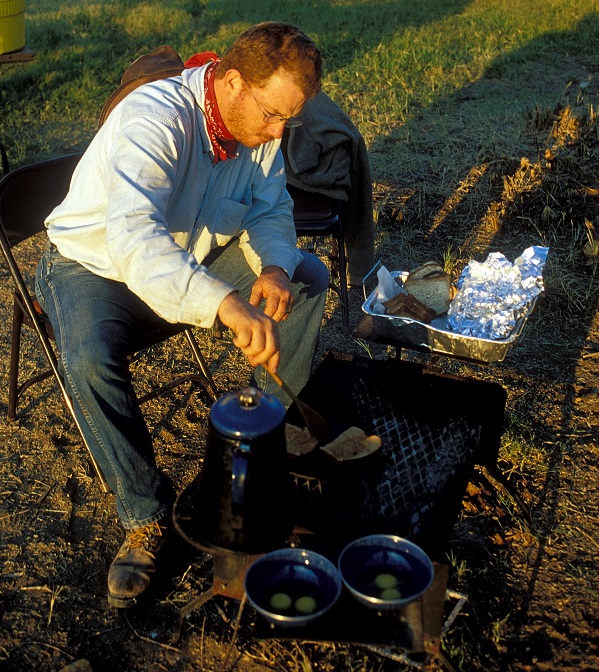
Campfire cooking

Campfire cooking


This is Passport to Texas

As author of the Texas Campground Cookbook, Roger Arnhart knows a few things about food preparation. He’s perfected recipes for everything from pot roast to pastries – creating his culinary masterpieces in rather out of the way locales, with unusual low tech equipment.

If you’re ready to test your campground culinary creativity, Arnhardt says two pieces of cooking apparatus that no open-air chef should leave home without are a cookie sheet and four aluminum soda cans…emptied.

A pit grill is a wonderful thing to cook on. Unfortunately the grill is fixed so you can’t control how high that grill is over your fire. So one of the things that I recommend that every camper does, is go buy aluminum cookie sheets. Along with what I call my riser, those are coke cans, put that cookie sheet on top of the coke cans and you can bring it up to the proper height. If it’s too high you can crush the coke cans and make it about a three-inch riser. And then you start your charcoal on the cookie sheet, under a pit grill.

He says a cookie sheet also comes in handy when cooking on a waist-high grill.

Put your charcoal on the cookie sheet, and then slide the cookie sheet under the waist high and you’ve got a perfect fire. And when you’re done cooking you let the fire burn out and the next morning all of your coals are in your cookie sheet, to dispose of them properly.

Find more ways you and your family can get the most our of the outdoors on the TPWD web site.

That’s our show for today…thank you for joining us. For Texas Parks and Wildlife, I’m Cecilia Nasti.

Prescribed Burning, 2

Tuesday, January 12th, 2010

This is Passport to Texas

Fire’s always played a vital role in the creation of healthy ecosystem. Yet, as Europeans settled Texas, fire suppression was the name of the game.

That’s correct. As Europeans settled Texas, the occurrence of fire went down, because nobody obviously wants to have their house burned up.

David Veale is biologist for the M. O. Neasloney (nez-low-NEE) WMA in Gonzales County. On January 16 he leads a prescribed fire workshop at the WMA.

We start off with the historical perspective of fire, you know, what some of the fire intervals were. The native Americans did use fire to manage some of their grassland communities. And, so why it’s important to reintroduce that fire into the landscape; we also talk about what fire can do, and what is the role of fire in vegetation management.

And that’s just the beginning of what participants can expect…although Veale says the workshop is simply an overview.

You know, you can give somebody the information, and you can talk about it on paper, but until they’re actually put fire on their actual place where they’re responsible for that fire, that’s a big hurdle to get over.

Veale recommends after the workshop, landowners and managers consider joining prescribed burn associations.

We have a lot of them popping up throughout the state. And it’s a pooling of resources, it’s a pooling of expertise—it’s really a good thing.

That’s our show… supported by the Wildlife Restoration program. For Texas Parks and Wildlife…I’m Cecilia Nasti.

Prescibed Burning, 1

Monday, January 11th, 2010

This is Passport to Texas

We’re taught from a young age to prevent fires. What we’ve forgotten is that nature relies on fire to flourish.

When you look at the historical occurrence of fire throughout the state, it’s something that pretty much every ecosystem in the state evolved with. All of our plant communities were evolved with fire at some certain interval—that’s going to differ throughout the state. But it’s been a pretty formative force in Texas ecology.

David Veale is a biologist for the M. O. Neasloney (nez-low-NEE) WMA in Gonzales County. He says we need reeducation about fire’s benefits.

And so we want to show landowners that it’s a responsible land management practice when applied correctly, when applied safely. And it’s something that’s really going to benefit not only your wildlife habitat, but generally your livestock program as well.

On January 16, Veale will lead a prescribed burning workshop at the M.O. Neasloney WMA.

The workshop is primarily targeted at landowners and land managers—the folks that are actually going to have the management decision to put fire on the ground and the responsibility for that. But it’s really kind of an introduction to burning. Because we’re not going to tell you everything you’d ever need to know about running a complete fire program in one day. So, this is just kind of a good overview; some of the things that need to be considered before a fire management program is started. And once that decision is made, it shows you some of the avenues for receiving some more training.

We have information about the workshop at passporttotexas.org. That’s our show… supported by the Wildlife Restoration program

For Texas Parks and Wildlife…I’m Cecilia Nasti.
________________________________________________________

January 16, 2010 — M.O. Neasloney WMA — Prescribed Fire Workshop — This workshop is designed to give landowners and managers a basic understanding of the use and application of prescribed fire in a wildlife and/or grazing management program. Topics will include historical perspectives on fire, the role of fire in vegetation management, fire weather and safety, planning the burn, fire line preparation, suppression equipment and smoke management. Participants will conduct a burn if conditions permit. Bring your lunch, drinks, leather gloves and boots and wear cotton outerwear. Accessible for the mobility impaired. 8 a.m.-4 p.m. (830) 424-3407