Archive for the 'Conservation' Category

TPW Magazine: Seeds of Hope

Monday, October 12th, 2015
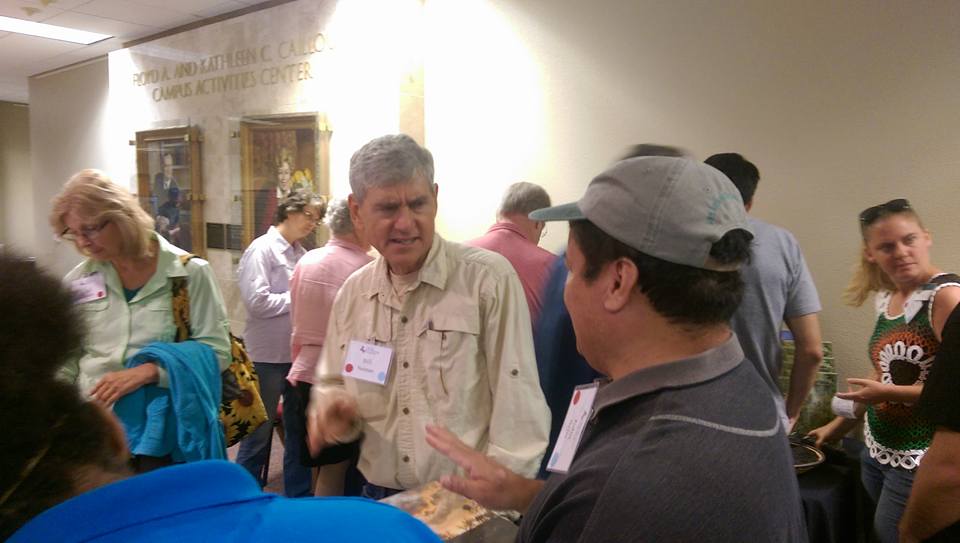
Bill Neiman talking to attendees of the Pollinator Pow Wow, Kerrville, Texas, September 2015. Photo: Cecilia Nasti

Bill Neiman talking to attendees of the Pollinator Pow Wow, Kerrville, Texas, September 2015. Photo: Cecilia Nasti


This is Passport to Texas

Bill Neiman [NEE-man] started saving native seeds and plants when he realized Texas had been losing its indigenous flora to development.

11- He’s truly a visionary in this area. And there were a few people around the state, and he and his wife Jan-in the mid to late 80s-made it a point to seek out these people.

Camille Wheeler wrote about Neiman for Texas Parks and Wildlife magazine. Neiman, who owned a landscaping business, watched non-native plants die without daily watering, when so-called native “weeds” thrived with nothing.

10-He just immediately made the connection: these non-natives are water hogs. He started looking for other people like him.

He found author and native landscaping expert, Sally Wasowski. They met in 1985 when Neiman attended a native plant conference where she gave the keynote.

18-She was challenging the audience. She said: where can we find native plants, and who can be trusted to grow them? And Bill Neiman–he didn’t even know he was going to do this–he just sprang to his feet and shouted out: I will do it! I have a nursery; I’m in Flower Mound, Texas and I’m converting the whole thing to native plants.

There’s more to this fascinating story, Seeds of Hope, by Camille Wheeler; find it in the October issue of Texas Parks and Wildlife magazine.

That’s our show for today… Funding provided in part by Ram Trucks. Guts. Glory. Ram

For Texas Parks and Wildlife…I’m Cecilia Nasti.
Whoopers Flying into Texas

Wednesday, October 7th, 2015
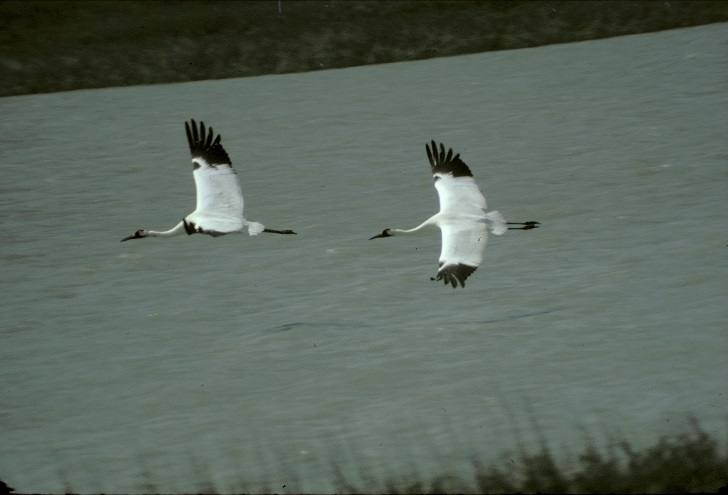
Whoopers in flight.

Whoopers in flight.


This is Passport to Texas

A flock of 308 endangered whooping cranes lives in Texas from October through April.

06- We fully expect to see the first of our migrating whoopers come into Texas in mid-to-late October.

The birds migrate from their summer breeding ground in Wood Buffalo National Park in Canada to their winter home at the Aransas National Wildlife Refuge in Texas.
Texas Whooper Watch coordinator, Mark Klym, says the species has rebounded from a low of just 15 cranes in the 1940s to about 600 today worldwide.

21-There are also two other flocks in the US. One that migrates from Wisconsin to Florida, and a reintroduced flock in Louisiana. We really need at least one more flock before we can consider it relatively safe to start considering down-listing them. Or, we need a thousand birds in the Aransas to Wood Buffalo
National Park flock.

While the majority of Texas cranes spend the winter at the refuge, some end up in other parts of the state.

13-In recent years we’ve seen them moving up and down the coast, as well as inland–as far as Wichita Falls for the winter. So, it is possible to see whooping cranes during the winter almost anywhere in the eastern half of the state.

Be on the lookout for whoopers, and if you see them, add your observations to Texas Whooper Watch. Find details in the Texas Nature Tracker section of the Texas Parks and Wildlife website.

For Texas Parks and Wildlife…I’m Cecilia Nasti.
H. Yturria Land & Cattle Company

Wednesday, September 30th, 2015

This is Passport to Texas

Take a ride with Danny Butler around the Punte del Monte Ranch in deep south Texas and you start to get an idea of his appreciation of all things wild.

09—We have a lot of white-tail, a lot of turkey, lots of quail. In my opinion, it’s better habitat now than it was 150 years ago.

The Butlers are the 2015 Lone Star Land Steward Award recipients for the South Plains Ecoregion. Three generations of Danny’s family owns and operates the 23-thousand acre ranch; they and their ancestors have been at this a long time.

08—Going on 160 years, which is getting rarer and rarer in Texas that lands pass through generations and generations and stay together.

Their H. Yturria Land & Cattle Company has become less reliant on cattle and more focused on wildlife, including hunting. To make the habitat work for wildlife, they improved water resources on their land. Randy Bazan is ranch foreman.

06—We’re roller chopping this pasture here. It makes an indentation in the soil, and that helps gather our rainfall.

This improves the diversity of forbes and grasses, making the land more productive. While native wildlife hunts make up the bulk of the ranch income, the family’s expanded into exotics. Richard Butler.

08—If you don’t diversify, get other sources of income coming in from the property you’ve got, eventually you won’t have the property.

Nominate a landowner for a Lone Star Land Steward Award. Find out how ion the Texas Parks and Wildlife website.

For Texas Parks and Wildlife, I’m Cecilia Nasti.

TPW TV: Good Guzzlers

Friday, September 25th, 2015


This is Passport to Texas

For most of us, the word “guzzler” has a negative connotation, but not for the groups working to restore bighorn sheep.

04— A guzzler is essentially a rainwater collection system for wildlife.

Mark Garrett is Texas Parks and Wildlife Project Leader for Trans-Pecos Wildlife Management Areas.

09— We’ve got two large panels of sheet metal that collect the rainwater, funnel that down into storage tanks that feed to wildlife friendly watering stations.

Adequate fresh water is essential for the restoration of big horn sheep. During a segment on next week’s Texas Parks and Wildlife PBS Television Series, see how volunteers from the Big Horn Society, Like Kathy Boone, install new guzzlers on the Black Gap Wildlife Management Area.

13— Work projects normally last a couple of days, and they are always in extremely remote areas. For this work project, we’ve had over a hundred people here to help us build two water catchment devices we call guzzlers.

Workers must travel by helicopter to the mountain tops to construct the guzzlers, but volunteer Charlie Barnes says the challenges that come with the work are worth it.

11— This land is suitable for all the game that live here. It was missing one thing. Water. And now it’ll have water. That’s conservation right there.

View the segment on Good Guzzlers next week on the Texas Parks and Wildlife PBS TV series. Check your local listings.

The Wildlife and Sport Fish Restoration Program supports our series. Through your purchases of hunting and fishing equipment, and motorboat fuels, over 40 million dollars in conservation efforts are funded in Texas each year.

For Texas Parks and Wildlife, I’m Cecilia Nasti.

Old Yeller: Not Just About a Boy and His Dog

Tuesday, September 8th, 2015
Fred Gipson, writer of "Old Yeller". Memorabilia from Mason, TX Memorial Library.

Fred Gipson, writer of “Old Yeller”. Memorabilia from Mason, TX Memorial Library.


This is Passport to Texas

Old Yeller by Fred Gipson is—at its heart—a story about a boy and his dog. It’s also about our connection with nature. Gipson gives readers a sense of what it was like to live close to the land in Texas’ Hill Country of the 1860s.

07—He’s talking about hunting—sitting quietly. In which, if you haven’t hunted, you sit for hours listening and watching.

Cynthia Pickens wrote about the book and its author for Texas Parks and Wildlife Magazine. Through his protagonist, a boy named Travis, Gipson reminds all that nature rewards us when we slow down to enjoy it.

25—To him, it was like a picture show. It was like entertainment. And I don’t think many of us realize that that can be the case. If you go out and sit in nature, and if you sit long enough, you will start to see the creatures and the light in the trees and the water playing over the creeks… It is a form of entertainment. It is lovely and peaceful, and anybody can do that. You can do it in your neighborhood; you can do it in your backyard.

Whether you read it as a child, or have young readers in your home, Pickens says Old Yeller is timeless.

20— I think it’s for any reader, and especially any person who’s interested in the Texas outdoors. I hope it would encourage children to go outside and see nature, because it’s a wondrous place. There’s lots to see if you open your eyes and your ears. And, all parents should give their children a copy of Old Yeller for Christmas [laughs].

Find Cynthia Pickens article that looks back at Old Yeller and Texas author Fred Gipson in the August/September issue of Texas Parks and Wildlife Magazine.

For Texas Parks and Wildlife, I’m Cecilia Nasti.
