Archive for the 'Conservation' Category

How to Help Monarchs

Wednesday, March 26th, 2014
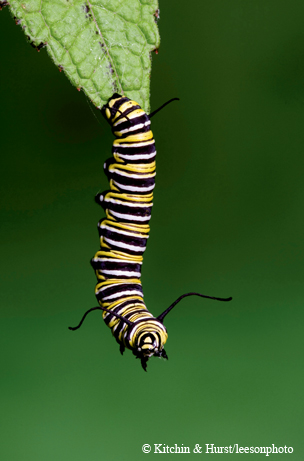
Monarch butterfly life cycle..4th Instar on Joe-Pye Weed.

Monarch butterfly life cycle..4th Instar on Joe-Pye Weed.


This is Passport to Texas

Loss of grasslands to farming and development means fewer “refueling stations” for monarchs during their migration. Master naturalist and writer, Rob McCorkle, says when homeowners living along the butterfly’s migratory route plant milkweed they provide food and habitat for adults and their young.

13— There are different milkweeds in Texas – there are about three predominant types of milkweed: antelope horn, green antelope horn and zizotes is the third one. They’re now becoming more available.

Grasslands aren’t the only monarch habitat disappearing. Logging of fir trees in Central Mexico where monarchs overwinter has severely reduced their roosts. So why provide food and shelter along their migration route if in the end, there’s no place for them to hibernate?

27— That is a good point. The Mexican government in collaboration with the US and Canada have formed a trilateral commission that has studied this impact for several years now. And they’ve taken steps to limit logging and protect the remaining habitat – and have had some success. A single monarch female can lay 300 to 400 eggs. So, the potential is there for the population to rebound to some degree.

Find links to follow monarch’s migration route, learn about installing a monarch friendly garden, and more at passporttotexas.org.

For Texas Parks and Wildlife, I’m Cecilia Nasti.

Monarch Migration Routes:
http://www.learner.org/jnorth/maps/monarch_spring2014.html

Butterfly Garden:
http://www.monarchwatch.org/garden/
Why Monarchs are in Decline

Tuesday, March 25th, 2014

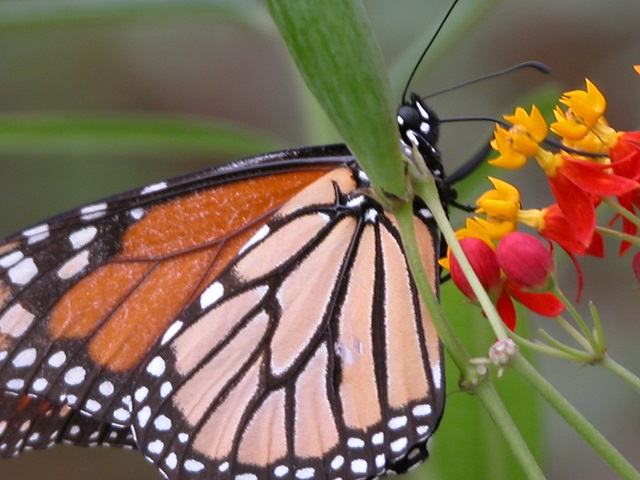
Monarch butterfly

Monarch butterfly


This is Passport to Texas

Fragmentation and loss of habitat creates hardships for monarch butterflies during migration and hibernation.

14— That is being propelled by the elimination of grasslands in the Midwest [where monarchs fuel up during migration] to plant GMO (genetically modified organisms) soybean and corn crops, and to plant crops for biofuels.

Logging in the mountains of Mexico where monarchs overwinter also affects the species. Rob McCorkle wrote an article about the decline of the monarch population for the March issue of Texas Parks and Wildlife Magazine.

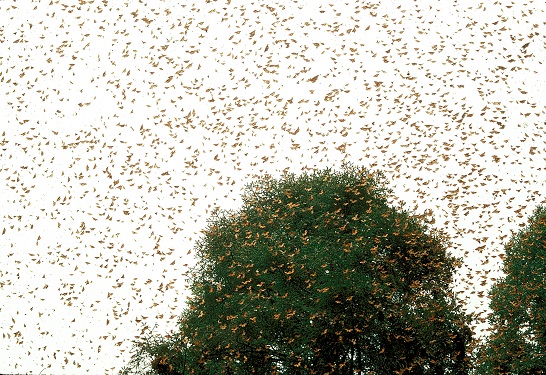
At their peak, a billion monarchs filled the skies; today that number is under 50-million. Yet, each of us along their migratory path can help them on their travels by doing one simple thing.

16— The most significant thing scientists say you that you can do is plant milkweed, because that is the sole species the monarchs depend on to lay eggs for emerging caterpillars to feed on.

Find more information about the kinds of milkweed to plant for monarchs at www.plantmilkweed.org. Tomorrow, the kinds of milkweed best suited for monarchs, and how the US, Canada and Mexico are working together to save this iconic species.

For Texas Parks and Wildlife, I’m Cecilia Nasti.

TPW Magazine: Monarch Decline

Monday, March 24th, 2014

Monarchs at their overwintering site.

Monarchs at their overwintering site.


This is Passport to Texas

Extreme weather and vanishing habitat, have taken a toll on monarch butterflies.

14—To use the oft-worn cliché about a “perfect storm,” that’s sort of what’s happened to the monarchs, unfortunately, and has caused their populations to plummet almost 80% since the winter of 2012.

Rob McCorkle wrote an article about the monarch decline for the March issue of Texas Parks and Wildlife Magazine. Monarchs migrate to Mexico from Canada and the US.

18—The first hit [to the monarchs] was in 2002 when they had a severe freeze in the mountains of Mexico where the population overwinters. Monarchs can take cold weather, but if it rains, or snows and they get wet – they can’t survive. They died off by the millions that year.

Weather is only part of the equation. Habitat loss is the other.

33—That is being propelled by the elimination of grasslands in the Midwest to plant GMO soybean and corn crops, and to plant crops for biofuels. What that’s done, obviously, is to limit the places where the monarchs go to fuel up for their migration. Also, the overwintering forests in the mountains of Central Mexico have been logged heavily and are being impacted by [tourism] people going to see the monarchs that overwinter there in the fir trees.

More on why monarchs are in decline and how to help — that’s tomorrow. For Texas Parks and Wildlife, I’m Cecilia Nasti.

Conservation: Creating Flow for Paddlefish

Thursday, March 6th, 2014

Paddlefish

Paddlefish


This is Passport to Texas

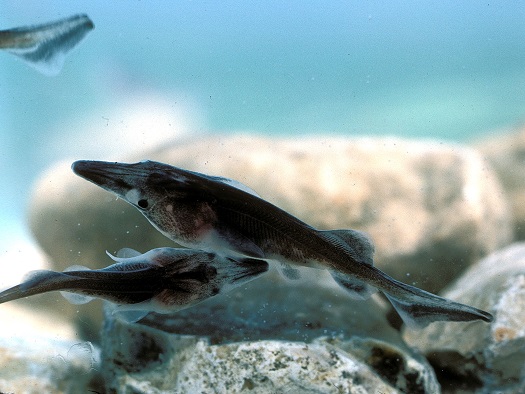
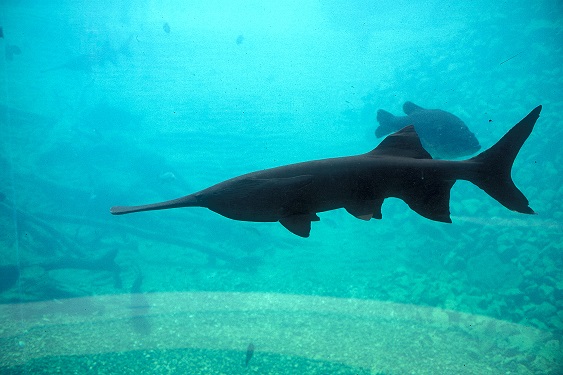
With a huge mouth and long paddle-shaped snout, the prehistoric paddlefish is a threatened species in Texas. In water systems like Big Cypress Bayou, their decline followed river modifications and dam construction [for Lake O’ the Pines reservoir] which altered in-stream flows necessary for their survival.

18—The in-stream flows that are released from the Lake O’ the Pines reservoir are critical for maintaining habitat within the river, as well as for initiating spawning conditions paddlefish need to reproduce.

Kevin Mayes, an aquatic biologist with Texas Parks and Wildlife, says after years of study and restoring key features of the Big Cypress system, the US Fish and Wildlife Service, Caddo Lake Institute, TPW and others, are returning this “big river” species to the ecosystem.

16—Part of that [work] was identifying that paddlefish require spring spawning pulses to support their reproduction So, we integrated those pulses into a flow regime that we call “in-stream flow building blocks” for the Big Cypress Creek.

This spring, researchers plan to release up to 50 radio-tagged paddlefish into the newly restored system, monitoring their movements, and making adjustments to flows based on the data.

The Wildlife and Sport fish Restoration Program supports our series. For Texas Parks and Wildlife, I’m Cecilia Nasti.

Conservation: Restoring the Paddlefish

Wednesday, March 5th, 2014

Paddlefish

Paddlefish


This is Passport to Texas

Weather permitting, Texas Parks and Wildlife, the US Fish and Wildlife Service and Caddo Lake Institute will release up to 50 paddlefish into Caddo Lake and Big Cypress Bayou in East Texas this week.

12—In Texas, it’s listed as a threatened species. Much of its range has been interrupted by damns on rivers; so the habitat just really hasn’t been there for the paddlefish to survive in Texas very well.

Predating dinosaurs, fisheries biologist, Tim Bister, calls the species “big river fish.” Populations exist in rivers like the Mississippi, but remain scarce in Texas waters.

13—It’s been a long time since we’ve collected a paddlefish in the Big Cypress River or Caddo Lake. So, this reintroduction is really more of an experiment to see if paddlefish are going to stay in the system.

Bister says they’ll “radio tag” the fish before release.

38—There’re going to be radio transmitters; there’s going to be three different towers down the stretch of the river, including one at the spillway of Caddo lake. So, every time a fish swims by one of these towers data will be collected. So, why now? What is it about this point in time that makes this seem like the right time? Well, for about the last 10 years, there have been several groups that have been working on establishing recommended flow patterns for The Big Cypress below lake of the Pine. So now that we’ve got some of these recommended flows in place, it’s time to put some fish in there that respond to certain flows, and see how they perform.

Tomorrow: in-stream flows and paddlefish.

The Wildlife and Sport Fish Restoration Program supports our series. For Texas Parks and Wildlife, I’m Cecilia Nasti.