Archive for the 'Education' Category

The Cyclist’s Toolkit

Thursday, November 11th, 2010

This is Passport to Texas

Part of the appeal of mountain biking, is the untamed terrain, however, the rocky trails can be a little rough on your bike.

08—For a beginner, the main things to worry about is do you know how to change a flat? Because if you ride ten miles in and you’ve got to come ten miles back out, you want to have that tire or else its going to be a very long walk.

Dan Oko, author of the Texas Parks and Wildlife guide – Bike Texas, says there are three basic tools that mountain bikers want to pack when heading out for a ride, starting with an Allen Wrench.

08—They have tire levers which are designed to go underneath the tire so that you can get that inner tube out if you happen to puncture it. I would say those are the two and the third thing is to have a chain device in case you break your chain.

Oko encourages riders to take it a step further than just packing those basic tools

23—You should learn to use the tools before you have a problem on the trail because chances are trying to figure it out on the trail will be really difficult. I was up in Cedar Hills State Park, outside of Dallas a couple of years ago, and a couple of guys rode up the trail and about two minutes later – they came back out. One of the guys had broken his chain. They didn’t have a chain tool, I did. When I handed the chain tool to the fellow, he didn’t know what to do with it. I ended up fixing his chain.

According to Oko, most local bike shops are more than willing to teach riders who to make repairs. Find bike trail information on the Texas Parks and Wildlife website.

That’s our show… For Texas Parks and Wildlife…I’m Cecilia Nasti.
______________________________________________________

Be sure to check out the Texas Parks and Wildlife YouTube channel for videos on biking at State Parks and Historic Sites.

Why Autumn Leaves Change Color

Tuesday, November 2nd, 2010

This is Passport to Texas

You can witness some amazing autumn scenery at Lost Maples State Natural Area when the Big Tooth Maples get busy.

06—Autumn’s a good time to come to Lost Maples cuz of the Fall foliage and brilliant colors we have here.

Park Superintendent, John Stuart, says it’s going to be a colorful year due to lots of cool nights and sunny days. The leaves of these maples may be charmed into changing because of the weather, but the real magic…that happens inside these chlorophyll factories.

33—Most of the year, when the leaves are green, you have a lot of chlorophyll in the plant; and that’s what actually feeds the tree and keeps it growing. And if the water supply is cut off and cold weather comes around, then the chlorophyll breaks down and leaves the other pigments remaining. On cloudy warm days, starches form tannins and they make it brown. And If it’s cold and sunny, then the sugars come to bear on the leaf, and they form with the proteins and it makes the beautiful colors we enjoy when we come out here.

It’s not just the colors that are special. They call the trees Big Tooth Maples because their leaves have deep cuts or ridges in them; and you don’t find them many other places.

11—The Ice Age wiped out most of the Big Tooth Maples across the continent. These are just surviving pockets. So they’re lost simply because what are they doing out there by their selves.

That’s our show… For Texas Parks and Wildlife…I’m Cecilia Nasti.
________________________________________________________

Check out the Foliage Color Change Report at Lost Maples State Natural Area.

Cooking Venison

Thursday, October 14th, 2010

This is Passport to Texas

Once deer season arrives freezers will be full of venison. That’s why I attended a Venison Do-It-Yourself class taught by Chef Jesse Griffiths, a hunter and chef from Austin. He says use the correct cooking method when preparing this perfect protein.

18—Either you’re going to cook it a very short amount of time or not even cook it at all—raw in the form of tartar—which is excellent. Or you’re going to cook it where it’s just got a nice brow crust on the outside, and it’s still rare or medium rare on the inside; or, you’re going to cook it at a very slow rate for a long time like a braise or a very slow roast.

Chef Griffiths says slow cooking allows fat, sinew and collagen to melt, which makes the meat juicy and tender.

15—So, braising is a good way, because it’s a moist cooking. You brown it off first, develop flavor, and then cook it in liquid. And so that keeps the moisture in there. Then cook it gently—don’t boil it—you have to get a nice simmer. Keep it in the oven. The secret is just to have patience.

Chef Griffiths also does all his own processing, because prefers to use all parts of the animal, including liver, kidneys, bones and more.

07—I think it’s just a shame to waste anything off of any animal. Especially when we put so much work into hunting.

Read about my experience in Chef Griffiths Venison DIY class—with pictures—in the October issue of Texas Parks and Wildlife magazine.

That’s our show…with support from the Sport Fish and Wildlife Restoration Program…For Texas Parks and Wildlife…I’m Cecilia Nasti.
_____________________________________________________________

The following recipes are not from Chef Griffiths, but tasty just the same, and a great way to use the perfect protein known as venison.

Venison Jerky Recipe
Venison Tamales

Do-It-Yourself Venison Processing

Wednesday, October 13th, 2010


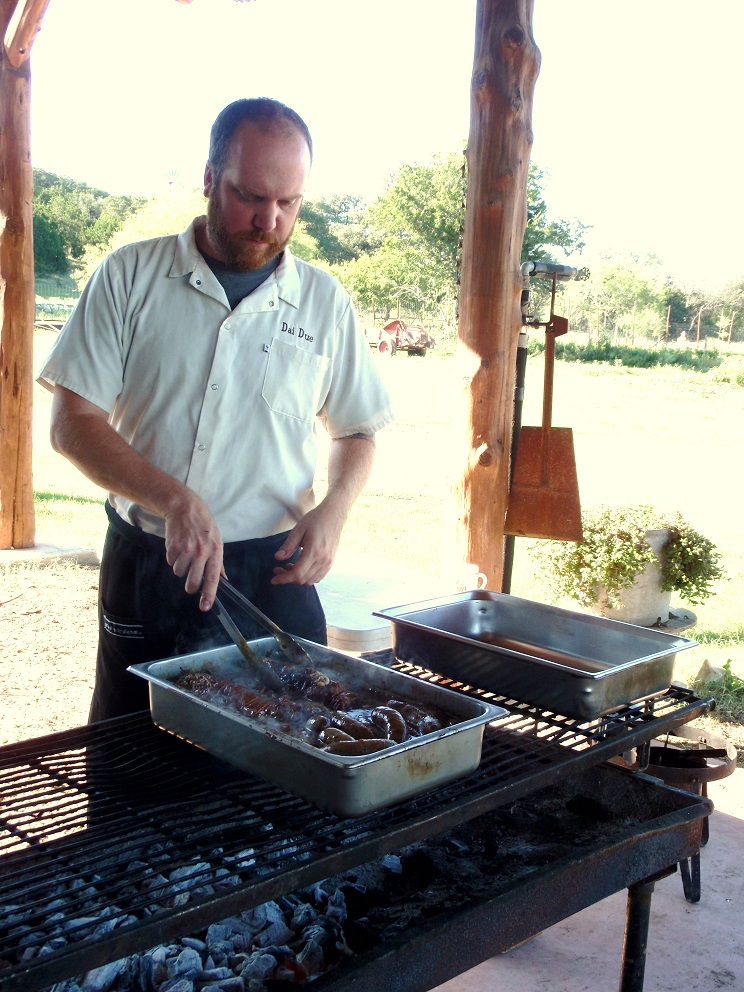
Jesse Griffiths at Montesino Farm in Wimberley grilling wild game.

Jesse Griffiths working with wild game on the grill

This is Passport to Texas

I love to cook and I love venison. So I attended a Venison Do-It-Yourself class taught by Jesse Griffiths, a hunter and professional chef in Austin, who says it pays to process your own deer.

:29—You know, there’s just a lot of reasons why doing it yourself is so much better… because, you don’t know what they’re mixing it with. Maybe you’re not even getting your own deer back. Maybe the people that they’re mixing your deer with –they didn’t take very good care of their deer. Maybe they did the whole, carry it around on the top of their Suburban in some hot weather for awhile. So, you don’t really know. And by putting it in your own hands, it’s really going to do everybody a little more good.

Chef Griffiths advocates using all of this perfect protein cooking.

:12—We’re going to use the liver and the kidneys and the bones, and the neck—everything today. I just want to show people how good that stuff is and if you’re taking the time to kill it, then take the time to enjoy every little bit of it, too.

Throughout the class we watched as Chef carved the venison into familiar cuts of meat: loins, ribs, cutlets, roasts, and flank steaks. After cutting came the cooking.

:05—I want to get people beyond the bacon, jalapeno situation that most game cooking is in.

Tomorrow: how to maximize the flavor of venison. You can also read about, and see pictures from, my Venison Do-It-Yourself experience in the October issue of Texas Parks and Wildlife magazine.

That’s our show…with support from the Sport fish and Wildlife Restoration program…For Texas Parks and Wildlife…I’m Cecilia Nasti.

Archery Levels the Playing Field

Tuesday, October 12th, 2010

This is Passport to Texas

It’s true for many team and individual sports that unless you have a certain level of physical agility and strength you’re not going to excel…except if that sport is archery.

13—If you were a petite little fourth grader, you could shoot at the same time as the high school jock and you may win. So, it’s said that it is the only sport where boys and girls can compete at the same time on the same team.

Burnie Kessner is archery coordinator for Texas Parks and Wildlife. He says archery levels the playing field.

13—Physical ability doesn’t even matter. A young man at [one of] our state tournaments had Down’s Syndrome; he was on the shooting line with everybody else. At the national tournament, there was a young man who was visually impaired on the shooting line with everyone else who was not visually impaired. And, the only difference was, he had a sighted person standing a little behind him, giving him the cues, “a little higher, a little lower, left, right, shoot.” So, it’s an even playing field, and that’s one of the fundamentals of this program, is that the equipment is standardized. Everybody has the same equipment.

The Texas National Archery in the Schools program certifies teachers in one-day intensive workshops to teach the sport to students of all ages and abilities. Find details on the Texas Parks and Wildlife website.

That’s our show… our series receives support from the Sport Fish and Wildlife Restoration program Program…working to increase fishing, hunting, shooting and boating opportunities in Texas…For Texas Parks and Wildlife…I’m Cecilia Nasti.
