Archive for the 'Education' Category

Prescibed Burning, 1

Monday, January 11th, 2010

This is Passport to Texas

We’re taught from a young age to prevent fires. What we’ve forgotten is that nature relies on fire to flourish.

When you look at the historical occurrence of fire throughout the state, it’s something that pretty much every ecosystem in the state evolved with. All of our plant communities were evolved with fire at some certain interval—that’s going to differ throughout the state. But it’s been a pretty formative force in Texas ecology.

David Veale is a biologist for the M. O. Neasloney (nez-low-NEE) WMA in Gonzales County. He says we need reeducation about fire’s benefits.

And so we want to show landowners that it’s a responsible land management practice when applied correctly, when applied safely. And it’s something that’s really going to benefit not only your wildlife habitat, but generally your livestock program as well.

On January 16, Veale will lead a prescribed burning workshop at the M.O. Neasloney WMA.

The workshop is primarily targeted at landowners and land managers—the folks that are actually going to have the management decision to put fire on the ground and the responsibility for that. But it’s really kind of an introduction to burning. Because we’re not going to tell you everything you’d ever need to know about running a complete fire program in one day. So, this is just kind of a good overview; some of the things that need to be considered before a fire management program is started. And once that decision is made, it shows you some of the avenues for receiving some more training.

We have information about the workshop at passporttotexas.org. That’s our show… supported by the Wildlife Restoration program

For Texas Parks and Wildlife…I’m Cecilia Nasti.
________________________________________________________

January 16, 2010 — M.O. Neasloney WMA — Prescribed Fire Workshop — This workshop is designed to give landowners and managers a basic understanding of the use and application of prescribed fire in a wildlife and/or grazing management program. Topics will include historical perspectives on fire, the role of fire in vegetation management, fire weather and safety, planning the burn, fire line preparation, suppression equipment and smoke management. Participants will conduct a burn if conditions permit. Bring your lunch, drinks, leather gloves and boots and wear cotton outerwear. Accessible for the mobility impaired. 8 a.m.-4 p.m. (830) 424-3407

Nature & Child Development, 2

Thursday, December 17th, 2009

This is Passport to Texas

To unwind from a demanding day at work or school, a simple change of scenery may do the trick.

Research and theory suggest nature is very supportive of human functioning.

Dr. Andrea Faber Taylor studies the connection between our environment and behavior at the University of Illinois. And her research has revealed what we’ve thought all along: nature, even if it’s just a small patch of green, can renew our minds.

Even a view of a green space is beneficial. So, it suggests to us that nature, and even a little bit of trees and plants makes it [a place that’s] restorative.

So what does nature offer that other settings or activities and don’t? Attention restoration theory provides an explanation.

Environments that might be restorative or helpful have characteristics that engage our attention, but in a very gentle way. For an environment to be restorative there’s room in your mind for reflective thought. A space maybe doesn’t need to be huge if it has enough richness and enough depth to engage our minds and hold our attention, but again, in a gentle way.

Taylor says video games and television are too riveting to be restorative. So, tonight: instead of the TV, try a walk in the park and see how much more refreshed you feel.

That’s our show… For Texas Parks and Wildlife…I’m Cecilia Nasti.

Nature & Child Development, 1

Wednesday, December 16th, 2009

This is passport to Texas

Could spending more time in nature help kids with attention-deficit hyperactive disorder?

The research so far suggests that there’s a relationship between contact with nature or playing in green space and improvements in attentional functioning.

Dr. Andrea Faber Taylor researches child environment and behavior at the University of Illinois. In one study, she had children with ADHD take guided, 20-minute walks in a downtown area, a neighborhood, and a city park, and afterward, tested their ability to concentrate.

What we found was that after the children walked in the park they generally scored higher on the measure of attention. And surprisingly, the neighborhood and the downtown area were not significantly different in scores. That said to us, there’s something about the park that makes it, perhaps, more restorative than the other two settings.

Taylor’s findings match other research as well, which suggest it’s the setting, not just the activity, that’s important.

Based on our work and the work of others, we feel very confident that children benefit from contact with nature or even just what we call green space, a small pocket of trees and grass. Certainly, we’re not suggesting that it’s going to cure a child from ADHD, but it appears to, at least, temporarily reduce their symptoms.

That’s our show…For Texas Parks and Wildlife

Hunter Education: Using a Hunting Harness

Tuesday, December 15th, 2009

This is Passport to Texas

Parents harness their kids into high chairs to keep them from taking a tumble. Hunters should always use a similar device called a fall restraint system that keeps them safely tethered to elevated stands.

Most of them fit like a fishing vest, but they have straps that go under your legs and secure it to your body.

Hunting education coordinator, Terry Erwin, says not all fall restraint systems are created equal.

When you’re going into an elevated stand of any type, you should always use a tree stand manufactures association approved safety harness. And, if it’s not TMA approved, then you don’t want to use it because it’s not going to be the one that will protect you the most.

For the restraint system to work properly, it must fit snugly around the body, with no slack in the tether.

Tether yourself, or secure yourself, above your head, so that there‘s no slack in the harness itself and the tethering line. So, if you were to accidentally fall asleep and lean forward, it would catch you within about 3 or 4 inches.

Finally, before using a fall restraint system in the field, Erwin says—give it a test run.

Go out and give it a try. Climb with it; secure yourself going up, and also secure yourself coming down.

Find hunter safety information on the Texas Parks and Wildlife website.

That’s our show…We receive support from the Sport Fish and Wildlife Restoration Program…funded by your purchase of hunting and fishing equipment and motorboat fuel…For Texas Parks and Wildlife I’m Cecilia Nasti.

Tips for Cooking Venison

Wednesday, December 9th, 2009

Wild Game for dinner

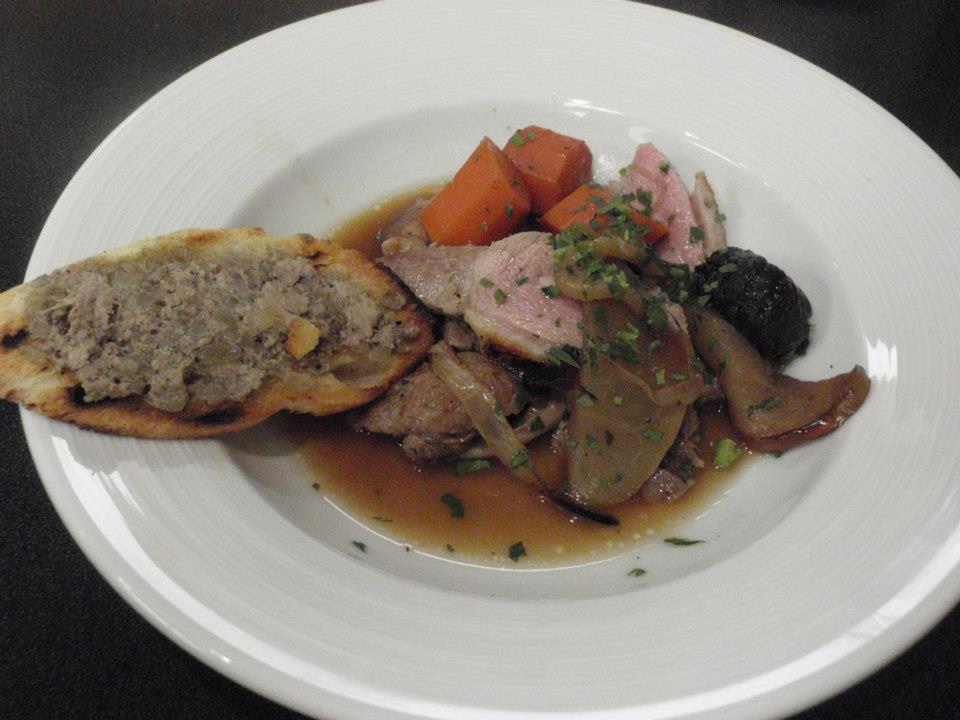
Wild Game for dinner, photo © Cecilia Nasti


This is passport to Texas

We’re in the thick of fall hunting season, which means venison is on the menu. When cooking this perfect protein, it’s important to use the correct method to achieve the best flavor and texture.

Either you’re going to cook it a very short amount of time or not even cook it at all—raw in the form of tartar—which is excellent. Or you’re going to cook it where it’s just got a nice brow crust on the outside, and it’s still rare or medium rare on the inside; or, you’re going to cook it at a very slow rate for a long time like a braise or a very slow roast.

Jesse Griffiths is a hunter and professional chef in Austin. He says slow cooking allows the fats, sinews and collagen to melt, which makes the meat juicy and tender.

So, braising is a good way, because it’s a moist cooking. You brown it off first, develop flavor, and then cook it in liquid. And so that keeps the moisture in there. Then cook it gently—don’t boil it—you have to get a nice simmer. Keep it in the oven. The secret is just to have patience.

Chef Griffiths also does all his own processing, because he uses all parts of the animal, including liver, kidneys, bones and more.

I think it’s just a shame to waste anything off of any animal. Especially when we put so much work into hunting.

We have a venison recipe from Chef Griffiths at passporttotexas.org.

That’s our show…For Texas Parks and Wildlife…I’m Cecilia Nasti.
_____________________________________________________
Stuffed Venison Flank
Recipe by Jessee Griffiths of Dai Due Supper Club, Austin, Texas

Tomatoes can be added to this dish to make a tomato-based sauce instead of just stock. Dried Fruit, mushrooms or other vegetables such as carrots or parsnips can be added to the braise as well.

Ingredients
2 boneless venison flanks
salt & pepper to taste
1 pound ground pork
chopped fresh herbs like thyme, rosemary & sage
1 cup fresh breadcrumbs
2 eggs beaten
olive oil
2 onions, sluiced thin
1 pint tomatoes (optional)
wine (optional)
stock or water, as needed.

Preparation

Preheat oven to 350 degrees
Lay the flanks in front of you with the grain running horizontally. Season them with salt & pepper. Mix the ground pork, herbs, breadcrumbs and eggs in a small bowl and season with salt & pepper. Spread this mix onto the flanks and roll the flanks around the stuffing. Tie the flanks with kitchen twine.

In a large pan (big enough to accommodate the rolled, stuffed flanks), heat a good amount of olive oil and patiently brown the stuffed flanks until browned. Remove the flanks to an ovenproof casserole. Add the onions (as well as other optional vegetables like carrots, celery, parsnips, garlic, ginger, etc.) to the pan in which you browned the flanks and cook until softened. Add the optional wine / or tomatoes and cook until reduced by half. Pour over the flanks and add enough water or stock to come halfway up the meat. Bring to a boil and place int eh oven, uncovered. Braise, turning the flanks every 30 minutes, for 2 to 5 hours, or until tender (this will depend on the animal). Add more liquid as necessary. Taste the finished sauce and season as needed with salt and pepper. Allow to rest for a few minutes or cool overnight; curt away twine, and slice thickly against the grain.
