Archive for the 'Saltwater' Category

Fish/Conservation: Artificial Reef Program

Monday, July 22nd, 2013
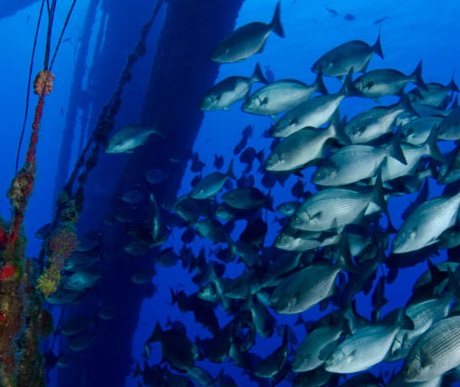
Fish inhabit reefed oil platform.

Fish inhabit reefed oil platform.


This is Passport to Texas

All year long we’re highlighting milestones achieved by Texas Parks and Wildlife during its 50 year history as an agency. Today, we recognize the Artificial Reef Program.

09— The program officially started in 1989 when the Texas Legislature tasked Parks and Wildlife to preserve marine life out in the gulf of Mexico.

Program leader, Dale Shively, says the Artificial Reef program started in earnest following approval of its management plan in1990.

14—An artificial reef is an environment where we take man made materials like concrete and steel, ships and oil platforms…and position those within a reef area to mimic a natural reef environment.

Artificial reefs provide hard substrate otherwise lacking in the gulf. The materials immediately attract marine life.

16—In most cases, marine organisms will attach and create an ecosystem within a few days. In some cases such as oil platforms, those platforms have been out there for thirty some years. So, they’re pretty well covered with marine life before we do anything to them.

Artificial reefing benefits sport fishing and the Texas economy – that’s tomorrow.

The Sport Fish restoration program supports our series and is funded by your purchase of fishing equipment and motorboat fuel.

For Texas Parks and Wildlife…I’m Cecilia Nasti.
Nature: The Value of Sargassum

Friday, July 5th, 2013

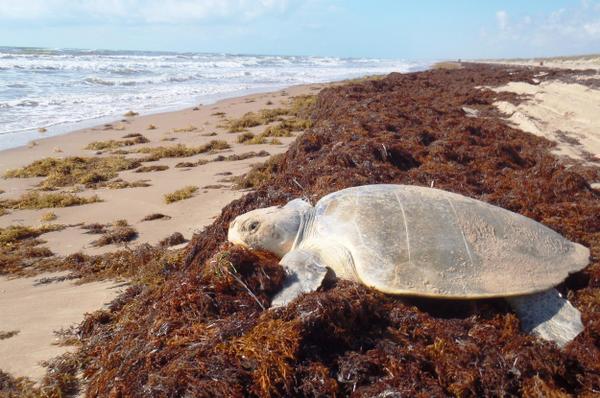
Kemp's Ridley resting on Sargassum; Image © Joseph Scarola

Kemp’s Ridley resting on Sargassum; Image © Joseph Scarola


This is Passport to Texas

The arrival of brown colored algae, called sargassum, to Texas beaches is nearly as predictable as the return of the swallows to Capistrano, but not as welcome.

07 – It shows up on the beach, late spring through early summer, and it can be a nuisance to your average partygoer.

Paul Hammerschmidt, with Coastal Fisheries, says tons of it washes up on the Texas coast from the North Atlantic, hindering beachgoer access to the water. Yet, sargassum is far from being a mere nuisance. It provides habitat for other living things.

13 – There are many animals that only live in the sargassum weed in the Sargasso Sea. It also is a nursery area for a whole lot of game fish like Mahi Mahi, Marlin, Sailfish, that type of thing.

On shore, Hammerschmidt says beachcombers discover shells and sea beans in the slimy tangle, as well as live animals. Cities and counties that obtain permits may move the seaweed to help rebuild sand dunes. If you get a hankering to bring home some Sargassum, it does make a good garden fertilizer – with one caveat.

07 – One thing you really do have to do is rinse the saltwater off of it. You don’t want that saltwater in your garden; that’s just not healthy for your garden.

The Wildlife and Sport Fish Restoration program supports our series, and funds the work of saltwater fisheries in Texas.

For Texas Parks and Wildlife…I’m Cecilia Nasti.
Nature: What’s up With the Sargassum?

Thursday, July 4th, 2013

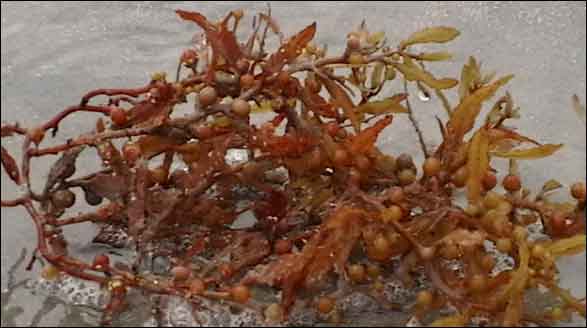
Sargassum, Image © Texas Parks and Wildlife Department

Sargassum, Image © Texas Parks and Wildlife Department


This is Passport to Texas

Every spring and summer, visitors to the Texas coast encounter piles of brown, wet, slimy vegetation lining Texas beaches.

02 – It’s a brown algae called sargassum.

Paul Hammerschmidt, with Coastal Fisheries, says sargassum may accumulate on tide lines for miles.

21 – It belongs to a whole group of plants that belong to the sargassum group. Most of those plants are attached to hard substrate – rocks, shells – that kind of thing. These particular species don’t attach to anything; they’re floating. They have little tiny gas bladders that help the plant float. So, periodically that breaks away and ends up on the Texas beach.

Sargassum originates in the Sargasso Sea, in the middle of the North Atlantic Ocean.

16 –…in a big floating gyre; a gyre is a big eddy. And this particular sea has no shoreline at all – no land shoreline. It’s surrounded by four different ocean currents that keep that seaweed trapped in this one particular area.

Yet, tons of sargassum escape and end up on Texas shores.

13 – Changes in the currents; winds and storms can occur in the area, and sections of it actually break off and get into the main currents. Those main currents will bring them into the gulf and eventually onto the beaches.

Tomorrow: the value of sargassum.

The Wildlife and Sport Fish restoration program supports our series.

For Texas Parks and Wildlife…I’m Cecilia Nasti.

Conservation: Public Reefing

Wednesday, June 12th, 2013

Concrete pyramids for near shore reefing

Concrete pyramids for near shore reefing


This is Passport to Texas

An artificial reef is marine habitat created by man and placed on the ocean bottom for the benefit of marine life.

06 – Fish like structure. And just about anything you put overboard will attract fish.

Paul Hammerschmidt, with coastal fisheries, says a program called public or near-shore reefing allows the public to deposit reef materials into the gulf.

12 —We’re going to allow the general public to reef material within state territorial waters, and that will expand the number of artificial reefs that we have out in the Gulf of Mexico off of Texas.

You shouldn’t think of this as an invitation to dump your garage sale rejects into the gulf.

13 – We have certain criteria for the material. It has to be stable; it can’t fall apart, it can’t wash up on the beach, it can’t float…all of those things, which is just exactly what we comply with when we do our own reefing.

More reefs in the Gulf of Mexico will mean better fishing for coastal anglers.

03—Our charge is to increase fishing opportunities, and this is a really good way to do it.

Find details about near shore reefing on the Texas Parks and Wildlife website.

The Sport Fish Restoration Program supports our series and provides funding for the operations and management of Sea Center Texas.

For Texas Parks and Wildlife…I’m Cecilia Nasti.

TPW TV: Coastal Fishing

Tuesday, June 4th, 2013

Image from June issue Texas Parks and Wildlife Magazine

Image from June issue Texas Parks and Wildlife Magazine


This is Passport to Texas

Summer officially arrives later this month. And if fishing is on your to-do list, Texas Parks and Wildlife TV Series Producer Don Cash says, a segment on this week’s show highlights angling opportunities along the Texas coast.

58 –I’m pretty sure that the fishing along the Texas coast is pretty good all year round, but summertime is when people seem to really think about going fishing. And this story focuses on a couple of different ways to do it. One of those ways is to take a charter boat out. The great thing about that is you’re surrounded by water — no land anywhere in sight – and you don’t really know what you’re going to catch sometimes. You never know what’s going to come up on the end of your hook; you can specifically fish for a certain type of fish, but Lord, there might be a hundred pound grouper, when you’re fishing for that two pound snapper. So, there’s a lot of excitement there. One thing you see in this story is the people fishing are having a really good time. Whoa! That’s a red snapper [laughs]. What I hope happens with this story is people will watch it and they’ll say ‘Wow. That looks like fun.’ If you can’t do a charter boat, you can always do wade fishing; you can go fish on the pier. There are all kinds of ways to go fishing on the coast, and all of them are a lot of fun.

Thanks, Don.

Support provided by Ram Trucks. Doing what’s right and good regardless of the degree of difficulty — takes guts. Those are the people who build Ram trucks. RAM.

For Texas Parks and Wildlife…I’m Cecilia Nasti.
