Archive for the 'Shows' Category

TPW TV: Home Again (Desert Bighorn Sheep)

Friday, December 5th, 2014
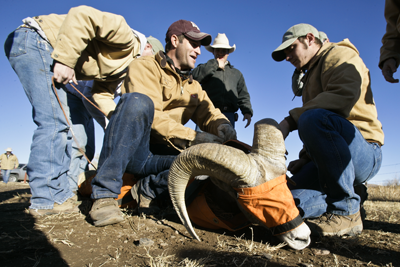
 

Relocating Desert Bighorn Sheep, photo by Earl Nottingham, TPWD

Relocating Desert Bighorn Sheep, photo by Earl Nottingham, TPWD


This is Passport to Texas

There’s a special quality about Far West Texas; and, as Froylan Hernandez can tell you, when the Desert Bighorn Sheep is on the landscape, it’s awe-inspiring.

08—When I’m up on top of Elephant Mountain, my first glimpse of them, it’s overwhelming. Even if it’s just a single animal.

Hernandez is Desert Bighorn Sheep Program Leader for Texas Parks & Wildlife. Meet him on an upcoming segment of the Texas Parks and Wildlife TV Series airing the week of December 8.

20—Historically, the native Texas Desert Bighorn Sheep occurred in about 16 mountain ranges out here in the Trans Pecos. Mainly due to unregulated hunting, diseases associated with the introduction of domestic sheep and goats, and net wire fencing – they brought the demise of the Desert Bighorn. And by the early 1960s, they were all gone from Texas.

For more than fifty years, Texas parks and Wildlife and partners have worked to restore the Bighorn to its home range in Texas.

08—Luckily, the population in Texas is now big enough, we’re using those sources to transplant the animals to Big Bend Ranch State park.

And Big Bend Ranch SP superintendent Ron Trevizo welcomes them to a new home on the range.

07—When we started talking about the release coming in – to release the Desert Bighorn Sheep at Big Bend Ranch, I’m like – Yea, that’s great!

See how agency biologists translocate Desert Bighorn Sheep to Big Bend Ranch SP on a segment of the TPW PBS TV series, the week of December 8.

For Texas Parks and Wildlife…I’m Cecilia Nasti.
Birding: Finding a Christmas Bird Count Near You

Thursday, December 4th, 2014


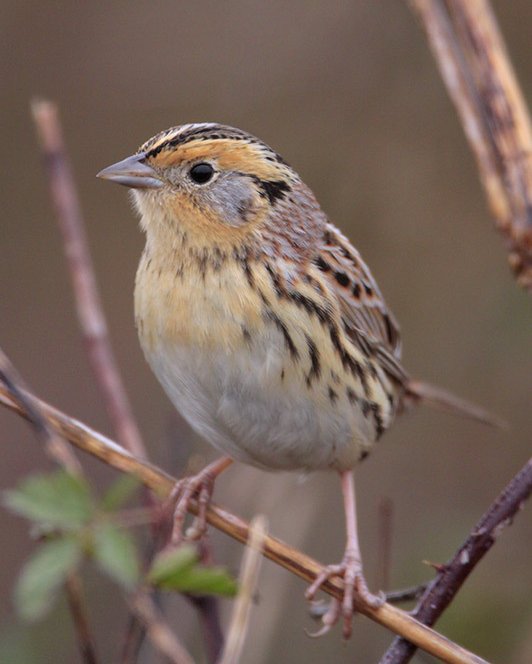
Le Conte's Sparrow,  image by Greg Lavaty, from www.audubon.org

Le Conte’s Sparrow, image by Greg Lavaty, from www.audubon.org


This is Passport to Texas

Counting birds at dawn during the Christmas Bird Count guarantees you’ll see lots of them. Yet, a big bunch of birds can lead to confusion.

04—Especially if you get into a big flock of robins or grackles; you just have to start estimating numbers. But, it’s really fun when you start getting big numbers of species. You know, you’ve only been out for an hour and you already have 30 species of birds; that’s really fun.

Cliff Shackelford is a non-game ornithologist with Texas Parks and Wildlife. This year’s count is December 14 through January 5.

07—There are over a hundred Christmas Bird Counts in Texas; so, chances are there’s one in existence in your area.

Counts take place inside 15-mile radius circles. Cliff says the best way to find a nearby count is online.

09—Search for Christmas Bird Counts in Texas, and figure out which one is nearest you. Also, you’ll see who the compiler is, and you can get phone number or email and start coordinating with that person.

Compilers act as “captains” of their circles, and relay data from the count back to Audubon, which analyzes it. Birders of all skill levels are welcome.

23—And what they’ll do [if you’re a novice] is stick you with some seasoned vets, and that’s really good because you learn a lot when you’re out in the field with someone whose been doing this awhile. So you go out with this team of observers and you basically beat the bushes and try to see as much as you can see. It’s a lot of fun.

The data volunteers collect help researchers better understand trends as they relate to our feathered friends.

For Texas Parks and Wildlife…I’m Cecilia Nasti.
Birding: Making Birds Count

Wednesday, December 3rd, 2014


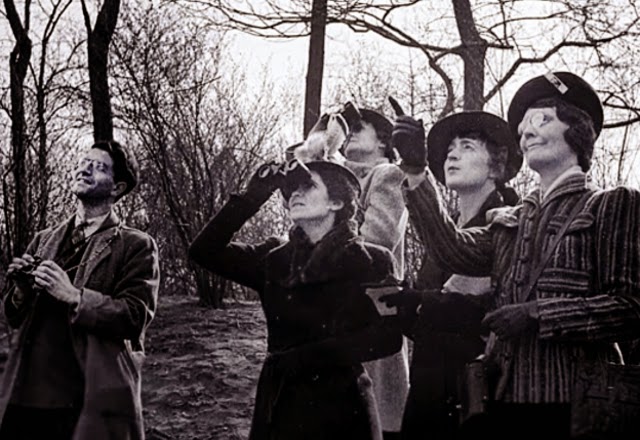
Christmas Bird Count -- the early years.

Christmas Bird Count — the early years.


This is Passport to Texas

The name “Christmas Bird Count” is a bit of a misnomer.

04—It doesn’t happen on Christmas Day. It happens in a period around Christmas.

That period is December 14th through January 5th. And it’s when volunteers go into the field to count birds.

04— You just have to pick a day in that three week period to do the count.

Cliff Shackelford is a non-game ornithologist with Texas Parks and Wildlife. Volunteers count birds in teams within a 15-mile radius circle with oversight by a count compiler who rules the roost.

11—And those people [compilers] decide on a day, and they divvy up the pie of where these teams can go look for birds in this fixed radius circle, and you count birds within that circle.

The time-frame for the count is 24 hours – midnight to midnight. You might wonder “who” takes the early shift.

10—A lot of people want to know about owls [for example]; so, they get up early. Three A.M., maybe, and go listen for owls. And that’s pretty valuable. But, most people do just the daylight hours.

Cliff recommends the earliest daylight: dawn.

12—That’s when you get the best bird diversity at dawn. Everybody’s waking up: singing, calling and foraging and activity is the greatest right at dawn. Because, birds have slept all night and they’re hungry for something to eat.

Compilers collect the volunteer’s data and submit it to Audubon, which analyzes it.

Find more information about the Christmas Bird Count at passporttotexas.org.

For Texas Parks and Wildlife…I’m Cecilia Nasti.
Birding: Evolution of the Christmas Bird Count

Tuesday, December 2nd, 2014
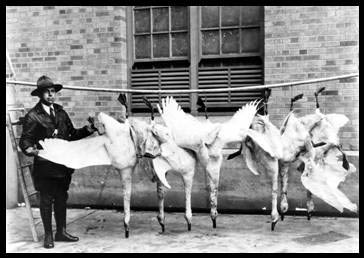
Inauspicious beginning to the Christmas Bird Count, image from http://www.islandguardian.com

Side Hunt participant, image from http://www.islandguardian.com

This is Passport to Texas

In the 1800s, an annual competition called The Side Hunt pitted teams of hunters against one another to see who could bag the most feathered and furry things. With growing conservation consciousness, the Side Hunt evolved into The Christmas Bird Census in 1900, and eventually into the Christmas Bird Count – where the only thing people kill nowadays is a thermos of coffee.

11—We’re now in the 115th year, which makes it the longest running citizen science project in the world. Which is pretty impressive, and it started right here in the US.

Cliff Shackelford is a non-game ornithologist with Texas Parks and Wildlife.

06—You go out into a fixed area and count birds. And the neat thing is, if you stick with that area like you should, and you do it for 10, 20, 30, 40 years…you start seeing trends.

Trend spotting is the true value of the bird count.

26—Those counts that are very old, that have forty plus years of data, we can start seeing things. And we are. We’re seeing things like the American Tree Sparrow is not coming down to Texas much anymore. I don’t think they’re rare, they just don’t need to come all the way south for –maybe –climate change. Maybe it’s not so cold up north; they don’t need to come down. That’s the beauty of the Christmas Bird Count – you can look at it continentally… and see where the changes are in the bird life.

For Texas Parks and Wildlife…I’m Cecilia Nasti.

TPW TV: Competitive Angling

Friday, November 21st, 2014

Award Winning Texas parks and Wildlife PBS TV Series

Award Winning Texas Parks and Wildlife PBS TV Series


This is Passport to Texas

Size, strength and speed…important attributes for most high school athletes; unless, of course, the sport is fishing.

06— You don’t have to be the biggest kid or tallest kid or the most athletic kid to be a bass fisherman. It’s all about your knowledge.

Colt Anderson is half of a competitive high school fishing duo; Jonathan Gray is his teammate.

09— It’s kind of like playing golf a little bit to where you have different tools and you have to adapt to the conditions. You can never become perfect at fishing, and that’s a cool thing because you can always improve.

Another factor that makes competitive high school fishing a great sport is young women can also participate – like Marinna Collins and Mia Sartor – the only female team at a recent tournament at Lake LBJ.

10—It’s hard being the only girl team out there. We’re going to represent. This is my first year, so I am a little scared, but, you
just have to relax. Chill. Just go with it.

View a segment about competitive high school fishing teams the week of November 30 on the TPW PBS TV series. Check your local listings.

14—Ooh. I think that’s the furthest I’ve cast yet. [giggles] That felt good. It’s really cool being in this club because you get to
meet a lot of different people. And, we’re all like one big family – and that’s really good to have friends you can be really close
with.

The Wildlife and Sport Fish Restoration Program supports our series. For Texas Parks and Wildlife…I’m Cecilia Nasti.
