Archive for the 'Shows' Category

Tech/Wildlife: Saving the Guadalupe Bass

Thursday, October 31st, 2013
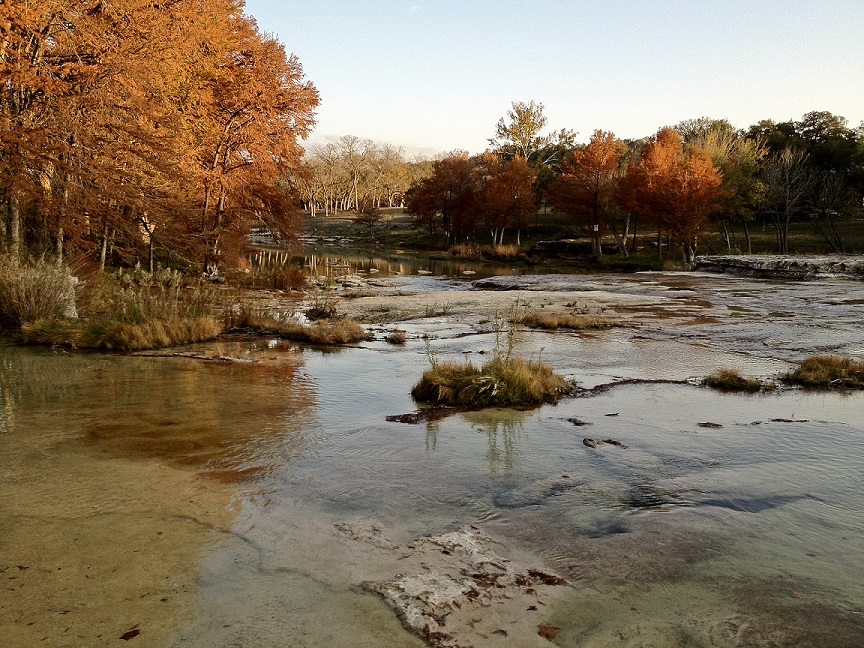
Fall foliage along the Blanco River

Fall foliage along the Blanco River


This is Passport to Texas

Unmanned aerial systems – or drones – in the hands of a trained biologist can improve the future a species…as it did with…

01— Guadalupe bass.

Tim Birdsong is chief of habitat conservation for Inland fisheries. Guadalupe bass – the state fish –once thrived in the Blanco River. In the 1970s TPW stocked smallmouth bass in it, but over time, the species bred creating a hybrid that outcompeted the Guadalupe.

12—That led to complete loss of Guadalupe Bass in that system. And we really didn’t see an opportunity to restore the Guadalupe bass populations in the Blanco River.

The 2011 drought caused the river’s flow to cease, leaving some enduring pools that concentrated the fish. Birdsong said they used a drone to map the location of the pools.

18—We used electro-fishing and nets to remove the remaining small mouth bass. Then flows improved in the Blanco in the spring of 2012 and we stocked roughly 150-thousand Guadalupe bass fingerlings; followed by a similar number in the spring of 2013.

Provided flows in the Blanco continue, Birdsong says he expects in 4 or 5 years we’ll have fishable populations of Guadalupe Bass in the river.

10—That’s a major success story, and it wouldn’t have been possible without this unmanned aerial system, or it would have required our staff to hike up and down miles and miles of riverbed to identify these pools.

The WSFR program supports our series and funds conservation projects in Texas…For Texas Parks and Wildlife…I’m Cecilia Nasti.

Technology: Unmanned Aerial Systems

Wednesday, October 30th, 2013

A group photo of aerial demonstrators at the 2005 Naval Unmanned Aerial Vehicle Air Demo held at the Webster Field Annex of Naval Air Station Patuxent River

A group photo of aerial demonstrators at the 2005 Naval Unmanned Aerial Vehicle Air Demo held at the Webster Field Annex of Naval Air Station Patuxent River


This is Passport to Texas

Biologists survey and collect data on species and habitat, which they use to manage both. For three years, TPW fisheries and wildlife biologists have used an unmanned aerial system, UAS, to assist with these tasks.

18—This is a low-cost platform that flies a predetermined flight path and collects digital still –red, blue, green (visual imagery) –and near infrared imagery. And then we splice those images together to form high resolution geo reference mosaics that are valuable in habitat mapping and wildlife assessments.

Tim Birdsong is chief of habitat conservation for Inland fisheries. The agency’s used this small aircraft as a science tool to inform conservation ractices on WMAs and in State Parks.

25—We’ve also used these platforms to map stream beds to support river restoration projects. We’ve attempted to use the platform on seagrass habitats on the coast to better understand how some of our education and outreach programs have worked –for example – prop scarring of seagrasses; how do we direct boaters away from some of those sensitive areas. And then also, in mapping nesting bird rookeries.

Before the UAS, Birdsong said some survey areas took extensive man power and a month or more to complete. With the UAS, they can accomplish the same work with fewer people in a single morning.

05—Now we’re working toward the next step of developing automated processing techniques.

More on unmanned aerial systems tomorrow.

For Texas Parks and Wildlife…I’m Cecilia Nasti.
Wildlife: Snake, Rattle and Run

Tuesday, October 29th, 2013

Rattlesnakes make a distinctive sound to let you know they are nearby -- and to stay away.

Rattlesnakes make a distinctive sound to let you know they are nearby — and to stay away.


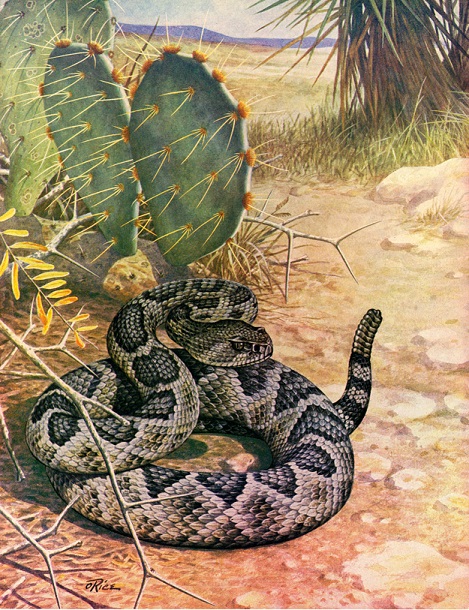
[SFX—western Diamondback Rattling] Hear that? That’s the sound of a Western Diamondback Rattlesnake, the deadliest venomous snake in North America. You hear that sound when you’re out hiking, and you better rethink your next step.

06—The rattle serves the snake well in warning us that, ‘Hey, there’s snake over here; please mind your business and leave me alone.’

Of course, sometimes that’s hard to do when they’re hiding from you. Nevertheless, Andy Gluesenkamp, a Parks and Wildlife herpetologist, says rattlesnakes would rather leave you alone.

01—Unless you’re a mouse.

Right…well…assuming you’re not a mouse, you’re safe. Now here’s something you might not know—snakes other than rattlers…rattle.

14—A rattlesnake rattles its tail with a rattle on the end that makes a very distinctive buzzing noise that once you’ve heard it you’ll never forget it. However, a lot of snakes will rattle their tail in the same way, and will even back their tail up against some dried leaves or something to give it more effect.

So, we’ll call those: dishonest, lying snakes.

13—Snakes that do that a lot include the Texas Rat Snake; Bull Snakes which are another large non-venomous snake; King Snakes. A lot of other snakes that are otherwise harmless use this tail rattling to try to scare away would-be predators.

Find information on Texas snakes at the Texas Parks and Wildlife website.

Support provided in part by Ram Trucks. Guts. Glory. Ram…For Texas Parks and Wildlife…I’m Cecilia Nasti.
Nature: Master Naturalist Program

Wednesday, October 23rd, 2013

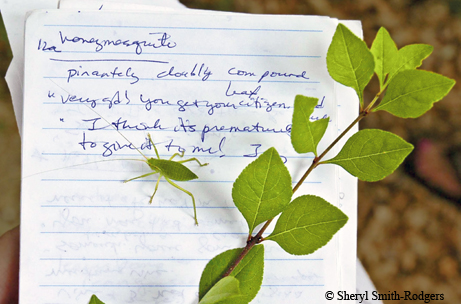
Master naturalist notes, Photo by Sheryl Smith Rodgers

Master naturalist notes, Photo by Sheryl Smith Rodgers


This is Passport to Texas

Protecting Texas’ vast habitat and wildlife resources requires effort from all Texans.

09—Well, as a state agency, we are constrained by our budget, and so we can’t possibly put as many eyes in the sky and boots on the ground as we need.

Kelley Bender, a parks and wildlife Urban Biologist in Central Texas, encourages folks to learn about and conserve resources by becoming a Master Naturalist.

22—The Texas Master Naturalist Program is a really exciting way for people to get involved in nature and wildlife in the state of Texas. There’s a nine-week course that’s provided by professionals in the field, where they get training that includes classroom training as well as field trips. And then we ask for a commitment back to provide 40 hours of volunteer service a year.

Master Naturalist training prepares you to be a leader in community-based conservation efforts.

19—Most chapters offer a get-to-know you class where they introduce all the topics that are going to be discussed. They also talk about what the commitment is and what will be expected of the students as well as what will be expected of the program. And all people are welcome and invited to join. We ask that people be 18 years and over.

Find the Texas Master Naturalist chapter nearest you at passporttotexas.org.

That’s our show… For Texas Parks and Wildlife…I’m Cecilia Nasti.

Wildlife: Pileated Woodpecker

Tuesday, October 22nd, 2013

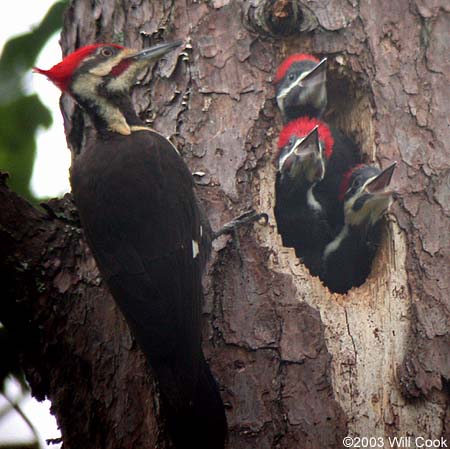
Pileated Woodpecker

Pileated Woodpecker


This is Passport to Texas

Fragmentation of old growth forests in the southeastern US and may have contributed to the “extinction” of the ivory billed woodpecker. In 2005, sightings of the bird in Arkansas were reported indicating that after nearly 60 years in oblivion, this phoenix had risen from the ashes.

12—We’ve been getting a lot of calls since that announcement in oh-five, from people in east Texas that are wondering why there’s all this hoopla over ivory bills, because they’ve hand them in their yard for years.

Cliff Shackleford is a non-game ornithologist with Parks and Wildlife. While the ivory billed woodpecker is the largest woodpecker north of Mexico…

09 – We didn’t do a very good job telling people there are two big woodpeckers. And the other one is a common bird in the eastern third of Texas, and that is the pileated Woodpecker.

That’s the bird people have spotted, said Shackleford. It’s an easy mistake to make, too, as the woodpeckers are similar in size and appearance.

18—They’re black, white and they have some red on them. But the big difference between the two—when they’re perched on the tree—the ivory billed has a white backpack. So, the folded wings give it the look like it’s carrying a white backpack. Whereas in the pileated, there’s no white [backpack]. It’s just continuously dark on the back.

Even so, researchers still want to hear about possible sightings of the ivory billed woodpecker…because they never lose hope.

For Texas Parks and Wildlife…I’m Cecilia Nasti.