Archive for the 'Shows' Category

State Parks: Outdoor Safety Tips

Monday, March 18th, 2013

Assisting a child put up a tent

Assisting a child put up a tent


This is Passport to Texas

It’s spring and folks are heading to state parks for outdoor fun. Our State Park Guide, Bryan Frazier, has tips to keep your family safe and comfy while outdoors.

58—A modest amount of common sense can really make that trip safe, enjoyable, and memorable so you’ll want to come back and do it again and again. Wear sunscreen, even in early spring; that old Texas sun can get pretty strong. Take extra precaution if you’re going to be around water. The warmer weather brings out all sorts of water critters like amphibians, snakes and turtles – and we want to take photos of them and observe them, but we don’t want to get too close. If you’re going to do paddling sports, check the water levels before you go. We’ve had drought in lots of areas. Check for burn bans before you go on your trip; a lot of people want that campfire experience, so check those burn bans. Spring is a great time for fishing, but make sure you take life jackets. There has to be a life jacket in a watercraft for everyone in the boat; children always have to wear theirs when they’re out on the water. So, keep these things in mind, and get outside and enjoy what spring is like in Texas.

Thanks, Bryan.

That’s our show for today…with funding provided by Chevrolet, supporting outdoor recreation in Texas; because there’s life to be done.

For Texas Parks and Wildlife…I’m Cecilia Nasti.
TPW TV: Restoring the Pines

Friday, March 15th, 2013

Restoring pine trees

Restoring pine trees


This is Passport to Texas

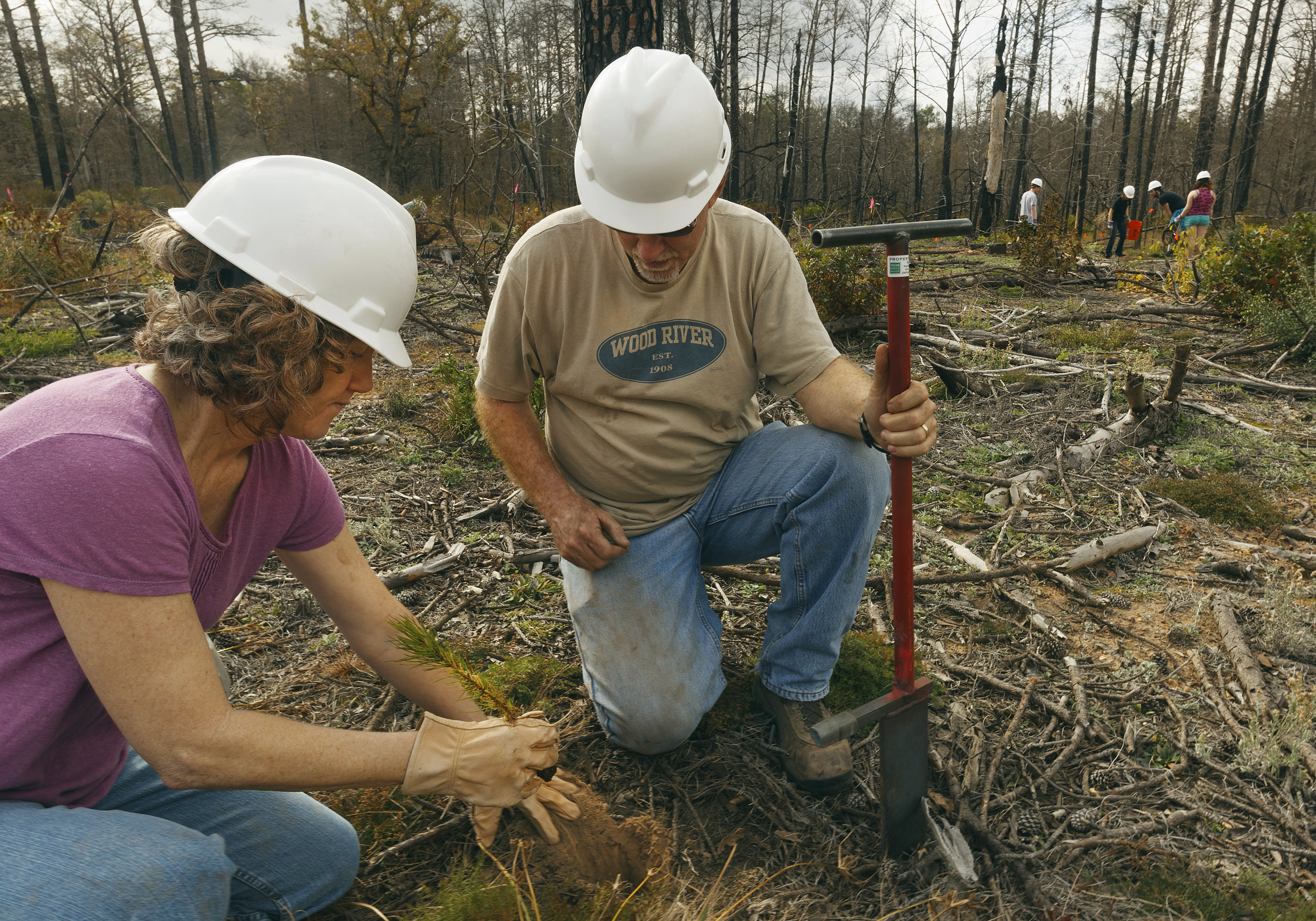
TPW TV series producer, Don Cash, has followed the restoration of two east Texas state parks following Hurricane Rita eight years ago. He says there was a silver lining in that storm.

58— I’ve been able to go back a few times over the years and watch as the parks change, slowly. Martin Dies State park in Jasper, and Village Creek State Park down near Beaumont were pretty badly torn up. Where you [once] had a real thick canopy and a real thick forest, you [now] had lots of sky. What I found, though, going back and talking to people in the parks is that the hurricanes have allowed them to do some habitat management on a little quicker scale than they would have otherwise had the hurricane not come through. In east Texas, the forests were originally longleaf pine; when timber companies came through, they cut the longleaf and planted loblolly, which is native to the US, but not native to Texas. It’s a faster growing pine, but the loblolly and the longleaf have different habitats, different animal species, different ground cover. So, the hurricanes have allowed the loblollies to get knocked down, and will allow the people in the parks to replant and reforest in the native longleaf pine.

Thanks, Don.

The segment titled Restoring the Pines airs the week of March 17th on PBS stations. Check your Local listings.

For Texas Parks and Wildlife…I’m Cecilia Nasti.
Conservation: Urban Life / Rural Impact

Thursday, March 14th, 2013

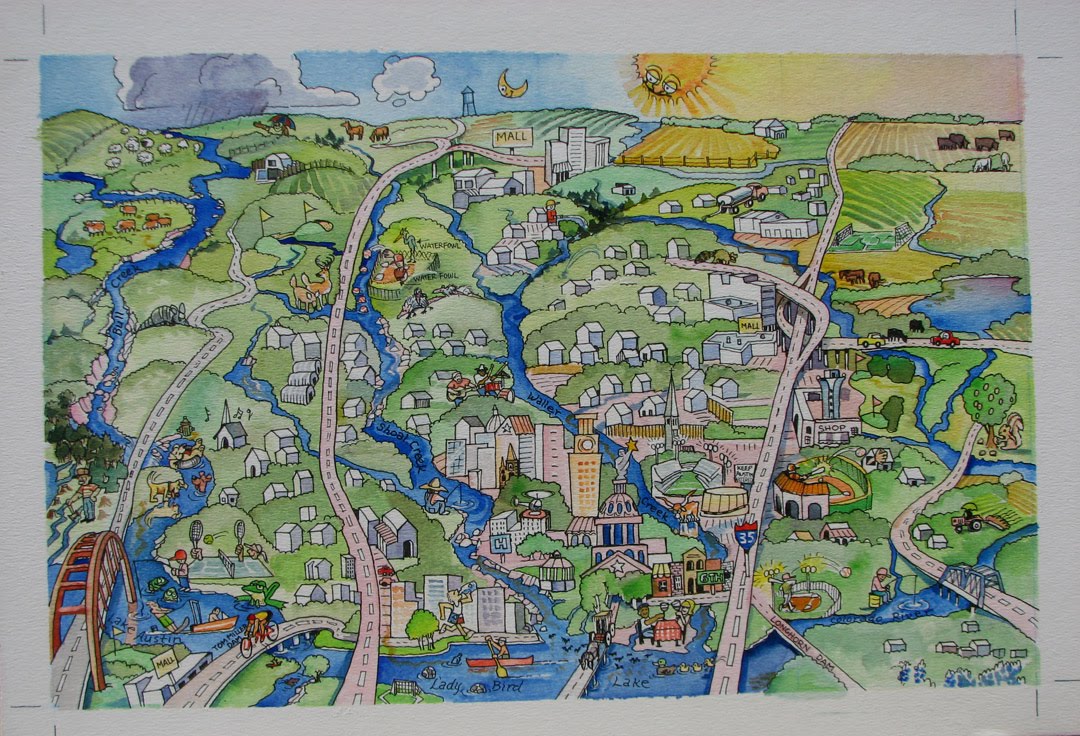
Austin watershed, Artwork Virginia Vaughan, vaughan.com

Austin watershed, Artwork Virginia Vaughan, vaughan.com


This is Passport to Texas

Most urbanites don’t realize they reside in watersheds; they’re also unaware the vitality of these natural drainage systems affects their quality of life, and that their behavior inside the concrete jungle influences the natural world beyond it. How do we raise collective awareness?

04— One thing we’re doing is trying to get them out of those urban areas and on to the countryside to go enjoy it.

Dr. Gary Garrett is state director of the watershed conservation program for Texas Parks and Wildlife. He says engaging nature leads to understanding and protecting it.

05— If you can use it, you support it; that’s just human nature. If you don’t use it, you’re not very interested in it.

While Dr. Garrett’s work involves guiding landowners through proper land management practices – which affects water runoff, absorption, quality and quality – he says educating cities and their citizens about their role in protecting watersheds is critical.

21— That clean, abundant water that we all want takes work. I’d love to see cities fully embrace that, and actually invest in those upstream areas – for their own good – to help us preserve those…
and to keep those solid clean flowing waters, and solid good environments available to use…and always there for your benefit.

Learn more about watersheds when you log onto the Texas Parks and Wildlife website.

The Wildlife and Sport Fish Restoration Program supports our series and funds conservation projects in Texas.

For Texas Parks and Wildlife…I’m Cecilia Nasti.
Conservation: Guadalupe Bass Restoration

Wednesday, March 13th, 2013

Guadalupe Bass

Guadalupe Bass


This is Passport to Texas

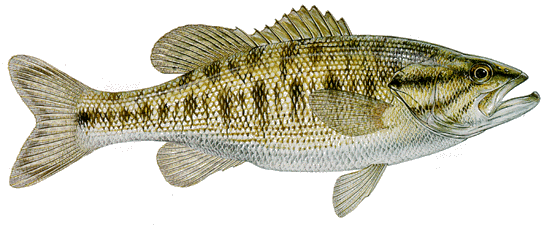
Nearly 40 years ago, Texas Parks and Wildlife began stocking smallmouth bass in the streams and reservoirs in the Edwards Plateau region to improve Hill Country angling opportunities. The unforeseen result: the fish hybridized with the native Guadalupe Bass (known only to those waters) threatening to displace the State Fish of Texas.

02—It’s got its problems and its challenges.

Dr. Gary Garrett says the plight of the species goes beyond hybridization. Inadequate land management caused changes to GB habitat, which also exacted a toll.

Over the past 20 years, fisheries research biologists, like Dr. Garrett – who heads up the watershed conservation program for Texas Parks and Wildlife – landowners, and others have worked together to help improve land and conserve GB habitat using an ecosystem approach.

29— The help is everything from restoring grasslands on the uplands; helping to restore and preserve good riparian habitat; preventing erosion; keeping sediment flows properly balanced within the streams; good water quality and water quantity. You don’t just stock more fish and they’re happier and everything’s cool. You do all of these things together to make a solid, sound, healthy ecosystem, and everything flourishes within it – especially our state fish.

Tomorrow: Life in the city affects life outside of the city.

The Wildlife and Sport Fish Restoration Program supports our series and funds conservation projects in Texas.

For Texas Parks and Wildlife…I’m Cecilia Nasti.
Conservation: What is a Watershed?

Tuesday, March 12th, 2013

Watershed

Watershed


This is Passport to Texas

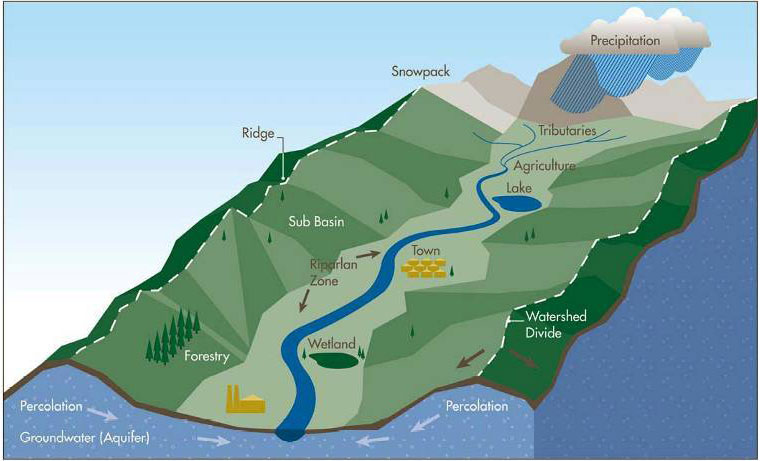
What is a watershed? Dr. Gary Garrett, state director of the watershed conservation program at Parks and Wildlife, says watersheds are interactive ecosystems.

10—Everything within that watershed interacts and affects everything else in that watershed – including us. So, there’s no one part of it that is more important or exclusive to the other parts.

That’s one reason why Garrett, a fisheries research biologist, takes a holistic approach to understanding and improving our state’s watersheds.

18—I work with wildlife biologists; I work with riparian ecologists, herpetologists…. Anything and everything that we can understand that brings it all together; then together we can synergistically apply the best guidance, the best restoration and conservation that’s possible.

How we care for the land affects the quality and quantity of our water – a concept that may seem abstract.

23 – We’re spending a lot of time with folks explaining that, because it is a large ecosystem approach to this. Grasslands, if they’re cedar thickets, and we take them back to grasslands, you reduce erosion; you reduce overland flow, you increase the ability for the water to soak in rather than run off, which then improves spring flows over time. It gives you a more dependable water source. That’s just restoring grasslands.

Restoring watersheds and an iconic Texas species. That’s tomorrow.

The WSFR program supports our series and funds conservation projects in Texas.

For Texas Parks and Wildlife…I’m Cecilia Nasti.
