Archive for the 'Shows' Category

Mule Deer Antler Restrictions

Wednesday, September 26th, 2018
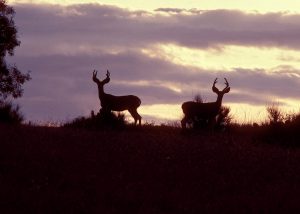
Mule deer at sunset.

Mule deer at sunset.

This is Passport to Texas

When Mule Deer season opens mid-November hunters must abide by antler restrictions on bucks in six counties in the southeast panhandle.

We’re using the same model as the white-tailed deer.

Restrictions implemented in the early 2000s in six east Texas counties for white-tailed bucks prevented hunters from taking very young animals from the landscape. The experiment saw an increase of bucks, and more natural buck age structure and sex ratios.

Shawn Gray is the state’s mule deer program leader. For white-tail bucks hunters use an inside spread restriction.

But, for mule deer—to protect the age classes that we want to protect, and to allow hunters harvest of the animals that we would like for them to harvest—instead of an inside spread, we’re going to use an outside spread of the main beam.

Which is ear tip to ear tip. There’s a 20-inch minimum restriction on the outside antler spread of the main beams on mule deer bucks.

And, we’re going to monitor that through voluntary check stations. Also, through our population surveys to see if we can improve our age structure of the buck segment of that population over there.

When hunting is not a factor, natural selection determines which bucks reach maturity. Antler restrictions on mule deer bucks are in Briscoe, Childress, Cottle, Floyd, Motley, and Hall counties

The Wildlife Restoration program supports our series and funds Mule Deer management in Texas.

For Texas Parks and Wildlife…I’m Cecilia Nasti.
Why We Stock Fish in Texas

Tuesday, September 25th, 2018
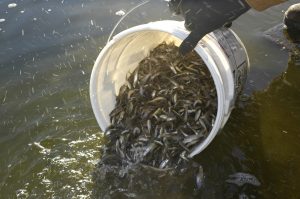
Stocking fingerlings

Stocking fingerlings in Texas waters

This is Passport to Texas

It’s no accident that some of the country’s best sport fishing happens in Texas lakes and rivers.

Fish stocking is an ongoing activity of Texas Parks and Wildlife Department’s inland fisheries division.

But why stock fish at all? Stocking helps to establish initial year classes of fish in new or renovated waters. It also supplements existing populations that, for some reason, have insufficient spawning or recruitment. Stocking also increases species diversity.

Restoring fish populations that have been reduced or eliminated by natural or manmade or catastrophes is another reason to stock fish in Texas waters.

Parks and Wildlife may also stock fish to either change or enhance the genetics of a particular fish population in a specific water body.

Moreover, the agency stocks certain lakes, streams and community ponds with catchable size fish year round—rainbow trout in winter and catfish spring through fall. Doing so makes sport fishing more accessible to all. The agency even offers free fishing in state parks, angler education classes and tackle loaner programs.

So, if you’re not catching fish in Texas, you’re just not trying. Find fishing information and the locations of Neighborhood Fishin’ lakes and ponds on the TPW website.
The Sport Fish Restoration Program supports our series. For Texas Parks and Wildlife…I’m Cecilia Nasti

“Citified” White-winged Doves

Monday, September 24th, 2018
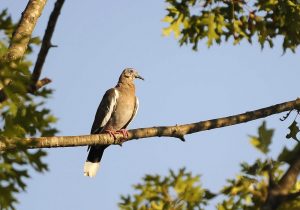
White-winged dove

White-winged dove hanging out in a suburban backyard.

This is Passport to Texas

White-winged doves, originally associated with the Lower Rio Grande Valley, have expanded their range. Changes in land use practices sent the species farther north into urban areas. Suitable habitat kept them there.

Probably 80-85% of the white-wing dove population in Texas is associated with urban and suburban areas.

Nesting white-winged doves prefer established residential neighborhoods with large live oak, pecan, and ash trees. The availability of consistent food and water sources (birdbaths and bird feeders) make the living easy. Owen Fitzsimmons, Texas Parks and Wildlife’s web-less migratory game bird leader says Texas Parks and Wildlife staff conducts yearly urban dove surveys. He encourages citizens to share their observations of the species, too.

That being said, there are a number of citizen science information collection methods—things like eBird. That’s something that is not run by states or by fish and wildlife service, but it’s something I guarantee, that everybody looks at. It’s a very valuable information source. So, while we don’t have citizens of Texas doing the urban dove survey, I encourage them to report whatever they find on eBird. You know, because, that information is looked at as well.

The Wildlife Restoration program supports our series and funds research on White-winged Dove Density, Distribution, and Harvest.

For Texas Parks and Wildlife…I’m Cecilia Nasti.
TPW TV –Game of Gobblers

Friday, September 21st, 2018
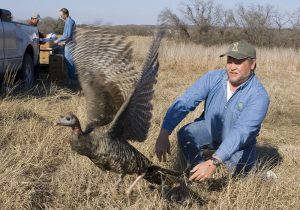
Turkey release.

TPW biologist Trevor Tanner releases a Rio Grande turkeys on Price 77 Ranch near Blooming Grove, Texas

This is Passport to Texas

When European settlers started coming to East Texas, turkeys were thriving. But those settlers quickly changed the landscape.

Around 1925, a hunter could harvest up to 25 turkeys a year. By the 1940s there were less than 100 eastern wild turkeys throughout East Texas. Over-harvest as well as habitat decline really led to the demise of the population.

Kyle Hand is a Texas Parks and Wildlife Natural Resource Specialist. In the 1970s, the agency started a program of bringing wild trapped turkeys from other states to Texas. The program looked promising. Over the next 20 years, more than 7000 eastern wild turkeys were stocked in East Texas.

Now we’re using a super stocking strategy where we release 80 turkeys onto one area of good habitat in hopes that the population will grow from there.

Thanks to the success of these stockings, hunters like Terrence Jackson of Houston have an opportunity to enjoy spring turkey hunting in parts of East Texas.

When I’m on these turkey hunts, basically I love to get away from the busyness of Houston and work and the crowdedness. The sound of the birds, the quiet in the morning and walking through the woods. It’s something that pulls at you.

Experience an East Texas turkey hunt the week of September 23 on the Texas Parks and Wildlife TV series on PBS.

The Wildlife Restoration Program supports our series.

For Texas Parks and Wildlife, I’m Cecilia Nasti.

National Hunting and Fishing Day

Thursday, September 20th, 2018
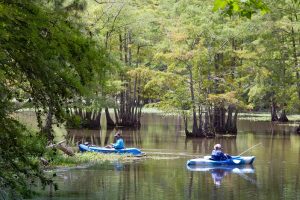
Kayak fishing

Kayak fishing at Gum Slough, part of the Hen House Ridge Unit at Martin Dies SP

This is Passport to Texas

Do you know what the North American wildlife conservation model is? It’s a science-based, user-pay system that fosters conservation success. Do you know who’s responsible for it? Hunters and anglers.

More than 100 years ago they recognized that rapid development and unregulated uses of wildlife were threatening the future of many species. These guys were proactive. You know how we have hunting and fishing licenses and game laws? What about the promotion of the sustainable use of fish and game? It’s thanks to them.

They were so committed to the preservation and reasonable use of resources that they even lobbied for taxes on sporting equipment to provide funds for conservation to state wildlife agencies.

To celebrate the passion, commitment and forward-thinking of hunters and anglers then and now, we observe National Hunting and Fishing day on September 22nd.

President Nixon signed the first proclamation of National Hunting and Fishing Day on May 2, 1972. It’s now observed annually on the fourth Saturday of September.

Observe the day by grabbing a fishing pole, some bait and head to a state park with fishing opportunities. While you relax on the bank, or lean over the railing of a pier, or bob around on a boat, remember those hunters and anglers then and now who do what they can to ensure we all have meaningful outdoor opportunities.

The Wildlife and Sport Fish Restoration program supports our series.

For Texas Parks and Wildlife…I’m Cecilia Nasti.