Archive for the 'Shows' Category

Northward Migration of White-winged Dove

Wednesday, September 19th, 2018
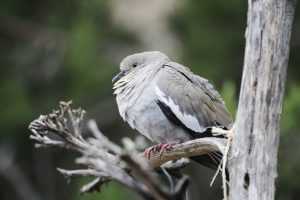
White-winged dove.

White-winged dove.

This is Passport to Texas

At the turn of the last century, white winged dove populations in Texas were robust. Found mostly in the Lower Rio Grande Valley, their numbers declined as agriculture took root there.

They [farmers] took out a lot of native habitat—your brush and shrub species that are native to South Texas. That’s where the birds bred and roosted, so they required that habitat. A lot of that was wiped out for agriculture. So, through the 20s and 30s and 40s, we saw a big decline in the white-wing population in Texas.

Citrus dominated the landscape. Owen Fitzsimmons is Texas Parks and Wildlife’s web-less migratory game bird leader. As citrus groves matured, the doves rebounded.

They like open areas with large mature stands of trees—and citrus groves were perfect for that. So white-winged doves quickly colonized those citrus groves.

Hard freezes in the 40s & 50s, and again in the 80s devastated the citrus groves, and also the doves.

So, the white-winged dove population fluctuated up and down through the middle of the century.

In the 80s, urban expansion moved northward along the I-35 corridor and white-winged doves followed.

They’re found throughout Texas, now. They’re found all the way up into Oklahoma. They’re breeding in Kansas and Missouri. Northward expansion is unlimited at this point.

The Wildlife Restoration program supports our series and funds research on White-winged Dove Density, Distribution, and Harvest.

For Texas Parks and Wildlife…I’m Cecilia Nasti.
Big Time Texas Hunts Deadline Approaches

Friday, September 14th, 2018

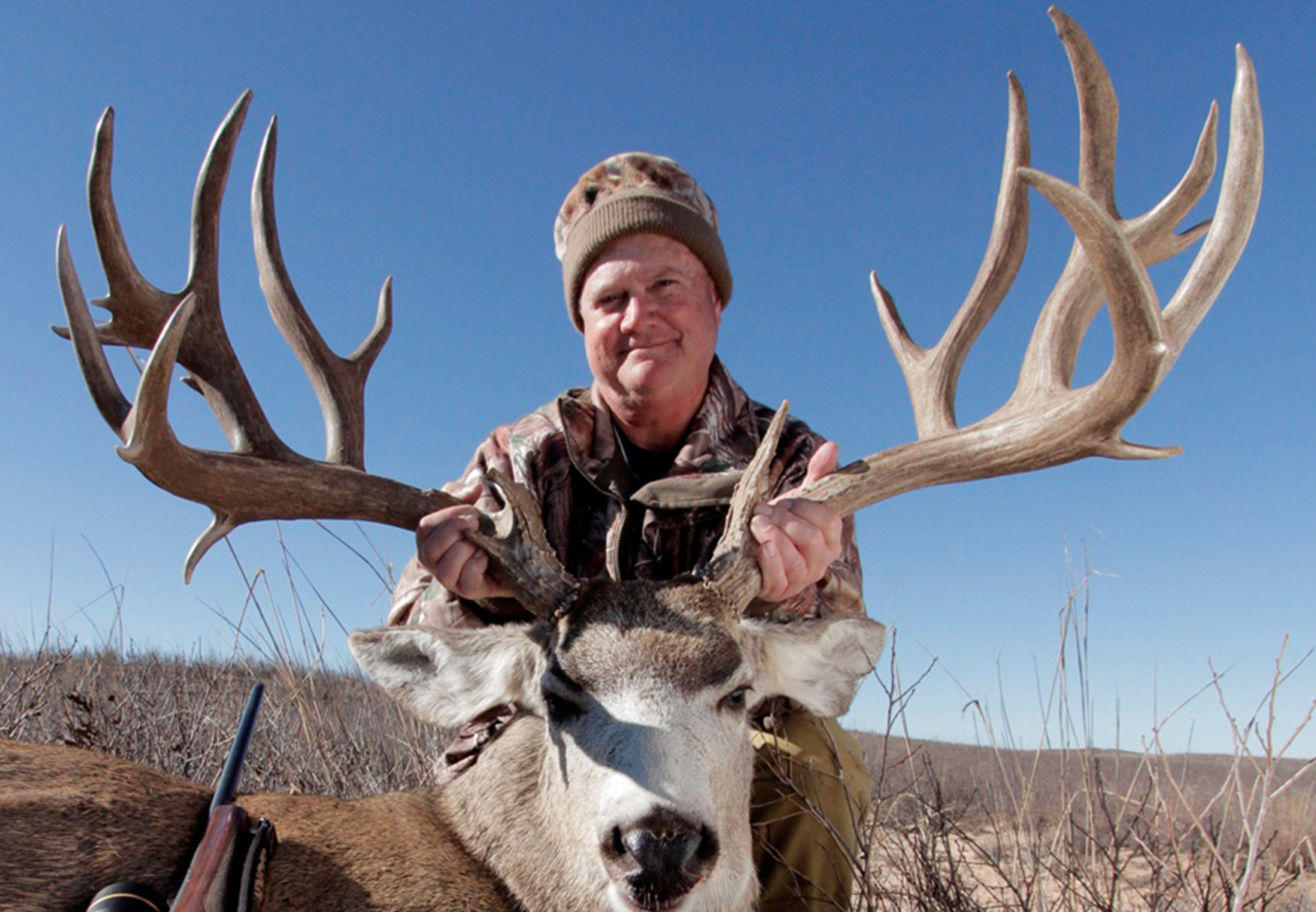
Previous winner, Steve Knowles, with his mule deer from the Ultimate Mule Deer Hunt.

This is Passport to Texas

When you enter Big Time Texas Hunts, you enter for a chance to win one of ten premium hunt packages while also supporting conservation.

Big Time Texas Hunts is a conservation fundraiser, basically. We try to raise money that we can put directly back into wildlife conservation work on our wildlife management areas and all of our public hunting lands across the state.

Justin Dreibelbis is Texas Parks and Wildlife’s program director for private lands and public hunting. Big Time Texas Hunts includes 10 premium hunt packages for a wide range of game animals.

The easiest way to buy chances for the hunt is to go onto our Texas Parks and Wildlife website and search Big Time Texas Hunts. There you’ll find opportunities for all 10 of these hunt packages. And you can buy as many as you want online; they’re nine dollars apiece.

There’s a $5 online administration fee, but it allows unlimited entries in a single transaction.

Right off the top every year, a portion of that money goes into our desert bighorn sheep program. It pays for surveys and a lot of that translocation work. We’re trying to put new populations in new mountain ranges in West Texas where they originally occurred. It also goes directly back to our Wildlife management areas for habitat projects. It includes all kinds of access improvements for our public hunters. So, it’s all going back to things that our public hunters care about.

The deadline to enter Big Time Texas Hunts is October 15th. Find complete details on the Texas Parks and Wildlife website.

For Texas Parks and Wildlife…I’m Cecilia Nasti.
Fishing is for Families

Thursday, September 13th, 2018
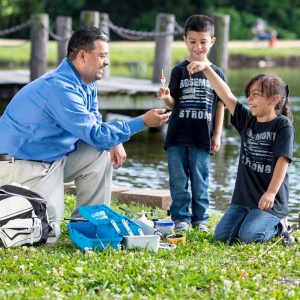
A family fishing outing at the lake.

A family fishing outing at the lake.

This is Passport to Texas

Catching a fish never fails to excite, especially if you’re a child. Reeling in one of these wiggly wonders has never been easier in Texas urban areas.

That’s because places for family fishing fun are in, or near, your neighborhoods…as are the opportunities for gaining the skills necessary for catching the fish.

Texas Parks and Wildlife’s Neighborhood Fishin’ program brings the fish to you. Currently, eighteen neighborhood fishin’ lakes are dispersed among eleven Texas cities: from Abilene to Houston and points in between.

Stocking takes place every two to four weeks during summer and winter seasons. Which means there should be a good supply of fish to catch and bring home for dinner whenever you find time to visit!

In addition to the Neighborhood Fishin’ program, state parks host fishing events where you learn about the best gear and bait to use, how to cast, and even how to cook what you catch. Some parks also loan tackle.

Fishing is a gateway activity into the Texas outdoors, and something the entire family can share together.

Find a list of the Neighborhood Fishin’ lakes on the Texas Parks and Wildlife website. While you’re there, check out the calendar section for fishing events near you.

The Sport Fish Restoration program supports our series.

For Texas Parks and Wildlife…I’m Cecilia Nasti.

Managing Coastal Fisheries

Wednesday, September 12th, 2018
Sea Center Texas

Sea Center Texas

This is Passport to Texas

Coastal fishing is one of Texas’ most popular recreational activities, and its future depends on quality management. That’s where Texas Parks and Wildlife comes in.

Fisheries biologists and technicians are responsible for direct management of the resource. This entails getting fish into the water through hatchery efforts of breeding, raising and stocking fish.

Just as important: educating the public. Texas Parks and Wildlife’s Outreach, Education and Communications teams take the lead there. It’s vital to help people to understand the value of the marine life and habitat.

Whether you live on the coast or are visiting, a trip to Sea Center Texas fish hatchery and Visitor Center in Lake Jackson can help you on your road to understanding. At the hatchery they breed red drum, spotted seatrout and southern flounder for stock enhancement. The Visitor’s Center focuses on the importance of environmental stewardship. There’s something for the whole family.

The goal of the center is to instill in the public a deep understanding of and appreciation for the role they play in the improvement and enhancement of our marine resources.

Find more information about coastal fisheries and Sea Center Texas on the Texas Parks and Wildlife website.

The Sport Fish restoration program supports our series.

For Texas Parks and Wildlife…I’m Cecilia Nasti.
TPW TV – Return of the Guadalupe Bass

Tuesday, September 11th, 2018

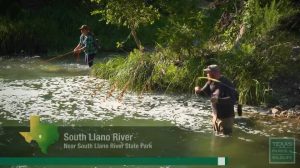
Fishing for Guadalupe bass in the South Llano River

This is Passport to Texas

Courtney and Brandon Robinson love to fly-fish for Guadalupe Bass in the South Llano River.

[Courtney] We’re not looking at a whole lot of deep pools, it’s more shallow water, skinny water.
[Brandon] Fish on! This is why I love catching Guad’s, their little fish, but they use the river to fight!
[Courtney] Um so we’re gonna see little bass in the shoal’s area like in that little rapids area over there. Oh, there we go!

The state fish of Texas wasn’t always easy to catch. It was on the brink of disappearing from the South Llano, due to introduced Small Mouth Bass that crossbred with the native Guadalupe for decades!

They can breed with each other and what results is what we call a hybrid, and those fish, they’re not our pure native Guadalupe bass, so we’re trying to restore these populations throughout the state.
We’re stocking large numbers of these pure fingerlings, and what the goal is these pure fish outnumber the Hybrids and so we reduce that overall hybridization rate and get it back to where we have almost an entirely pure population of Guadalupe Bass.

But the data shows the Guadalupe Bass are back.

We’ve been working on the Guadalupe Bass here in the Texas Hill country for about twenty-five years, and been really successful in restoring these populations in these iconic Texas hill country streams, and now we have Guadalupe Bass in a lot more reaches of these streams here for people to enjoy!

Reel in an eyeful of Guadalupe bass the week of September 23 on the Texas Parks and Wildlife TV show on PBS.

The Sport Fish restoration program supports our series.

For Texas Parks and Wildlife…I’m Cecilia Nasti.
