Archive for the 'Research' Category

Wildlife: Alligators and Drought

Tuesday, May 13th, 2014
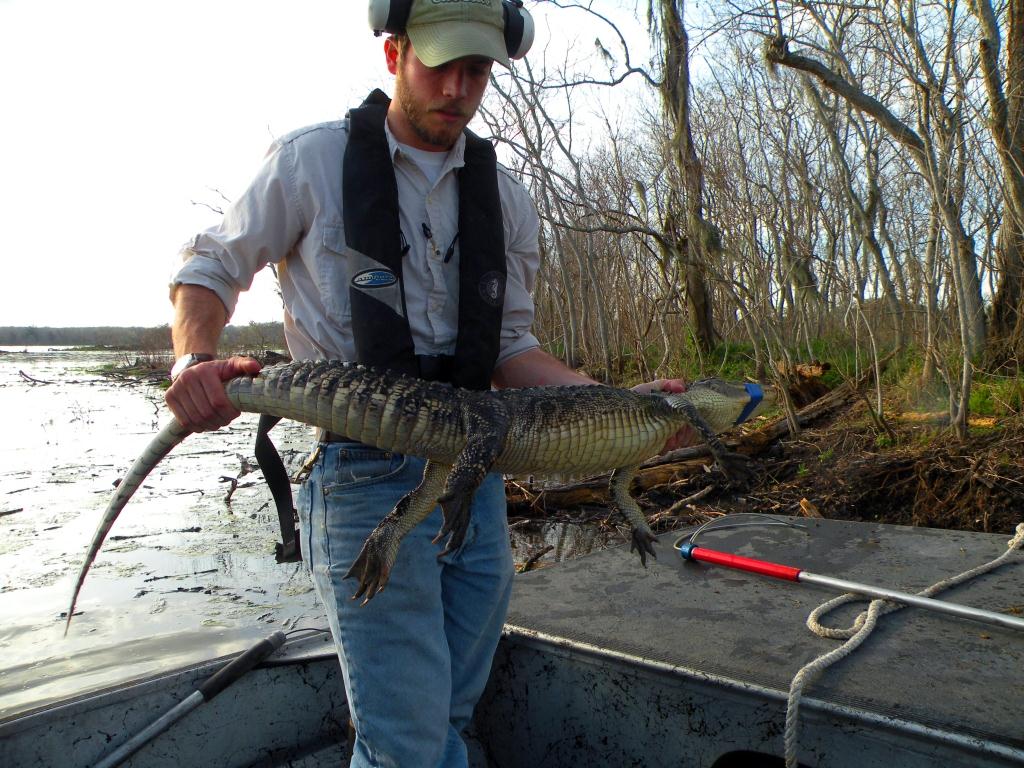
Cord Eversole with a small alligator.

Cord Eversole with a small alligator.


This is Passport to Texas

Tussling with alligators isn’t just for reality TV.

09— Typically, anything that’s under about seven feet in length, we capture from a boat. The real small ones, like the hatchlings, you can grab with your hand; they’re pretty harmless.

The bigger ones take more caution, finesse, and duct tape, says 25-year-old Cord Eversole, a graduate student at A&M-Kingsville.

09— We’re real fortunate to be able to be involved in a study looking at reproduction – in particular – and how drought affects hatching success of the eggs.

He studies the reptiles in his role as a research assistant at the Caesar Kleberg Wildlife Research Institute.

22— A large majority of our data was collected through mark/recapture, and so we tagged roughly 250 alligators at Brazos bend SP, and then captured [them] a year later, so that we could look at how much they had grown in a year’s time, and how the data that we gathered differs from data that was gathered in other parts of their range in the United States.

Thus far, his data reveals something rather unexpected. And we’ll hear about that tomorrow.

The Wildlife and Sport Fish Restoration program supports our series and funds diverse conservation projects throughout Texas.

For Texas Parks and Wildlife, I’m Cecilia Nasti.

Conservation: First Friday at the Kerr WMA

Tuesday, September 4th, 2012

Feral Swine

Feral Swine


This is Passport to Texas

Friday September 7th marks the second of a three month series called First Fridays at the Kerr WMA. It’s an education and outreach program for resource managers, land owners, and other interested persons in the Edward’s Plateau Ecoregion. This session addresses critical issues facing the area.

07—We have many issues critical here in the Edward’s Plateau. Number one primarily, probably on everyone’s mind right now is water.

Water for humans and wildlife; Ryan Reitz is a wildlife biologist at the Kerr.

16—We’re here to address this issue on a rangeland scale. We’ll have Steve Nalle, a natural resource manager, discussing how to manage your land to capture water, retain water and to get that water into the aquifer. As well as provide that water more effectively in terms for wildlife.

Feral swine research and management and censusing white-tailed deer in small acreages will also get attention during this First Friday event at the Kerr WMA. Registered attendees will tour the facility.

15—We want to give the public a good and specific look not only into what we are doing here on the Kerr area, in terms of research, but give them a perspective of what role you can play as a land manager, a resource manager, or an interested party in wildlife management.

First Friday – part two – at the Kerr is September 7. It’s free to attend, but you must register. Find out how on the Texas Parks and Wildlife website.

For Texas Parks and Wildlife…I’m Cecilia Nasti.

Conservation: Kerr’s August First Friday Tour

Thursday, August 2nd, 2012


This is Passport to Texas

The Kerr Wildlife Management Area is a research and demonstration site for the Edwards Plateau Ecoregion…and August third begins the first of a three-part monthly series called First Friday Tours.

06—Our First Friday Tours are a series of seminars that we offer annually as part of our outreach program.

Wildlife biologist, Ryan Reitz, says the first part of the free series focuses on the basics.

31—We’re starting out with the basics here, on our first part of our three-part series. And we will be discussing those elements of habitat—those things critical in the successful management of any wildlife species: food, water and cover. We’ll be discussing these in detail. We’ll be addressing the diets of native species—and even exotic species. We’ll be discussing how important water is on the landscape. And we’ll be discussing development strategies and cover requirements—how these plants provide both food and cover to our wildlife resources.

It’s free to attend, but Reitz says you need a reservation.

13—We do ask that everyone interested in attending call in for reservations. You can call the Kerr WMA. Our office number is 830-238-4483, and sign up for a spot on our First Friday Tours.

Again, the First Friday is on August 3.

If you’re not in the Edwards plateau ecosystem, go to the TPW website and find your nearest WMA, and programs offered specific to your area.

The Wildlife and sport fish restoration program supports our series and celebrates 75 years of funding diverse conservation projects throughout Texas…

For Texas Parks and Wildlife…I’m Cecilia Nasti.

Conservation: Kerr Wildlife Management Area

Wednesday, August 1st, 2012


This is Passport to Texas

Located at the headwaters of the North Fork of the Guadalupe River, the nearly 65-hundred acre Kerr Wildlife Management Area offers more than striking Hill Country scenery.

13—We are a research and demonstration site in the Edwards Plateau ecological region. Our goals out here are to mainly develop and manage wildlife habitats and wildlife populations of indigenous species.

Ryan Reitz is a wildlife biologist at The Kerr.

12—Out here you’ll find white tailed deer, Rio Grande turkey, bobwhite quail… We also boast very successful populations of the endangered black capped vireo, golden cheeked warbler, and toe bush fishhook cactus.

The Kerr opens its gates to land managers and others interested in wildlife and habitat management in the Edwards Plateau Ecoregion…but other ecoregions also offer programs.

13—Yes. There are Wildlife Management areas throughout our great state of Texas, and they’re established by ecoregion. And you certainly can contact your local wildlife management areas and see what programs and opportunities are provided within that ecoregion.

But if you do happen to own or manage land in the Edwards Plateau, the Kerr hosts a First Friday Tour…this Friday.

06—Our First Friday Tours are a series of seminars that we offer annually as part of our outreach program.

Details tomorrow. The Wildlife and sport fish restoration program supports our series and celebrates 75 years of funding diverse conservation projects throughout Texas… For Texas Parks and Wildlife…I’m Cecilia Nasti.

Conservation License Plates

Tuesday, December 7th, 2010

This is Passport to Texas

Ninety percent of the 12-hundred vertebrate species in Texas—that’s including fish—are non-game.

04—It doesn’t even include all the invertebrates that we have.

Invertebrates are estimated at 50-thousand. Matt Wagner, deputy Director for the Wildlife Division at Parks and Wildlife, says hunting and fishing license sales support conservation of game species and their habitats.

13—When you talk about non-game, and the species that aren’t hunted, there’s a lack of funding there. Although hunters have been paying for habitat work, we need to expand the number of folks that are contributing to conservation through their pocketbooks.

There are several ways for Texans to do that, and one way Wagner suggests celebrates a spiky Texas icon.

08—If you buy a horned lizard license plate for $30, $22 comes back to the agency to do non-game programs.

Sales of the horned lizard license plate generate between a quarter million to 300-thousand dollars annually.

12—We take that money, and then we leverage it with grants that come from the US Fish and Wildlife Service into the agency so that we can implement our Texas Conservation Action Plan.

Tomorrow: species that have benefited from Texans’ purchase of the conservation plate.

Our show receives support from the Sport Fish and Wildlife Restoration Program…funding the private lands and public hunting program.

For Texas Parks and Wildlife…I’m Cecilia Nasti.
