Archive for the 'SFWR' Category

Alligator Gar: A Big Fish With a Big Fight

Wednesday, November 11th, 2009

This is Passport to Texas

Alligator gar, virtually unchanged from prehistoric times, is attracting an enthusiastic 21st Century following.

The species in recent years has become very popular amongst anglers and bow fishers.

David Buckmeier is a fisheries scientist for Parks and Wildlife. To fish for gar, you have to know where to find them.

Most alligator gar are found in coastal rivers along the eastern part of the state; rivers like the Trinity are very, very well-known for their alligator gar populations. They’re also found in our coastal bays. They’re an interesting species in that they can go back and forth—maybe not into full salt water like in the gulf—but definitely in the bay systems. And they can go back and forth into the river and into those upper parts of those bays.

The alligator gar is the largest freshwater fish in Texas and gives anglers a good fight.

Yes, they actually fight quite well. As you can imagine, any fish that weighs 150 or 200 pounds has a lot of power. So, they do fight; they actually jump quite a bit. They’ll completely clear the water. There’s some variations; some of them are more sluggish than others. But, they’re very entertaining and that’s the reason, I guess, for the popularity.

Anglers may keep one of these big fish per day. Lean more about freshwater fishing at the Texas parks and Wildlife website.

The Sport Fish and Wildlife restoration program supports our series…For Texas Parks and Wildlife…I’m Cecilia Nasti.

Alligator Gar: The Fish that Time Forgot

Tuesday, November 10th, 2009

This is Passport to Texas

Evolution bypassed the alligator gar. Compare today’s gar to the fossil record, and the differences are insignificant.

They’re often perceived as this very primitive, horrible fish that is kind of scary looking. So people, for that reason, have some fear of them.

David Buckmeier, a fisheries scientist for parks and wildlife, says this coastal river-dwelling freshwater fish is actually quite docile despite appearances.

The alligator gar is the largest freshwater fish in Texas, and can grow up to ten feet long and have the potential of tipping the scales at over three hundred pounds.

They have a head shaped much like that of an alligator, hence the name. They are quite primitive; they have heavy bony scales all across their body, which are called ganoid scales. And it’s actual bone plates that protect that fish.

A behavior that some find unnerving is the gar’s tendency to linger at the water’s surface.

Their gills aren’t advanced enough to get enough oxygen, especially when the water temperatures are warm. So, that’s why people will frequently see them at the top of the water; they’ll come up, gulp air then and go back down.

So maybe, it’s not that their gills aren’t advanced enough, maybe they are evolving and they’re going to be crawling on the land soon.

(laughs) Unlikely. They’ve been around for a long, long time, and they’ve been the same way.

Alligator gar is abundant in Texas, and is a sought after sport fish. More on that tomorrow.

The Sport Fish and Wildlife Restoration Program supports our series…For Texas Parks and Wildlife…I’m Cecilia Nasti.

Texas River Otters Revisited

Friday, November 6th, 2009

Texas River Otter

Texas River Otter


This is Passport to Texas

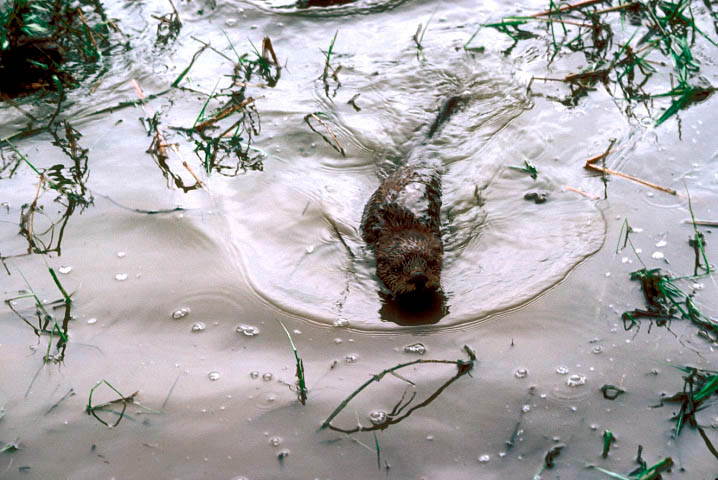
A few months ago we aired a program about Texas river otters with biologist Gary Calkins. At the time, he told us few people ever get to see otters…but then…

With the awareness now from the program, people are talking about it. And so, we’re getting to hear what they’re seeing.

What you’re seeing and telling us about, are river otters… a lot of them it seems…and some in unexpected places.

This has been awesome. We found out about otters a lot further west and further north than we really had an idea that there were good populations. So it’s been really interesting.

Calkins says having extra sets of eyes looking for otters has been a boon to his research.

I was very surprised, but also pretty psyched. It was really neat to start getting some feedback from the radio program on something that we had been trying to do other ways and hadn’t been able to get there.

Researchers are interested in Texas river otters for more than their playful personalities.

They’re kind of an indicator species of how healthy our environment is. So, by trying to get a handle on how their population’s doing, it kind of tells us how our environment is doing overall.

If you spot an otter…on land or water…tell us about it …you know you ought to…at passporttotexas.org.

The Wildlife restoration program supports our series…For Texas Parks and Wildlife…I’m Cecilia Nasti.

TPW TV: Eagles in Texas

Monday, November 2nd, 2009

This is Passport to Texas

This week the Texas Parks and Wildlife television series shares a hopeful story on the bald eagle, [SFX: bald eagle call] a bird that Producer, Abe Moore, says was once in trouble.

Really in trouble. And it came off the endangered species list in 2007. As far as the eagles that live in Texas year-round, we have like, 200 nesting pairs. We were down to four back in the seventies; four nesting pairs. We visit with a landowner down near Victoria that has an eagle nest on his property, and he gets to see them raise their eaglets every year.

They’re a wild bird that is doing its thing right out there in the open—right up there in that tree. It’s nice to be able to keep that kind of thing going.

We also visit with some professional photographers that follow a nest that’s a little more out in the open. Out near Llano, right along highway 29, there’s a nest that the eagles have been using since 2004.

There we go. (clicks) Oh, there goes the baby with it’s wings again. Beautiful. (clicks) That’s good. (clicks) There you go, baby. (clicks).


So, it’s just an amazing bird. And we also, in the story, look at the future of eagles in Texas, and kind of some of the struggles its going through.

Thanks, Abe.

That’s our show… we receive support for the series from the Wildlife restoration program…For Texas Parks and Wildlife…I’m Cecilia Nasti.

Responsible Hunting

Tuesday, October 27th, 2009

Passport to Texas from Texas Parks and Wildlife and the sport Fish and Wildlife Restoration program

We’re in the midst of dove season, which comes with rewards and responsibilities.

We want everybody to have a really good time and be safe while you’re out there. But, so many times we look around a dove area where people have hunted, and we see a lot of trash and debris that the hunter has carried out there.

Hunter education coordinator, Terry Erwin, says leaving trash behind can be harmful to animals that use the land.

Any debris that you took in with you, always take it out. Pick up your hulls especially. The expended shotgun shell hulls that are laying on the ground—cattle will pick those up and eat them. And, sometimes it will be very detrimental to that cattle’s well being.

Packing out whatever you packed in is just one part of being a responsible hunter. The daily bag limit for dove is 15 birds…but what if you shoot your limit and can’t find one of the birds?

If you actually happen to shoot a dove and you can’t find him, although you may only bring home fourteen doves, the one that you didn’t find—let that be part of your bag limit.

Improving your skills and hunting with man’s best friend is all part of responsible hunting.

Always practice and home your shot-gunning skills, and always use a good retriever dog that will help you find that bird so that it’s not wounded and lost.

Find hunting information on the Texas Parks and Wildlife website.

The Sport fish and Wildlife Restoration program…supports our series and is funded by your purchase of hunting and fishing equipment and motorboat fuel…For Texas Parks and Wildlife I’m Cecilia Nasti.