Archive for the 'Wildlife' Category

TPW TV — CWD Response Team

Friday, June 2nd, 2017
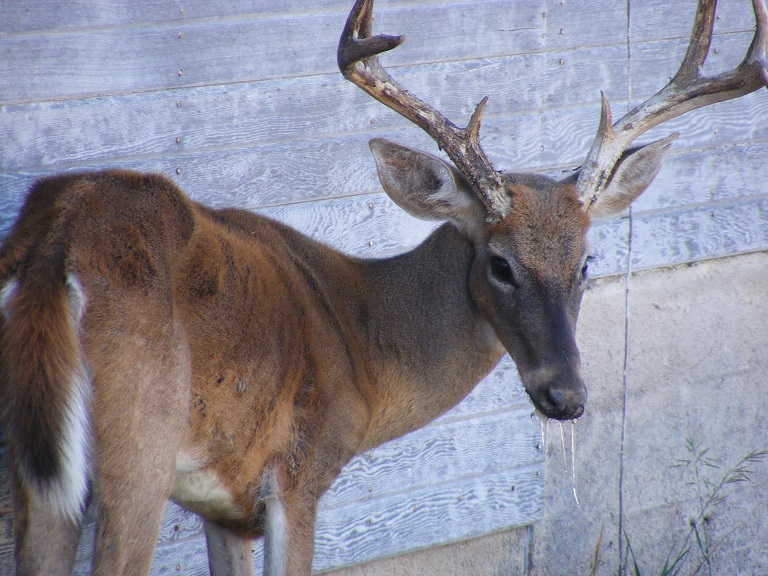
CWD Deer

CWD Deer

This is Passport to Texas

The first case of Chronic Wasting Disease, or CWD, was discovered in 2012 in free-ranging mule deer in an isolated area of far West Texas. Three years later…

2015 the sky fell out. They found a positive in a deer breeding facility.

CWD is a fatal, highly communicable neurological disease in deer. Ryan Shoeneberg is a wildlife program specialist, and part of Texas Parks and Wildlife’s CWD response team. The Texas Parks and Wildlife TV series on PBS features the team on this week’s show. Paul Crossley is a license and permit specialist on the team.

There is not treatment or cure. The only real management technique we have is containment.

This meant shutting down TWIMS—the Texas Wildlife Information Management Service—the central database used to manage deer breeding in Texas. It essentially halted the transfer of deer from breeding facilities, which affected people’s livelihoods.

Our job is to nip it at the bud. Find it like a cancer. Wall it off, and not let is spread out.

The team had the job of helping breeders get deer moving again.

We were essentially given a deadline that said, look, we’ve got to get deer breeders moving again. We’ve got to get commerce going again—by deer hunting season. I think it was 57 days.

The Texas Parks and Wildlife CWD Response TWIMS Reprogramming Team took action. Find out what they did this week on the Texas Parks and Wildlife TV series on PBS. Check your local listings. The Wildlife restoration program support our series.

For Texas Parks and Wildlife…I’m Cecilia Nasti.
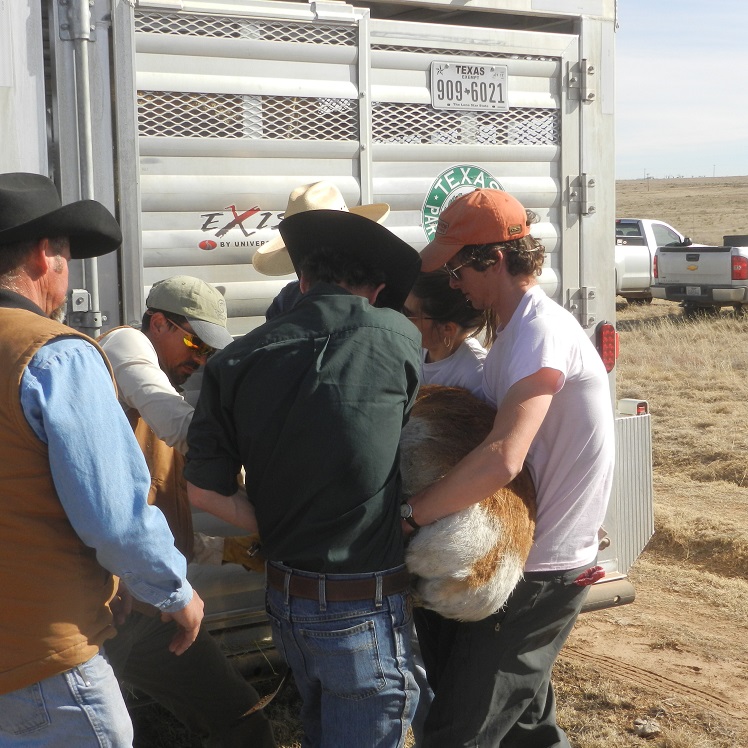
Pronghorn Restoration Benefits Communities

Tuesday, May 30th, 2017
Working to restore pronghorn to the Trans Pecos.

Working to restore pronghorn to the Trans Pecos.

This is Passport to Texas

Wildlife biologist Shawn Gray finds pronghorns fascinating, and hopes you will, too.

The pronghorn is a unique mammal of North America; it’s the only one found in its family. It’s the fastest mammal in North America. It’s a big game species.

Gray is the pronghorn program leader and oversees the Pronghorn Restoration Project. Because it’s is a game species, hunting them should pick up as their population grows, thus benefiting local communities.

In 2008, we issued probably like 800 buck only hunting permits. And, shoot, in 2009 or 10, we were issuing less than 100. And there’s a lot to that. Not only is it the money that they get for trespass access for hunting, but the hunters come into the local communities and spend time and spend money. So, there’s a lot of those economic impacts as well with a much reduced pronghorn population out here.

The Trans-Pecos pronghorn population dipped below 3,000 in 2012, and Gray says through translocation, range management, and natural reproduction, they hope to see the number rise to 10,000.

Most of the local communities in the Trans-Pecos really miss the pronghorn. And they really want to see pronghorn back on the landscape at numbers that they are used to seeing.

With the continued success of the restoration project, they may get their wish.

The Texas Parks and Wildlife Foundation supports our series.

For Texas Parks and Wildlife…I’m Cecilia Nasti.
Restoring Pronghorn to its Range

Monday, May 29th, 2017
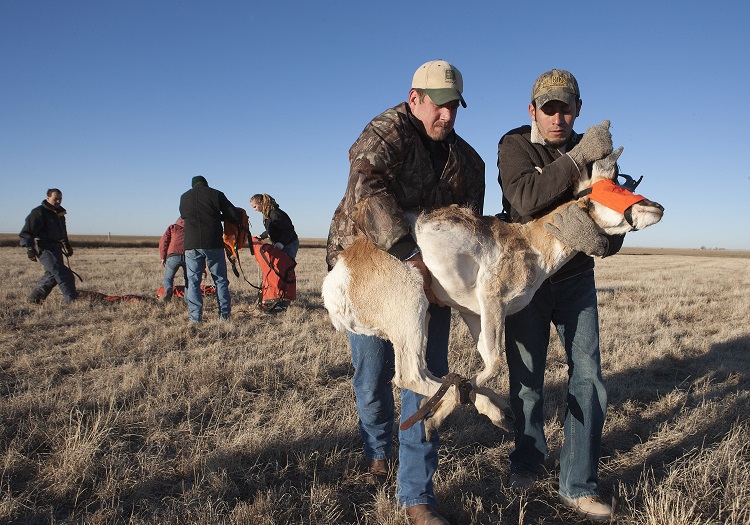
Pronghorn capture and release.

Pronghorn capture and release.

This is Passport to Texas

Wildlife biologist, Shawn Gray, stays busy most days in his role as Texas Parks and Wildlife pronghorn and mule deer program leader in the Trans Pecos.

I get to oversee the management and research for the two species for Texas parks and Wildlife.

This includes orchestrating the restoration of these species to their native range. Earlier this year, Texas Parks and Wildlife successfully relocated 109 pronghorn.

Our surplus populations are located in the Northwest and Northeast Panhandle. We take animals from healthy populations there to boost our local populations in the Trans Pecos that have in recent years seen historic decline.

Texas Parks and Wildlife worked with partners to redistribute the animals. After trapping them, each received a health checkup; some got radio collars for monitoring.

Translocation has been one of the management tools we’ve been able to do to help those populations rebound. There’s a whole suite of things that we do to improve populations. And, of course, we always need help from Mother Nature to make all those things work for us.

Drought was a leading factor in the pronghorn’s decline in the Trans Pecos; Shawn Gray is addressing it and other range issues to ensure the pronghorn’s future.

Through time and our management practices, the populations have been responding well.

The Texas Parks and Wildlife Foundation supports our series…and pronghorn restoration. Find out more at tpwf.org.

For Texas Parks and Wildlife…I’m Cecilia Nasti.
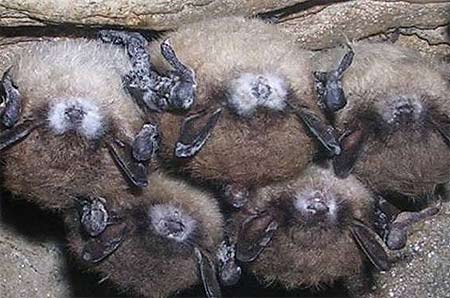
How a Fungus May Spread Among Bats

Thursday, May 4th, 2017
Fungus that causes White Nose Syndrome discovered in six Caves in the Texas Panhandle.

Fungus that causes White Nose Syndrome discovered in six Caves in the Texas Panhandle.

This is Passport to Texas

Texas has the highest diversity of bats in the nation: 33 documented species in 4 families.

And [Texas] is where a lot of eastern and western bats comingle.

That’s a problem, says mammologist Jonah Evans, now that the fungus that causes the bat killing disease White Nose Syndrome was discovered this year in six Panhandle counties.

The other big concern is our Mexican Free-tailed bats, because they migrate and do not hibernate, they are not expected to suffer the same level of catastrophic impacts from the fungus. However, because they don’t die when they are exposed to the fungus—potentially—that would make them even better at spreading it. It is sort of a bat Armageddon situation.

Mexican Free-tail bats migrate in huge numbers across the Americas, creating concern they may spread the fungus.

When really susceptible species get the fungus, usually about 80 percent of the mortality happens in the first year that the disease turns up. What that tells us is that we have to be very proactive on the front end. We have to really start doing something soon. If we wait, we’re going to be trying to treat these stragglers that are left over, and the bulk of the population will be lost.

Researchers continue searching for treatments and cures. Find information about White Nose Syndrome, and decontamination protocol for cavers, on the Texas Parks and Wildlife website.

The Wildlife Restoration program supports our series.

For Texas Parks and Wildlife…I’m Cecilia Nasti.
A Fungus is Finally Among Us

Wednesday, May 3rd, 2017
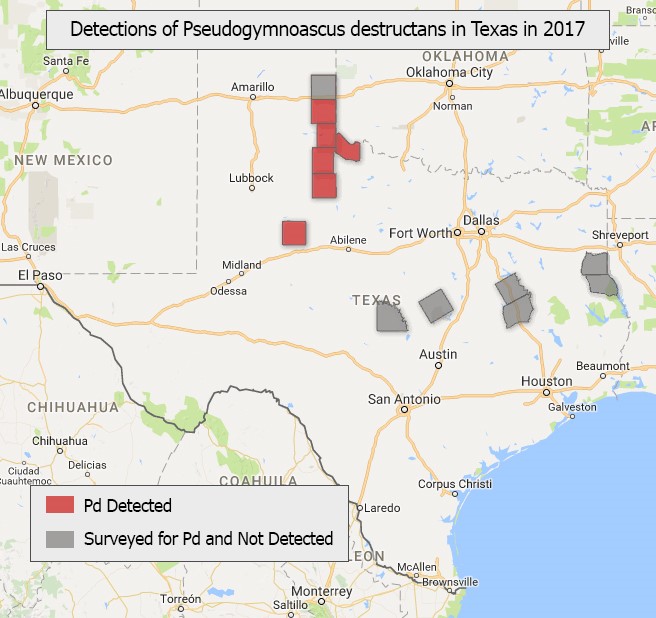
Locations where fungus detected.

Locations where fungus detected.

This is Passport to Texas

The fungus that causes White nose Syndrome, a disease that affects hibernating bats was detected for the first time in Texas earlier this year. Texas Parks and Wildlife mammologist, Jonah Evans says it may have been present for up to a year…

… but at levels too low to detect. So, when you look at the maps of the spread of the fungus across the united States, those maps are always going to be behind where the disease actually is.

Researchers discovered six caves in six Panhandle counties with the fungus.

These are locations where we had previously identified as the most likely for the fungus to turn up first. And sure enough, it did. And so, we had expected to see the disease and the fungus to slowly move across Oklahoma towards Texas. For me, personally, it was a bit of a surprise to have it suddenly one year we go there and it’s all over the place.

For the past six years, the caves in question have come up clean when surveyed.

Likely, it came in at extremely low levels first, and slowly spread. And then, one winter’s worth of growth of the fungus in all of these sites suddenly put it over that threshold where we are now able to detect it.

Find more information on White Nose Syndrome in bats, and decontamination protocol if you go caving, on the Texas Parks and Wildlife website.

The Wildlife Restoration program supports our series.

For Texas Parks and Wildlife…I’m Cecilia Nasti.
