Archive for the 'Wildlife' Category

Assisted Living: Attwater’s Prairie Chickens

Tuesday, February 21st, 2017
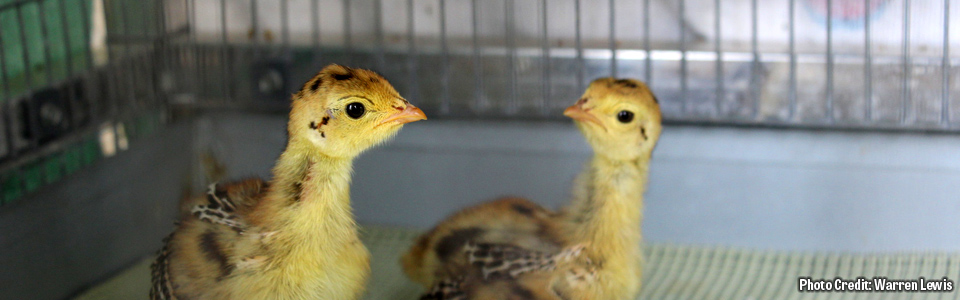
Baby Attwater's Prairie Chickens At Fossil Rim

Baby Attwater’s Prairie Chickens At Fossil Rim

This is Passport to Texas

We all need help sometimes. And in the case of the endangered Attwater’s Prairie Chicken, they’re getting it in the form of captive breeding programs, including one at the Fossil Rim Wildlife Center in Glen Rose.

Adding birds from the captive breeding program has allowed us to keep birds in the wild. Without the captive breeding program this species, undoubtedly, would have been extinct by now.

Biologists estimate there are fewer than 100 Attwater’s Prairie Chickens in existence today. Mike Morrow is a wildlife biologist at the Attwater’s Prairie Chicken National Wildlife Refuge in Eagle Lake. The juvenile prairie chickens at Fossil rim are color banded and radio collared in preparation for release onto the refuge.

How many other species can we watch go extinct, before it starts making a difference the ability of the world to support us as a human species.

Juvenile birds take a long ride to the refuge and are kept in an outdoor enclosure until they’ve acclimated to their new habitat. After two weeks in their pen, they’re released onto the refuge.

Biologist Morrow says he knows not all the birds they release will survive, but those that do, represent the future. He says Texas Parks and Wildlife and partners will continue to build the population with wild birds. And that’s where he says we place the hope for the recovery of the species.

The Wildlife Restoration Program supports our series.

For Texas Parks and Wildlife…I’m Cecilia Nasti.
Most Endangered Bird in North America

Monday, February 20th, 2017
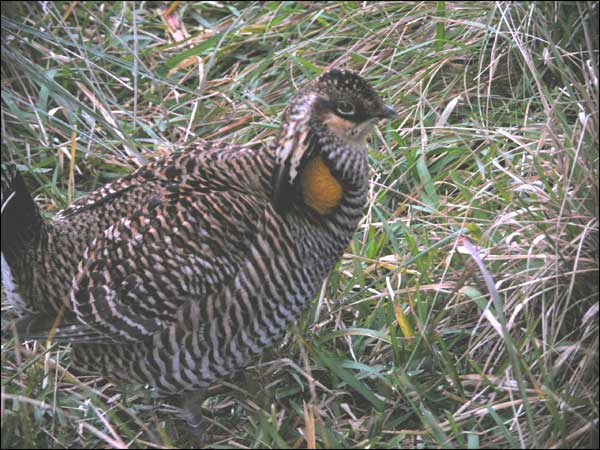
Attwater's Prairie Chicken

Attwater’s Prairie Chicken

This is Passport to Texas

The most endangered bird in North America is a chicken. No, it’s not your ordinary farmyard fowl. It’s the extraordinary Attwater’s Prairie Chicken—a species unique to Texas coastal prairies. Yet, over the past two decades fewer than 100 individuals have been reported in the wild.

For a species that only lives on average two years—that’s a very bad place to be.

Mike Morrow is a wildlife biologist at the Attwater’s Prairie Chicken National Wildlife Refuge in Eagle Lake. He works with biologist Rebecca Chisholm.

You know, they’re [prairie chickens] an endangered species all over the rest of the country and the world. But this one here, lives only in Texas.

The birds are part of our natural heritage. At the refuge, Morrow and Chisholm work together to give the Prairie Chicken a chance at survival, which includes building predator deterrent fences around nest sites.

The idea of this predator deterrent fence Is to deflect predators away from the nest area so that hopefully they won’t find the nest and destroy it.

The fence doubles the chance of survival for the hens and chicks. And when there are fewer than 100 members in a population, you take those odds.

Working with—arguably the most endangered bird in North America—has its ups and downs. I mean, sometimes, it’s a little bit disappointing. Things don’t go quite as well as you want, but it’s also rewarding when things do. So I think everyone would agree that it’s worth it.

Wildlife Restoration program supports our series.

For Texas Parks and Wildlife…I’m Cecilia Nasti.
Rabbits Versus Hares — Some Differences

Monday, February 13th, 2017
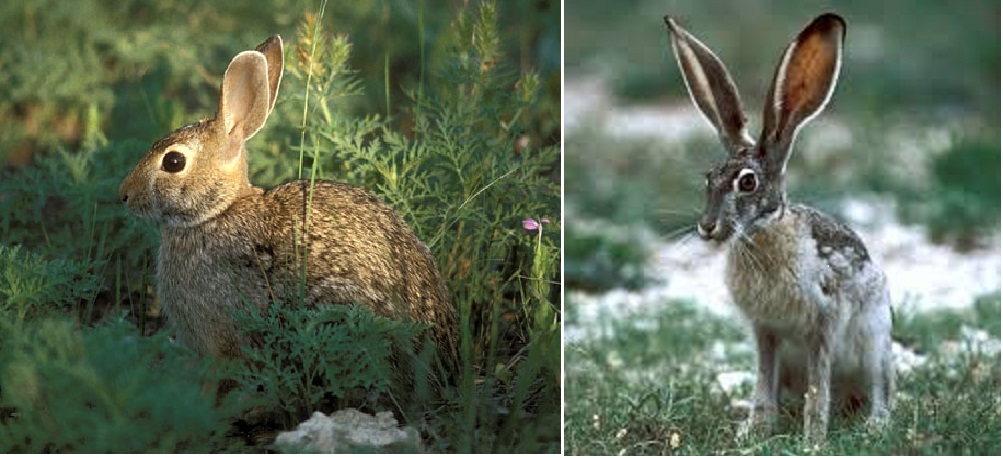
Side-by-side comparison of a cottontail (left) and hare (right).

Side-by-side comparison of a cottontail (left) and hare (right).

This is Passport to Texas

A cottontail is a rabbit and a jackrabbit is a hare. And although they’re in the same family, they’re different species. Hares have longer ears and back legs than rabbits—and the differences don’t stop there.

One of the differences between hares and rabbits are the types of nests they build. And this is determined by the condition of their young at birth.

Heidi Rao is a hunter education specialist. She says true rabbits are born hairless, blind, and dependent on their mother’s care.

A young jackrabbit is actually born with his eyes open, and his body fully furred, and with the ability to hop around only moments after birth. It doesn’t need an elaborate nest to be reared.

Hares are less social, and they give birth and raise their young in above ground nests. Rabbits live in groups, and give birth and raise their young in underground burrows or warrens. There is one exception. The cottontail.

The eastern cottontail’s nest is a saucer-like depression three or four inches deep and about eight inches across. And they line it with mouthfuls of soft, dead grass mixes, and hair from the mother’s body.

Hares are more skittish than rabbits and do not make good pets. But they both are good eating. Hunting rabbits and hares…that’s tomorrow.

For Texas Parks and Wildlife…I’m Cecilia Nasti.
TPW TV – Bat Monitoring

Friday, December 30th, 2016
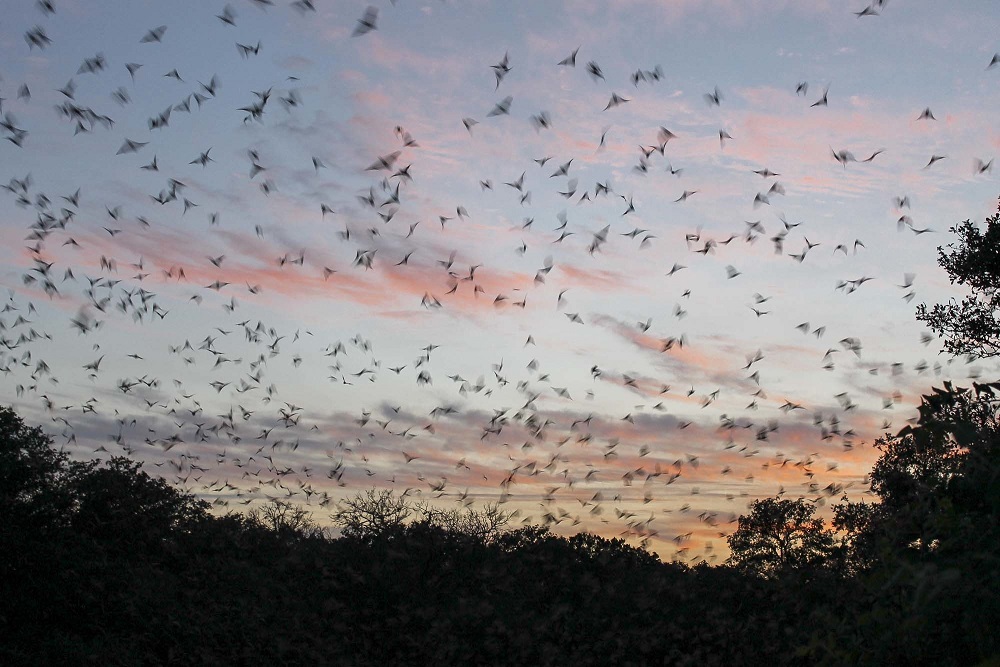
Bats emerging from Bracken Cave.

Bats emerging from Bracken Cave.

This is Passport to Texas

Texas is home to 33 of the world’s more than 13-hundred bat species. Bats devour tons of agricultural insect pests, pollinate crops and native plants, and bring tourists to Texas.

We have the largest congregations of bats in the entire world. People travel all over the world to see Bracken Bat Cave, Old Tunnel State Park, Congress Street Bridge. It’s a wildlife phenomenon

But Jonah Evans, Texas Parks and Wildlife mammologist, says Texas bats face a serious threat: White Nose Syndrome, a fungal disease fatal to hibernating bats, discovered 10 years ago in the Northeast.

It’s right at our border. And during that time, it has killed an estimated 6-million bats. Which, in some states, amounts to a very high percentage of all the bats in their states.

Evans and other bat conservators discuss the problem of white nose syndrome next week on the Texas Parks and Wildlife TV series on PBS.

At this point, all we can do is monitor closely, learn what we can, and be prepared if an opportunity to apply some kind of treatment arises. There is currently no way to stop the spread of White Nose Syndrome. However, there are many smart people working really hard on trying to find ways of doing just that.

Watch this highly informative segment on Bat Monitoring in Texas on the Texas Parks and Wildlife TV series on PBS the week of January 1, 2017. Check your local listings.

The Wildlife Restoration program supports our series.

For Texas Parks and Wildlife…I’m Cecilia Nasti.
Monitoring for Chronic Wasting Disease

Tuesday, December 13th, 2016
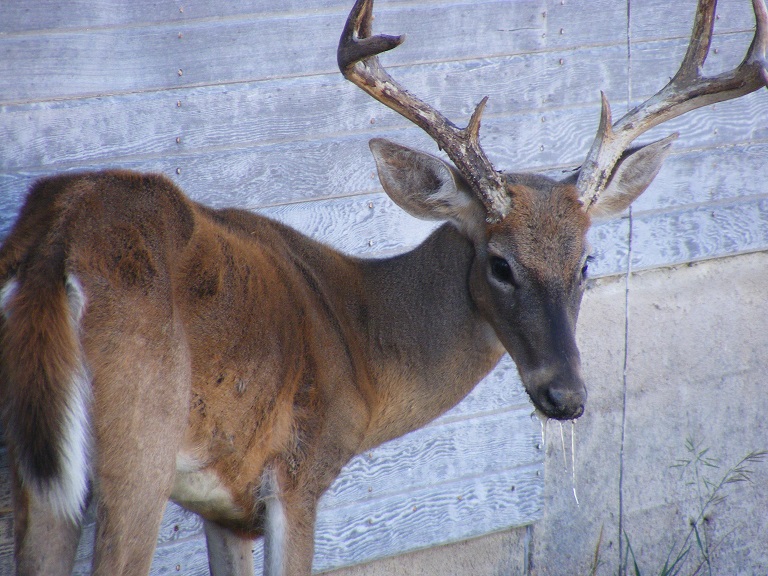
Deer suffering from Chronic Wasting Disease (CWD).

Deer suffering from Chronic Wasting Disease (CWD).

This is Passport to Texas

The outlook for deer season is outstanding thanks to plentiful rainfall. White-tail program leader, Alan Cain.

The rainfall that’s been very prevalent across the state this year, has also provided great vegetation for the mule deer and the pronghorn out there in West Texas. Hunters that are out there pursuing mule deer and pronghorn will have an excellent year [too].

To maintain healthy herds, biologists want hunters to help monitor deer for Chronic Wasting Disease [CWD]—a neurological disease that kills deer, but has no known effect on humans.

Chronic wasting disease has been a concern in Texas since 2012—since the first discovery in the trans Pecos. We also had a new positive discovered in the Panhandle this past hunting season 2015.

Texas Parks and Wildlife created mandatory containment and surveillance zones for Chronic Wasting Disease testing and rules for transporting harvested deer in parts of west Texas.

Hunters in those Chronic Wasting Disease zones that harvest a deer, are required to bring those deer to the check stations so our staff can pull a CWD sample. We do have another CWD zone in portions of Medina, Uvalde and Bandera counties; and that is a voluntary surveillance zone. So, we would appreciate all the help we can get from our hunters out there to bring deer in so we can monitor for CWD.

Find more information on the Texas Parks and Wildlife website.

The Wildlife restoration program supports our series.

For Texas Parks and Wildlife…I’m Cecilia Nasti.
