Archive for the 'Wildlife' Category

TPW Magazine/Invasive: Lionfish

Thursday, December 19th, 2013
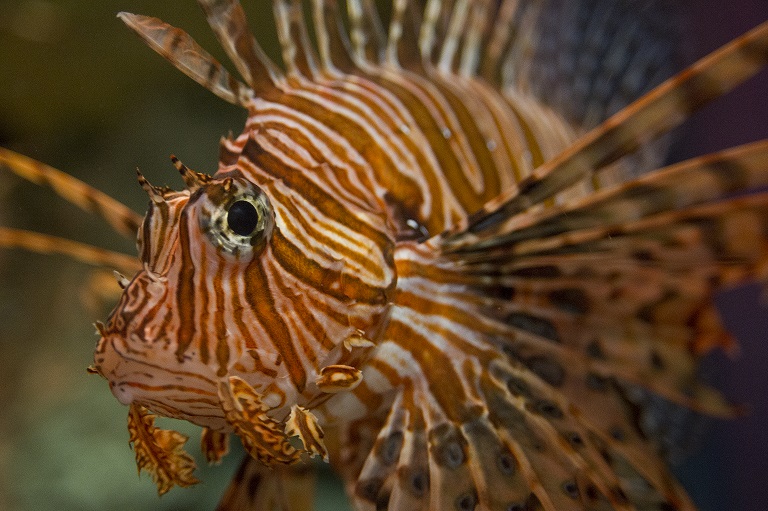
Lionfish, CHASE FOUNTAIN, TPWD ©2013

Lionfish, CHASE FOUNTAIN, TPWD ©2013


This is Passport to Texas

Since 1986, scientists have followed the spread of Lionfish from the south Atlantic to the Gulf of Mexico.

04— So far their effect in the Gulf has been minimal; but that will change.

Melissa Gaskill is a science and travel writer living in Austin. She wrote an article about the potential problem of Lionfish for the December issue of TPW Magazine, on newsstands now.

11—They’re very voracious eaters, and they eat everything and anything. They eat all kinds of fish; they’ll eat anything that can fit in their mouth. And they’ll eat and eat and eat, and just grow and grow and grow. And nothing eats them.

We may have saltwater aquarium enthusiasts to “thank” for the current Lionfish situation.

07— Someone probably got fed up with their pet lionfish eating all of their other pet fish and just decided to dump them in the south Atlantic.

In addition to the species’ voracious appetite, it’s also a prolific breeder.

23— They spawn more often than most reef fish; they also spawn in pairs. And when they reproduce, their little fishies drift on currents; so it’s inevitable they’d end up in this part of the Gulf given prevailing currents. And scientists and divers have been able to watch this gradual and not so gradual spread. They were first seen out around the Flower Gardens, and now they’ve been seen closer to our coast.

Tomorrow: managing this invasive species with butter and lemon.

For Texas Parks and Wildlife…I’m Cecilia Nasti.
Wildlife/Birding: Christmas Bird Count

Monday, December 9th, 2013

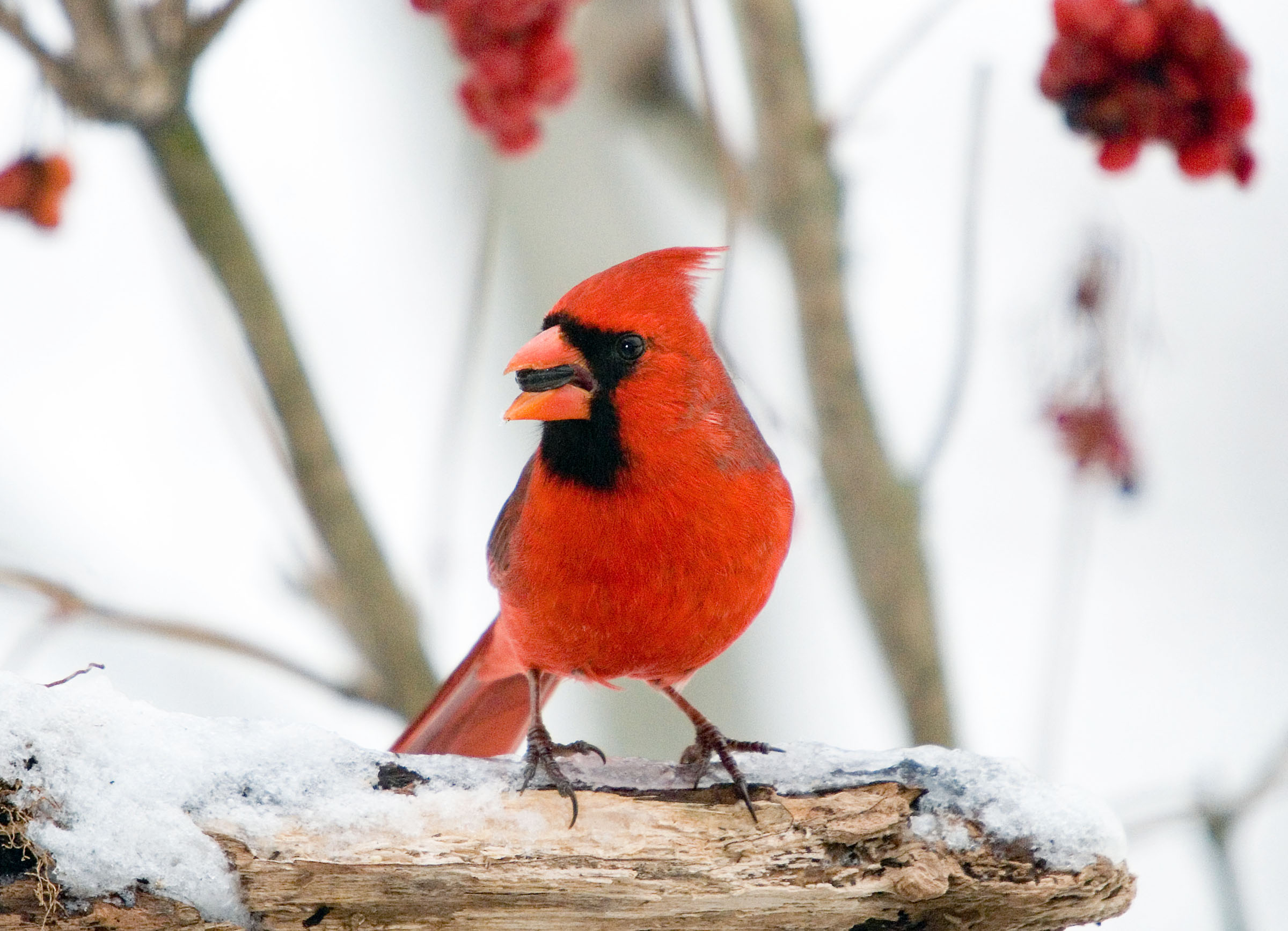
Christmas Bird Count, image Jerry Acton, www.audubon.org

Christmas Bird Count, image Jerry Acton, www.audubon.org


This is Passport to Texas

More than a hundred years ago people participated in a time-honored Christmas tradition.

06— People would go out and do what was called a side hunt, and the winning group would come back with the biggest pile of dead critters.

How festive. The majority of critters in those piles were birds. Cliff Shackelford, a non-game ornithologist with Parks and Wildlife, says conservationists had a better idea.

05—Early conservationists thought that we ought to count birds and not try to collect birds.

Today we have the nationwide Christmas Bird Count. Between December 14 and January 5, volunteers, armed with bird lists, head into the field and count birds over a 24-hour period.

15—What people do is they get into teams, and they have a defined 15 mile radius circle that they’re counting in, and that circle never moves. The hope is that you would count that circle for decades and decades and over time you would see trends.

Different groups pick different days within that three week period to count birds. Researchers use the census information to assess the health of bird populations, and to guide conservation action.

05—They might need a full year’s heads up to chew on it and figure out, hey, I want to do this next year.

Go to audubon.org for more information. The Wildlife and Sport Fish Restoration program supports our program. For Texas Parks and Wildlife…I’m Cecilia Nasti.
Wildlife: Where to See Whooping Cranes

Friday, December 6th, 2013

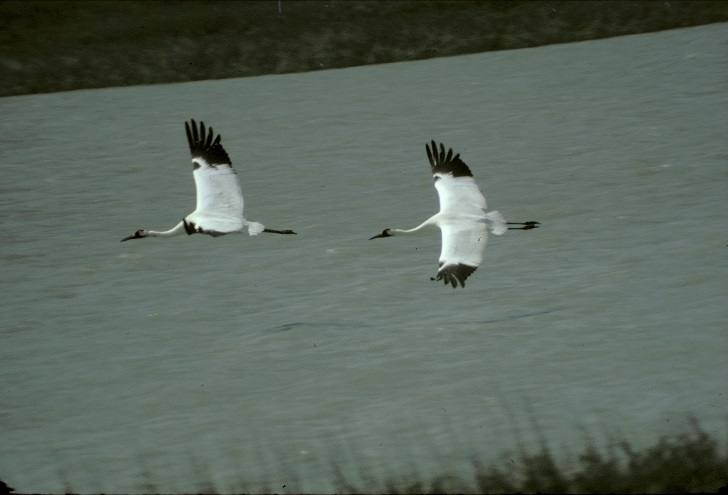
Whoopers in flight.

Whoopers in flight.


This is Passport to Texas

According to Parks and Wildlife biologist Leeann Linam, sightings of migrating whooping cranes, which winter in Texas, started in October.

21— Mid-October is traditionally the early arrival time. By mid-December they should all be in Texas. So, from there, we’ll take a look and see where they’ve chosen to spend their wintering time this year. And they’ll remain on those wintering grounds until late February to early or mid-March, when some migration movements will start, and by mid-April they’re mostly gone from the state.

Some of the birds are still moving through Texas and depending on where you live – you might be able to catch a glimpse of them heading toward the coast.

23 – Well, the center of the migration path probably passes over Wichita Falls, western Tarrant County – Fort Worth area – down across Waco, just east of Austin, probably. Then, from there on down to Victoria and the Texas coast. So, that’s the center of the flyway. And from that center, 100 miles to the east and the west are the greatest possibilities of seeing them.

Look for a large white bird with black wing tips that’s flying in a group of three to six. If you miss them on the way here – you can always catch them on their way back to Canada in spring.

Learn more about whooping cranes and the Whooper Watch program on the Texas parks and Wildlife website.

The Wildlife and sport fish restoration program supports our series.

For Texas Parks and Wildlife…I’m Cecilia Nasti.
Wildlife: Whooping Crane Recovery Update

Thursday, December 5th, 2013

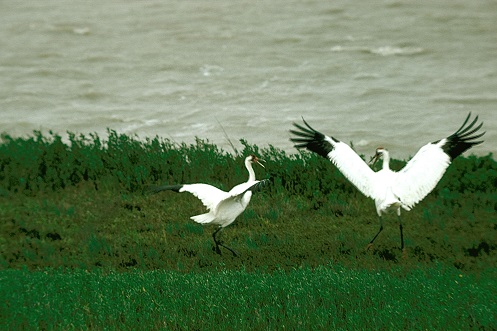
Pair of Whooping Cranes

Pair of Whooping Cranes


This is Passport to Texas

Parks and Wildlife biologist, Leeann Linam, has a long history with Whooping Cranes.

11— [chuckles] well, I may age myself here, but we moved to the Aransas National Wildlife Refuge when I was 12. And so I guess that means about 40 years or so I’ve been involved with whooping cranes.

Whoopers winter at the refuge, where Leeann’s father worked for the US Fish and Wildlife Service. Yet, after 70 years of conservation—and a low of 15 birds—there are still fewer than 300 members in the migrating population.

24 – Part of it is the nature of the animal, itself. Whooping cranes are one of these birds designed to be around for a long time. They live 25 to 30 years and more (in captivity). They don’t reproduce until they’re four or five years old; they usually only raise one chick successfully per year. So it just takes a while. You just have to be patient and provide the right conditions for a long time and then the numbers start to add up.

As their population increases and becomes more widespread, maintaining an accurate tally of the birds becomes a challenge. Whoopers are moving farther up the coast away from their traditional wetland habitat.

07 – Some in the rice country in Horton County and most interestingly, in Central Texas, we’ve had some whooping cranes wintering in Williamson County.

Tomorrow: where to see migrating whoopers.

The Wildlife and sport fish restoration program supports our series and funds diverse conservation programs in Texas…

For Texas Parks and Wildlife…I’m Cecilia Nasti.
Tech/Wildlife: iNaturalist

Friday, November 8th, 2013

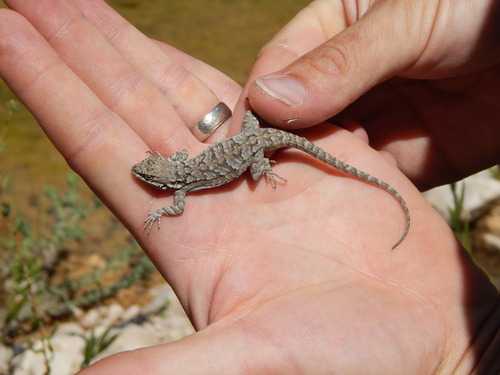
Big Bend Tree Lizard, image by Michael Smith

Big Bend Tree Lizard, image by Michael Smith


This is Passport to Texas

Next time you observe an amphibian or reptile share it with Herps of Texas (HOT) online at iNaturalist (http://www.inaturalist.org/projects/herps-of-texas).

10 — We chose to go with the platform iNaturalist, because it is accessible, and at the same time, allows us to capture the data we need for our database.

Cullen Hanks manages the Texas Natural Diversity Database at Texas Parks and Wildlife. He says identifying the species before posting it online isn’t necessary.

26—By doing so, it encourages the community to help them validate that observation by figuring out what the species ID is. iNaturalist covers what kinds of species? You can post any species of plant or animal to iNaturalist. You can post something even if you don’t know what species it is. For example, if you see a lizard and you don’t know what species of lizard it is, by posting it, the community will help you identify that species.

This crowd-sourced information helps Cullen map known herp populations across the state.

12—And we found this is a great platform that allows people to share these observations that they’re seeing out there, but it also – by setting up a project – it allows us to capture the data we need so that those observations have value to conservation.

Learn more about Herps of Texas on iNaturalist in an article by Cullen Hanks in the November issue of Texas parks and Wildlife Magazine.

For Texas Parks and Wildlife…I’m Cecilia Nasti.
