Archive for the 'Food' Category

Early Texas Life…and Sausage

Friday, August 21st, 2015
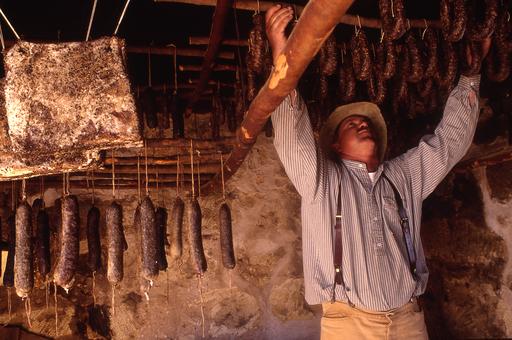
Hanging sausage to dry at Sauer-Beckmann Living History Farm

Hanging sausage to dry at Sauer-Beckmann Living History Farm

This is Passport to Texas

Buying ready to cook food wasn’t an option for early Texans. Most grew vegetables and raised animals to feed their families. Timing was everything when processing certain foodstuffs.

05-Things like this butchering that we’re doing today, or making sausage, has to be done in the wintertime.

Summer heat would spoil fresh meat. The Sauer-Beckmann Living History farm, at the LBJ State Park and Historic site, interprets early Texas life.

05-What we’re doing on a daily basis down here is just trying to show you how people would have lived a hundred years ago.

Which means this early 1900s farmstead did not have the benefit of refrigeration. If families wanted bacon or sausage in summer, for example, they had to plan ahead and make it during the cooler months of the year.

05-Because a lot of the meats we prepare, they take about ten days to cure.

Attempting to cure meat in 10 days of Texas– summer heat would raise a stink. Staff uses 60 % beef to 40% pork when making sausage, a favorite of the German families that settled Texas Hill Country communities.

10-You know, these people ate a lot of lard, they ate a lot of fat. But they were working so hard that it really didn’t make them fat, because they burned it all off. They worked their way through all those calories.

Something to consider next time you’re in air conditioned comfort, eating a sausage sandwich, unbuttoning the top button of your jeans.

That’s our show… For Texas Parks and Wildlife…I-m Cecilia Nasti.
TPW TV: Spice on Fish

Monday, August 10th, 2015
Cooking Crappie at Camp

Cooking Crappie at Camp


This is Passport to Texas (Aug 10)

Next week, Texas Parks and Wildlife’s Tim Spice takes viewers from pole to platter, when he cooks up crappie filets outdoors on the Texas Parks and Wildlife PBS TV series.

After cleaning, deboning, skinning and drying the fish…

11- We’re going to lightly prep it with a little bit of salt and a little bit of fresh pepper [grinding pepper]. Just a little bit of pepper, though, because crappies are really nice delicate fish, and you don’t want to overpower it.

Next, he dredges the fish in plain cornmeal.

05- I was raised with simple cornmeal; and you’ll get a great fish flavor just this way.

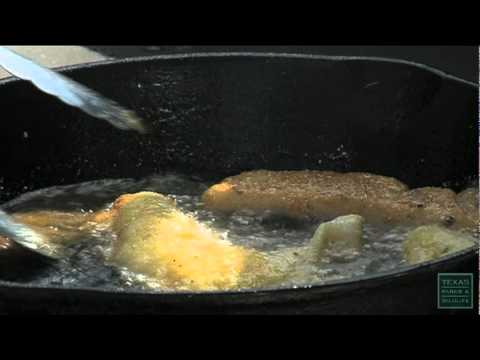
Buttermilk added to the cornmeal makes a thick batter, but if you want to taste the fish, Spice says: less is more. A camp stove supports a cast iron skillet with hot oil.

15- Alright. We’ve got that temperature right where we like it– about 275. Now, we’re just going to take our fish and put ’em right in the oil. Watch your fingers so you don’t splatter that hot grease. We want to cook the crappie for about two minutes on each side. Nice light brown; that keeps it nice, moist, and tender on the inside.

The filets are done and ready to serve in no time.

08– You want to know how your fish are done? Here’s a simple test: take a fork, and if you can break apart the flakes–that means your fish is done.

For an even lighter dish, Tim Spice demonstrates a pan seared, herb rubbed fish recipe the week of Aug. 17 on the TPW PBS TV series. Check your local listings.

That’s our show… Funding provided in part by Ram Trucks. Guts. Glory. Ram

For Texas Parks and Wildlife, I’m Cecilia Nasti.

Cooking Fish with a French Twist

Wednesday, July 1st, 2015
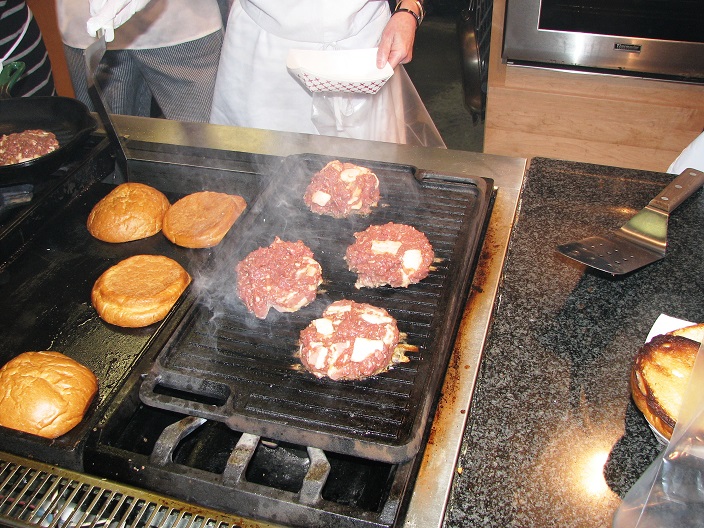
Previous Central Market Class making Elk Burgers at  Fort Worth Coking School, photo by Brett Johnson.

Previous Central Market Class at Fort Worth location, photo by Brett Johnson.


This is Passport to Texas

Since the French flag flew over Texas, and since the area they originally colonized was on the Texas coast, and since Bastille Day, which celebrates the beginning of the French revolution is July 14, Texas Parks and Wildlife, with Central Market Cooking Schools statewide, is holding cooking public classes on July 14 that feature seafood with a French twist.

08—I love the saltwater as well as freshwater. But the saltwater you have more variety. You never know what you’re going to pull up. It’s exciting – like Christmas morning.

That’s Cindy Haenel, an avid angler and a staff chef at the Austin Central Market Cooking School. Snapper, shrimp, and striped bass will take on the flavors of France during the class. The key to preparing any fish dish to perfection—French or otherwise—is to not overcook it.

22—Most people, if they don’t like the taste of fish, it’s probably because they’ve overcooked it. And, as it cooks, and the oil of the fish starts to come out of the flesh, it burns very, very quickly. So, if you will undercook your fish, or protect that fish with either a salt crust, or even if it just has a little butter, or some kind of fat on the outside it still protecting that fish while it’s cooking.

A Texas Parks and Wildlife representative will be on hand to discuss the various species on the plate as well as coastal fishing in Texas.

Find a Central Market Cooking School Registration at passporttotexas.org.

For Texas Parks and Wildlife…I’m Cecilia Nasti.

The “Cure” for Feral Swine

Monday, May 25th, 2015
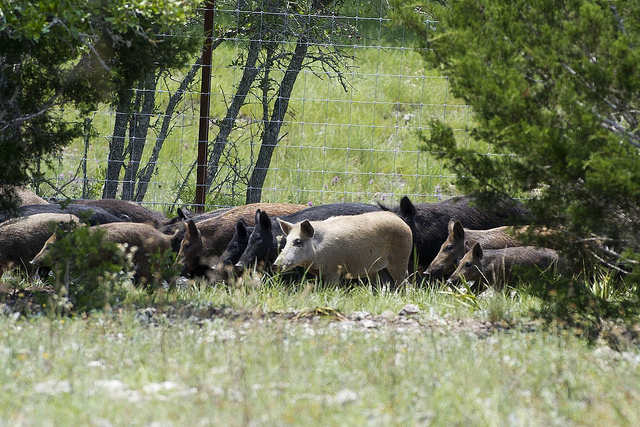
Feral Hogs at the Kerry Wildlife Management Area

Feral Hogs at the Kerry Wildlife Management Area

This is Passport to Texas

It’s ironic that sodium nitrite, a preservative used in sausage-making, might one day aid in the control of feral swine in Texas.

11- Sodium nitrite gives cured meat a red color, improves the flavor; we eat it all the time in bacon, ham and any cured meat.

Biologist Donnie Frels works out of the Kerr Wildlife Management Area. Sodium nitrite can reduce the blood’s ability to carry oxygen throughout the body. Humans and most mammals have an enzyme which efficiently reverses this process: swine cannot.

10- We are attempting to take advantage of that and exploit that in order to use sodium nitrite as a possible control measure in feral swine.

Exotic feral hogs compete with native wildlife for food and destroy habitat. Researchers are working with professional chemists to stabilize the sodium nitrite so they can successfully place it into a “bait matrix”.

12- Which can then be used in a specific feeder which only hogs can gain access to. That way we ensure that other non-target animals are not exposed to the toxicant bait.

Researchers at the Kerr have been investigating sodium nitrite as possible control for feral swine since 2010 (in a secure 12 acre research facility); while it looks promising, Frels says it may be several more years before an effective toxic bait is available commercially.

The Wildlife Restoration Program supports our series.

For Texas Parks and Wildlife…I’m Cecilia Nasti.

May is a Great Month to Picnic at State Parks

Thursday, May 7th, 2015


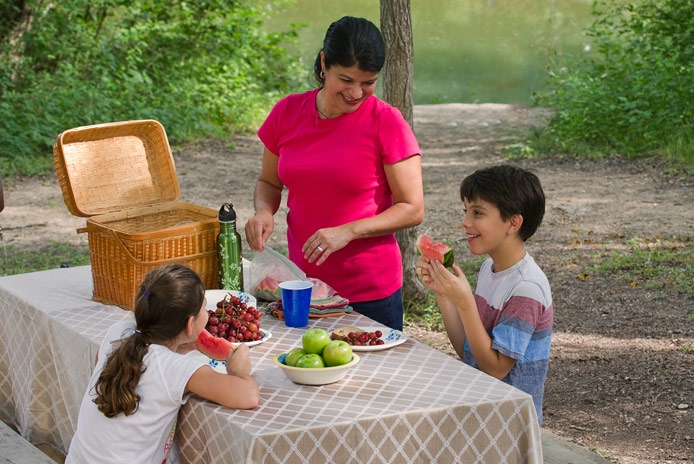
Picnics in state parks do not have to be complicated.

Picnics in state parks do not have to be complicated.


This is Passport to Texas

May is the start of picnicking season in Texas. Angela Shelf Medearis, an author and cook, whose moniker is The Kitchen Diva, offers tips for a stress-free picnic.

62— Well, let me give you Diva Picnic 101. For one – make foods that you could do in advance. If I was doing a picnic, I would have something like a really good roast chicken; just cut the pieces up and pack those in there. I do a Carolina Cole Slaw; you toss it up, throw it in the refrigerator – it gets better day-by-day. So, if you want to do that ahead you could. You don’t have to worry about having to do everything that day. That takes all the fun out of the picnic to me if you’re trying to do all the food prep, and pack everything, and get everybody to the park. So, start your picnic a few days ahead. Use a lot of fresh fruits for dessert. The thing about a picnic that I love is you can totally unplug and really focus on the people you should be paying the most attention to. You can get out in nature; we have some beautiful parks. Some beautiful places to go in Texas. And, it gives you a chance to really focus on the most important things: your family, nature, the beauty of life… So, do a little planning ahead, and pick dishes that will be fine hot or cold, and you can’t go wrong for a great picnic.

Remember: always pack out what you pack in, and leave your picnic site in better condition than you found it.

That’s our show… Funding provided in part by Ram Trucks. Guts. Glory. Ram

For Texas Parks and Wildlife, I’m Cecilia Nasti.