Archive for the 'Conservation' Category

Happy Earth Day!

Wednesday, April 22nd, 2015
Earth Day in Texas--what will you do to make it a better place?

Earth Day in Texas–what will you do to make it a better place?


This is Passport to Texas

On April 22, 1970, 20 million Americans took to the streets, parks, and auditoriums to demonstrate for a healthy, sustainable environment…and thus began the annual celebration of the planet called Earth Day.

2015 marks the 45th Anniversary of Earth Day, and millions of people worldwide are gearing up for it. But a once a year celebration is useless if that’s where it ends. So I want to challenge everyone listening, to do something every day to care for Mother Earth.

What kinds of things can you do? Perhaps plant native plants that use less water and provide food and shelter for wildlife. That’s my plan. Or take a ceramic coffee mug to the office instead of using disposable cups. Perhaps when you’re out fishing you could properly dispose of monofilament fishing line so it doesn’t harm aquatic life.

In addition, when camping, leave your campsite in better shape than you found it. Or, your stewardship goal might be to spend time with your family outdoors instead of inside with the television—because you’re no good to nature with a remote in your hand.

Mix it up, and add new earth friendly activities to your list every month between now and next Earth Day. Challenge your family, friends and neighbors to do the same.

What will you do? Go to passporttotexas.org and let me know in the comments section, and start inspiring others.

That’s our show… For Texas Parks and Wildlife…I’m Cecilia Nasti.
TPW Mag: Sharing Responsibility for Nature

Tuesday, April 14th, 2015
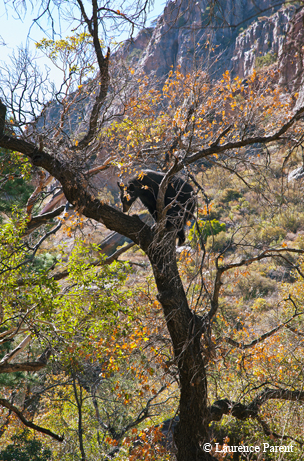
A black bear looks for a beehive in a tree in Big Bend's Chisos Mountains

A black bear looks for a beehive in a tree in Big Bend’s Chisos Mountains


This is Passport to Texas

The Chihuahuan desert ecosystem sprawls across Texas and Mexico, making the conservation of its flora and fauna a shared responsibility between the two nations. However, writer Melissa Gaskill says the conservation philosophies of the countries differ.

21—In this country, we form something like Big Bend National Park, and it’s just for the recreation and the wildlife, and people don’t live there. On the Mexican side, they have more of sort of what we would see as a conservation easement approach. Where an area is protected, but there are still homes and ranches and villages—life goes on—but they behave a little differently toward nature.

Gaskill wrote the article Nature Without Borders for the April issue of Texas Parks and Wildlife magazine. Although the US and Mexico share conservation challenges, they also share the successes.

31—One of the successes is black bears. They disappeared on this side back in the 1950s, but given the remoteness of the country on the Mexican side, they remained there, and once they started protecting them actively in Mexico, and we started having all these protected lands on this side that provided good habitat, the bears on their own, crossed the river and repopulated in the Big Bend area. And, they’re doing pretty well; they have the potential to spread elsewhere within Texas where there’s good habitat.

Learn more about the flora and fauna of this area of Texas when you read Melissa Gaskill’s article Nature Without Borders in the April issue of Texas Parks and Wildlife magazine.

The Wildlife and Sport Fish Restoration program supports our series.

For Texas Parks and Wildlife…I’m Cecilia Nasti.
TPW Mag: Nature Without Borders

Monday, April 13th, 2015

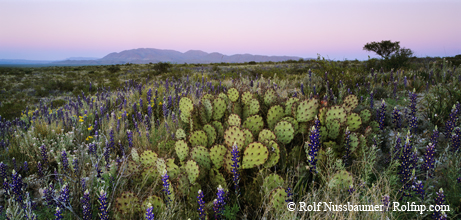
Desert in bloom with Big Bend Bluebonnet and Prickly pear cactus

This is Passport to Texas

Men create borders which nature ignores.

07—Down in the Big Bend area there’s a heck of a lot of nature and there’s a border running right through it and the animals and plants just don’t care.

Nature Without Borders is an article by writer Melissa Gaskill for the April issue of Texas Parks and Wildlife magazine. She explores how the US and Mexico coordinate their efforts to preserve our shared flora and fauna.

20—They’ve actually been collaborating for a really long time in trying to work together. This is really one big ecosystem – the Chihuahuan desert. The way to protect it and effectively manage it, you really have to do that by cooperating on both sides. One side can’t be doing half the job and the other side doing a completely different half the job. It just wouldn’t work that well.

One of the biggest challenges both sides face is the shear vastness of the area in question, but that’s not all.

20—We’re talking about three million acres all told, and that’s a lot of ground to cover for anybody. The fact that there’s an international border in the middle of it—even when you can cross—it just complicates things. You have two governments; two very different approaches to conservation between the two countries; you have a language issue. And then there are the specific challenges in terms of the types of animals out there.

We’ll hear about those tomorrow. The April issue of Texas Parks and Wildlife magazine is available on newsstands and for download on the new Magazine APP. Find download information at tpwmagazine.com.

The Wildlife Restoration program supports our series.

For Texas Parks and Wildlife…I’m Cecilia Nasti.
Conservation: Wild For Texas License Plates

Friday, April 3rd, 2015
Conservation License Plates

Conservation License Plates


This is Passport to Texas

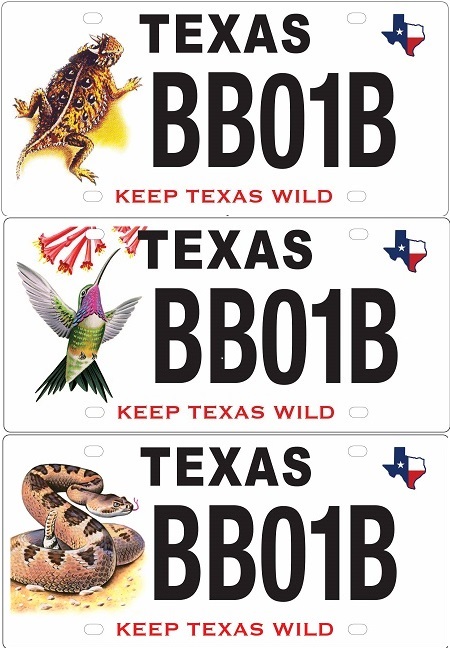
Texas Parks and Wildlife recently launched two new conservation license plates to support native wildlife projects in Texas. Janis Johnson says one features a Lucifer hummingbird, while the other a diamondback rattlesnake.

09—And these two critters, if you will, join our horned lizard license plate. And together, we’re calling it the “Wild for Texas”
collection. Sounds fun, doesn’t it?

Janis is a marketing specialist with Parks and Wildlife. Proceeds from the sale of license plates in the Wild for Texas collection support native wildlife projects.

14—Anything from building out habitat and restoration of the Bracken Cave. Taking care of endangered or threatened species. Finding new habitat that’s suitable for our horned lizard. We’ve got some educational programs, [too].

Since its debut in1999, the horned lizard plate’s raised nearly $ 4-million dollars for native wildlife. Combined with sales from other plates, that number increases to $7-million dollars for conservation in Texas. Have a driving passion for conservation?

12—Just go to conservationplate.org, and check out all 7 of our conservation license plates. They’re only $30 and you can put one on your vehicle, trailer or motorcycle.

Twenty-two dollars from every sale goes directly toward conservation projects in Texas.

For Texas Parks and Wildlife…I’m Cecilia Nasti.
Nature: Texas Wildflowers

Thursday, March 19th, 2015
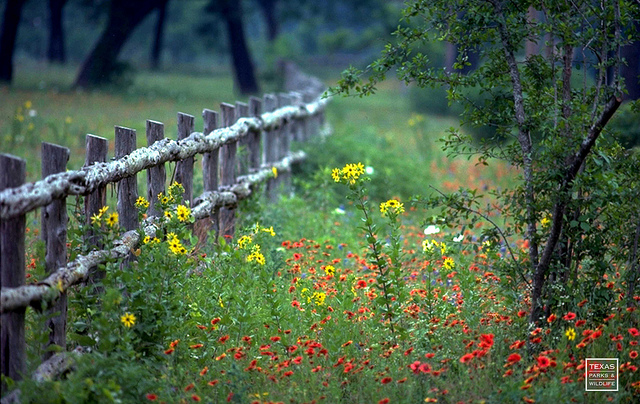
Wildflowers at LBJ State Park

Wildflowers at LBJ State Park


This is Passport to Texas

Spring in Texas is a colorful time of year thanks to wildflowers growing statewide. Jackie Poole says these native plants create a sense of place.

09— That is something Ladybird Johnson said that was so great about these wildflowers: they really are unique to different areas.

I spoke with Jackie, a former Texas Parks and Wildlife Botanist, at the Ladybird Johnson Wildflower Center. To get a sense of how wildflowers define a locale, she says look beyond the roadside.

20—If you get away from the roadside, you’ll notice that the wildflowers are different in South Texas to Central Texas to the Trans Pecos to East Texas to the High Plains. And so, they’re all unique; it’s like having a home town. You can always go back and you can recognize these areas of the state by the plants that are growing there.

As bluebonnets and Indian paintbrushes start winding down, look for other flower forms to begin popping up.

21— [Such as] Little yellow daisy-like flowers. Later in May, there’s a plant that called the basket flower; it’s a tall plant, three to four to even six feet tall with large pinkish-white flowers. Right before that, you’ll have Mexican Hats and Fire wheels starting in April
and going through May and maybe even going into June.

Find more wildflower information at the Texas Parks and Wildlife website.

For Texas Parks and Wildlife, I’m Cecilia Nasti.
