Archive for the 'Shows' Category

State Parks: Photography and Wildlife Viewing

Monday, March 4th, 2013
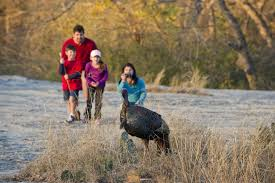
Photographing Texas Wildlife in State Parks

Photographing Texas Wildlife in State Parks


This is Passport to Texas

Make your wildlife viewing trip to a state park “picture perfect’ when you bring along a camera. Our State Park Guide, Bryan Frazier, offers tips on taking great shots.

60—If you’re a beginner, in particular, get a versatile lens – something that has some zoom capabilities, but also has some wide angle capabilities. If you’ve got one or two lenses that have some versatility it will save you on fatigue, and also keep you in the game where you can make some adjustments on the fly. Another one I like to tell people is to use a tripod or a monopod. And a lot of times these will double as a hiking stick. So using something as a stabilizer, like a monopod, will make a difference. The other thing – don’t ignore landscape shots. Sometimes the wildlife just doesn’t cooperate. So when you’re out in nature, look for the unique scenery. Look for the wildflowers; look for the colorful skies that can sometimes save a trip from a photography standpoint even if the wildlife doesn’t cooperate. Get kids involved in it – cameras these days are easy to use. You’ll want to take some extra batteries and extra memory cards. But, it’s a great way to engage the whole family in a memorable outdoor experience.

Thanks, Bryan.

That’s our show for today…with funding provided by Chevrolet, supporting outdoor recreation in Texas; because there’s life to be done.

For Texas Parks and Wildlife…I’m Cecilia Nasti.

Nature: Wildflowers and Other Native Plants

Friday, March 1st, 2013

Texas Mixed Border Homeowner Inspiration Garden; Image from www.wildflower.org

Texas Mixed Border Homeowner Inspiration Garden; Image from www.wildflower.org


This is Passport to Texas

Texas roadsides will be awash in colorful wildflowers soon. Dr. Damon Waitt, senior botanist at the Lady Bird Johnson Wildflower Center, says these and other native plants have a place in the built landscape as well as nature’s landscape.

61—Natives provide really important ecosystem services for local wildlife, pollinators. They filter storm water and rainwater, so they provide all these services to the ecosystem, and they can provide similar services in the built landscape, and reduce things like water use, pesticide use and fertilizer use. In addition, they have the aesthetic qualities that we want people to learn to appreciate, so they’re not looking for that next exotic ornamental—that they
‘re more interested in finding that next native plant that looks great and functions perfectly in their environment.

There are a lot of people who might look at wildflowers and native plants and say, gosh, how do those fit into my idea of a formal landscape?

That’s something we’re really trying to fight—that concept that if you’re a native plant enthusiast, then your yard must look wild and unkempt. At the wildflower center, we model different design styles using native plants, and you can use native plants in very high designs and very formal designs if that’s the look you’re going for.

Find plants that are right for you at wildflower.org.

That’s our show…for Texas Parks and Wildlife…I’m Cecilia Nasti.
Angling: Sport Fish Restoration Program,2

Thursday, February 28th, 2013

Sport Fish Restoration Monies

Sport Fish Restoration Monies


This is Passport to Texas

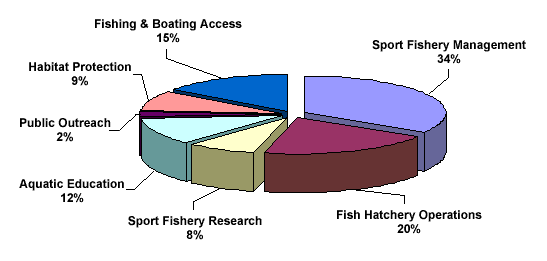
The Federal Sport Fish Restoration program—funded by your purchase of fishing equipment and motor boat fuel—funds a variety of conservation projects in Texas. Last year Texas Parks and Wildlife received $17.4-million from the program.

11—That funding went to support sport fisheries management, sport fish stocking in Texas waters, fish habitat conservation, enhancement and restoration efforts, and aquatic education.

Timothy Birdsong coordinates the Sport Fish program for Parks and Wildlife.

08 – Fifteen percent of that program is used to perform improvement to boat ramps and other boating access facilities around the state.

Birdsong says this is a successful conservation model—a user pay, user benefit program.

24 – The taxes that you contribute as anglers, and as boaters, to this pot of money, is used to improve the resource for you…to provide additional opportunities…provide additional access to these waters. So, it is vital that we continue to have the support of the anglers and the boating community to be able to maintain the program at the level that it is currently.

See how Parks and Wildlife spends these funds when you visit the Texas Parks and Wildlife website.

That’s our show… with support from the Sport Fish restoration Program…funded by your purchase of fishing equipment and motor boat fuel.

For Texas Parks and Wildlife…I’m Cecilia Nasti.

TPW Magazine: All About Fishing

Tuesday, February 26th, 2013

TPW Magazine March 2013

TPW Magazine March 2013


This is Passport to Texas

We’re hooked on fishing here at Texas Parks and Wildlife; and if you are, too, then the March issue of our magazine might reel you in. Editor, Louie Bond.

63— Well, you know, it’s spring, so we’re knee deep in water and we are fishing. We fished in February and had our special digital out there, which is still very relevant. People can go to our website and take a look at that and get lots of good fishing information. But in the March print issue, we’ll have some great fishing stories as well. We’re going to take a look at power plant lakes, which early in the spring when the water’s still cold, it’s a great place to fish, because they generate warm water – so there’s nice, warm steamy water – the fish love it and they’re biting like crazy. Then we’re going to talk about cat fishing as well. You know, we’ve spent a lot of time looking at how to grow bigger bass, and now TPW is looking at growing bigger catfish. Catfishing is an incredibly popular sport in Texas; very abundant. So, it can only get better from here. And our last feature is kind of wild and whacky. They describe it as a combination of fishing and hunting – plus a little ‘wow’ I think. It’s when you’re going out for alligator. Can you imagine hauling in an alligator into your boat? It’s a very exciting story. It’s lots of fun. So, lots of fishing and fund and adventure in our March issue.

Thanks, Louie

For Texas Parks and Wildlife…I’m Cecilia Nasti.
State Parks: Spring Break

Monday, February 25th, 2013
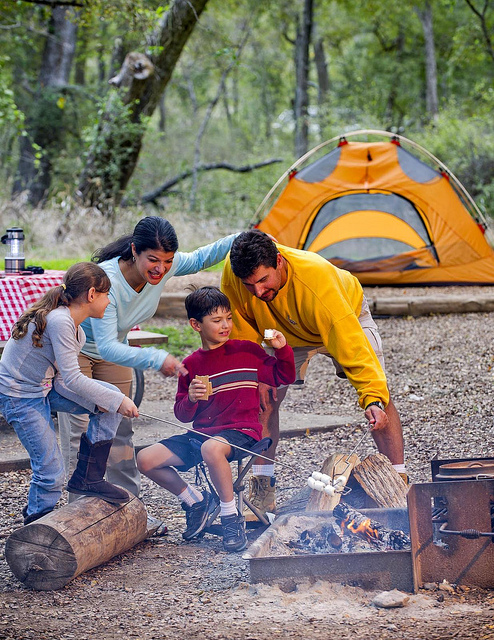
Family Camping in Texas

Family Camping in Texas


This is Passport to Texas

Lots of people choose state parks as their spring break destinations. Our SP Guide, Bryan Frazier tells us, parks fill fast, so spring breakers need to act fast.

56— Even this time of year, we really encourage people: make your reservations as soon as you know your travel dates. Lots of people have cabin fever and are ready to get out and so every year we encourage people to make their reservations [early] – but especially this year. And if you’re going to go to places like Indian Lodge in Far West Texas, or Inks lake in the Texas Hill Country, or Brazos bend State Park near Houston, places like that are going to fill up – so make your reservations. We’ve got cabins, campsites, screen shelters, miles of trails, great mountain biking and hiking opportunities, fishing for all kinds of species. So, there’s lots and lots to do inside state parks. People like to go south toward the beaches and boardwalks we have at state parks. So, make your reservations; you can do it online at texasstateparks.org, or by calling the reservation center at 512.389.8900.

Thanks, Bryan.

That’s our show for today…with funding provided by Chevrolet, supporting outdoor recreation in Texas; because there’s life to be done.

For Texas Parks and Wildlife…I’m Cecilia Nasti.
