Archive for the 'Shows' Category

Clean Windows May be Dangerous to Birds

Thursday, December 14th, 2017
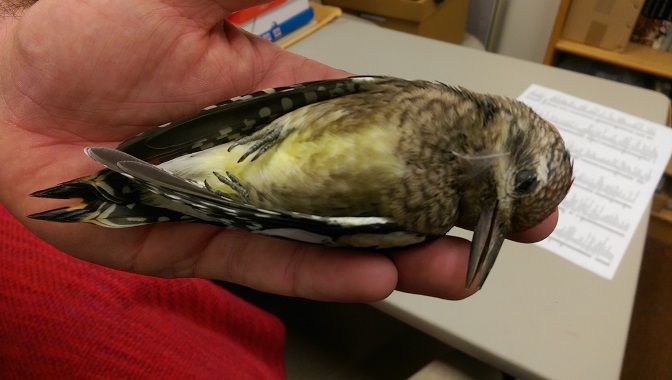
A deceased yellow-bellied sapsucker that flew into a clean window.

A deceased yellow-bellied sapsucker that flew into a clean window.

This is Passport to Texas

When ornithologist, Cliff Shackelford, visited the studio recently, he brought with him a small, lifeless bird.

And it turns out to be a yellow-bellied sapsucker.

The little woodpecker had flown into a window at Texas Parks and Wildlife headquarters. Cliff determined its sex and age by the smattering of red feathers on its head and white ones on its throat.

This is a female, yellow-bellied sapsucker, first year bird. I have a permit that allows me to salvage these and take them to a museum where it can be put up as a museum specimen for scientific use.

You’ve probably seen dead birds in your neighborhood.

Bird deaths are rampant in urban areas [from] windows and/or housecats. You can’t take the killer out of a cat. And then windows: go outside—try to take the perspective of a bird. Look at the window. You’ll see blue skies and white clouds, and the trees. It’s all a reflection of what’s behind you.

Birds, especially the young and inexperienced, fly into the reflection because it looks like clear passage.

The really sad part is, this bird doesn’t breed in Texas or anywhere close to Texas. This is a winter bird. And actually, I haven’t seen one yet this fall. It’s sad that the first one [I see] is a dead one in my hand.

As a museum specimen, researchers will study the little bird to better understand her species.

Her death is not in vain, but tens of thousands of birds across the planet die every day by hitting windows.

As good a reason as any not to wash your windows. The Wildlife Restoration Program supports our series.

For Texas Parks and Wildlife…I’m Cecilia Nasti.
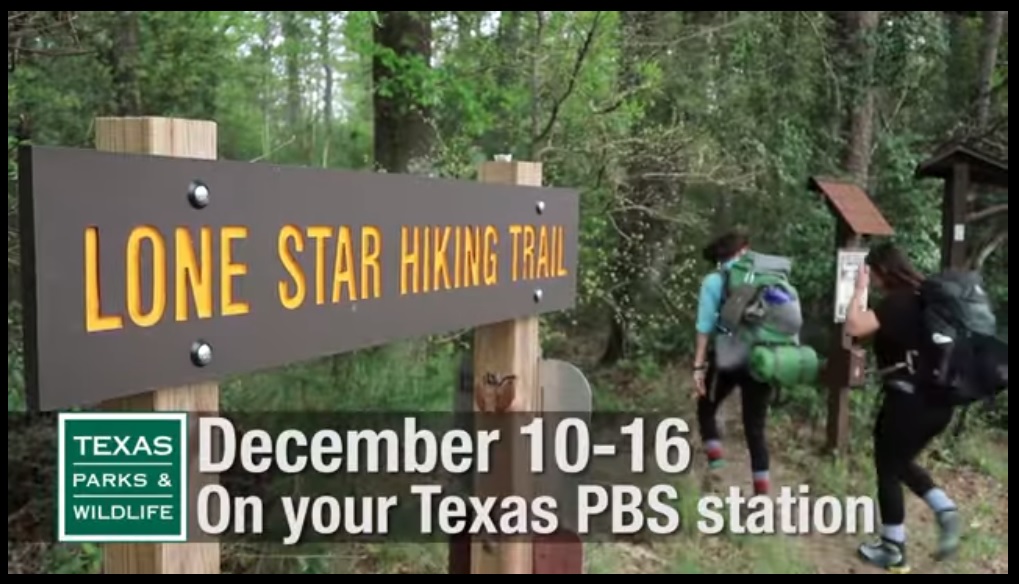
TPW TV–Lone Star Hiking Trail

Friday, December 8th, 2017
The 100-Mile Hike on TPWD TV on PBS

The 100-Mile Hike on TPWD TV on PBS

This is Passport to Texas

Texas Parks and Wildlife TV producers go the distance to tell compelling stories. In, Jeffrey Buras’ case, that distance was 100 miles for a segment called: The Hundred Mile Hike.

It is a challenge, because not only are you doing a 100-mile hike, but you’re also trying to shoot a video of that hike. For Emily, she got to just enjoy it and experience it, but I was worried about angles and lighting and batteries.

The segment follows 20-year-old Emily Lozano, a former State Park Ambassador as she backpacks the Lone Star Hiking trail in Sam Houston National Forrest.

I’ve always loved the outdoors. So, this spring break I decided to try something a little bit new, and go on a backpacking trip. I’m going to do the Lone Star hiking Trail; it’s extremely long. We’ll see how it goes.

Emily is alone for most of her trek, and Jeffrey did his best to remove himself from her experience. But at the end of the day when recording voice over recaps…

It was funny because while we were doing those little recaps, she would say ‘Oh, and then Jeffrey did this. Oh, I can’t talk about Jeffrey.’ Then she would say “Well, my imaginary friend did this…’. She kept referring to me as her imaginary friend.

Emily’s experience is anything but imaginary. Join her on the trail next week on the Texas Parks and WildlifeTV series on PBS.

It was such a great spring break. Great in ways I wouldn’t have expected it to be. I’m so glad I went.

And you’ll be so glad you watched. Check your local listings.

For Texas Parks and Wildlife…I’m Cecilia Nasti.
Stocking Southern Flounder

Thursday, December 7th, 2017
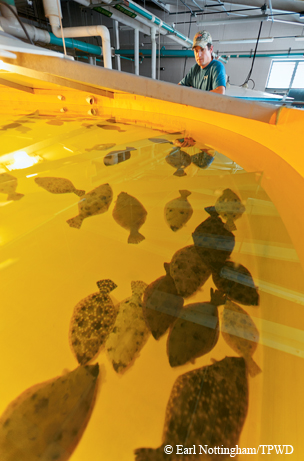
Shane Bonnot, hatchery biologist at Sea Center Texas in Lake Jackson, looks over one of several flounder brood stock tanks where fertilized eggs will be recovered.

Shane Bonnot, hatchery biologist at Sea Center Texas in Lake Jackson, looks over one of several flounder brood stock tanks where fertilized eggs will be recovered.

This is Passport to Texas

Spotted sea trout, redfish and southern flounder are the top three popular sportfish. Sea trout and redfish populations are stable, but not so for Southern Flounder.

We’ve had a slow, but stead, decrease in flounder populations throughout the coast of Texas. It’s been worse in some bays than it has in others. But it’s just been a slow decline.

David Abrego oversees the hatchery program at Sea Center Texas. Data suggests fewer females, over fishing, and loss due to shrimp bycatch are some of the main issues affecting flounder. Coastal hatcheries are tasked with helping boost the Southern Flounder populations.

The whole point of the stocking enhancement program is to supplement the natural population with fish.

Former stocking team member, Shane Bonnot, says there’s a learning curve with flounder.

Flounder is totally different than redfish and trout; it’s a whole new ballgame. So, we’re at the beginning stages of learning how to culture this fish.

The process begins with capturing male brooders to fertilize the eggs. And it’s not easy to do.

You have so many factors that can go against you. Whether it’s the wind, or a strong tide. And of course, visibility is not optimal.

They breed healthy males with females at the hatchery, and after three months, they release thousands of flounder fingerlings into the bays to supplement the wild population…for your angling pleasure.

The Sport Fish Restoration program supports our series.

For Texas Parks and Wildlife, I’m Cecilia Nasti.

Gigging After Dark for Flounder

Wednesday, December 6th, 2017
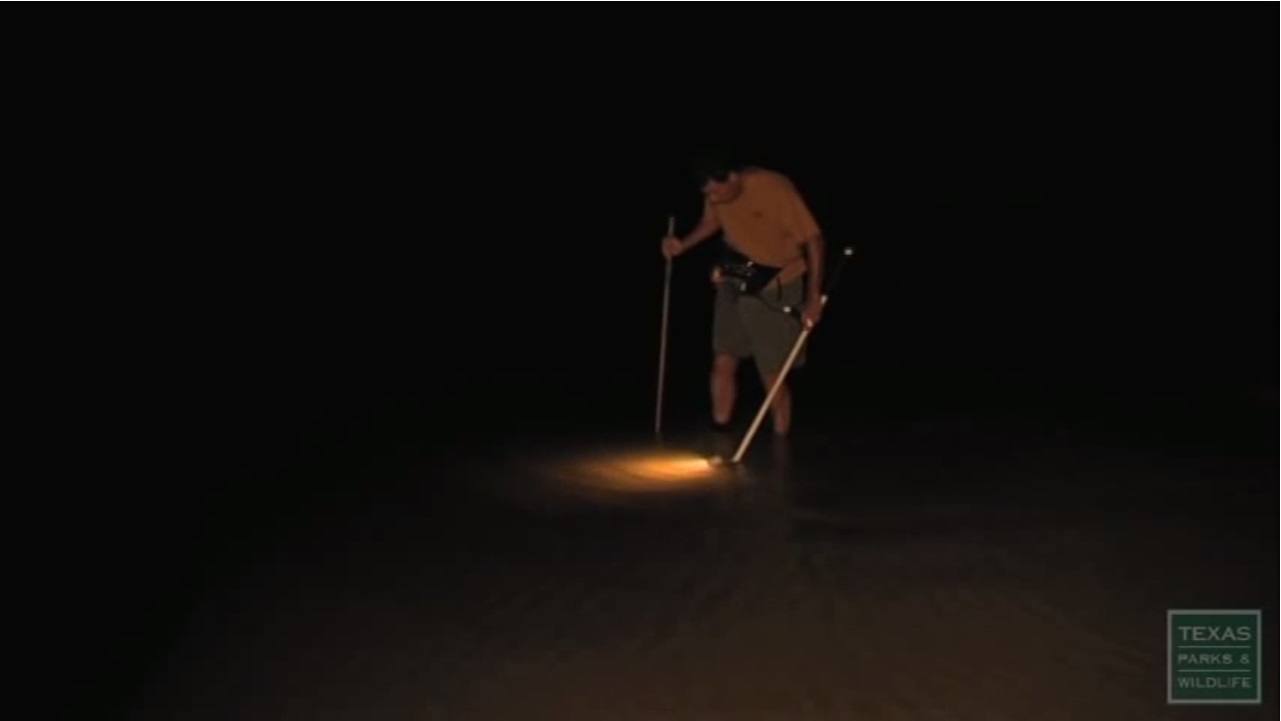
Gigging flounder in Christmas Bay.

Gigging flounder in Christmas Bay.

This is Passport to Texas

If you think fishing is a warm weather endeavor for the daytime hours, think again. Kelly Parker and his son Coe take to Christmas Bay in the dark of night in fall and winter months to flounder—as in fishing for flounder.

It’s nice and cool. You’re not worried about a sunburn. So, it’s relaxing. You aren’t working up a sweat. And it’s just very enjoyable. Very peaceful.

The Parker’s wade into the bay armed with a gig and shining a light on the water. A gig is pole fitted with a multi-pronged spear for impaling the fish. Gigging is a legal means of harvesting flounder between December 1st and 14th. The bag limit is two fish per day.

[Kelly] Hurry. Hurry. Hurry before it goes. That cloud’s going to get over it. Go! [splash] Yeah. There you go. [Coe] That actually looks like a Gulf flounder. [Kelly] I knew there was one hiding out here somewhere. [Coe] Yeah, they’re very hard to find. And a lot of people first time gigging ask what they’re looking for. And literally you’re looking for what we call the imprint. It’s the outline of the flounder. So, it looks like a football with a tail. That’s how I kind of describe it to new people that are coming out to the sport.

This flatfish is skilled at laying low, and blending with its surroundings. Sometimes they’re closer than you think.

[Coe] Oh shoot. [Kelly] Stepped on him? [Coe] I stepped on him. I missed him. Let me see if I can find another one real quick. I saw a few over here.

Watch your step, and find fishing information on the Texas Parks and Wildlife website.

The Sport Fish Restoration program supports our series.

For Texas Parks and Wildlife, I’m Cecilia Nasti.

Fishing for Flounder

Tuesday, December 5th, 2017
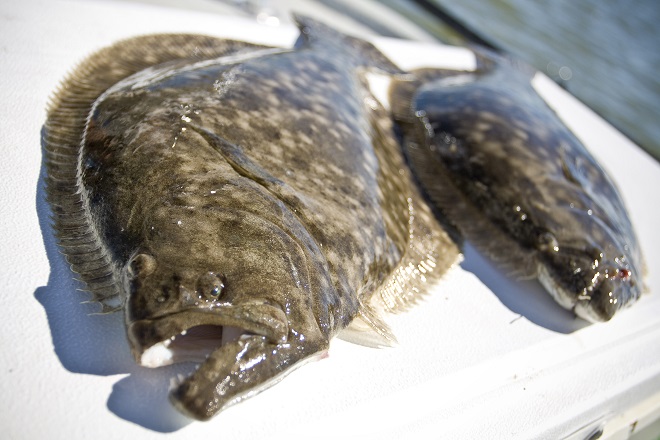
A wily, tasty flat fish: flounder.

A wily, tasty flat fish: flounder.

This is Passport to Texas

Flounder’s flat shape and ability to blend with its surroundings, makes it nearly invisible and difficult to catch—unless you’re Brian Treadway…

I think I’ve got a hit. Fish on! Fish on! I give you the southern Flounder. They live to be about six years of age. The state record’s 13 pounds. So, a 20-inch flounder’s considered a trophy fish.

Treadway fishes for flounder in Chocolate bayou, which he says is ideal flounder habitat.

The edge of the shoreline is a prime example of what you want to fish. It’s not flat. It’s simply curvy, and lots of points. Lots of edges. Drains are coming out of the marsh. It’s just a prime example of great, great terrain for the flounder.

December 1st -14th, the daily bag limit is two flounder, taken by any legal means. The current minimum size for a keeper is 14 inches with no maximum.

Oh, shoot. I stepped on him.

When Coe Parker’s not stepping on flounder in Christmas Bay, he’s gigging them.

The tools you need for gigging are a good gig—two prong preferably. I have mine marked off with the legal size limit. You have an underwater gig light, as well as a 12-volt deer feeder battery. That’s pretty much all you need.

Gigging with the best of them. Tomorrow.

The Sport Fish Restoration program supports our series.

For Texas Parks and Wildlife, I’m Cecilia Nasti.