Archive for the 'Wildlife' Category

TPW Magazine — Texas Brigades

Tuesday, September 12th, 2017
Learning conservation with Texas Brigades.

Learning conservation with Texas Brigades.

This is Passport to Texas

Texas Brigades is a wildlife and natural resource focused leadership development program for youth, 13 to 17.

Texas Brigades has been around for 25 years. It started out as Bobwhite Brigade back in 1993, and then it just kind of morphed.

It’s morphed into is eight summer camps, each with a different conservation focus. Aubry Buzek [Byu-zik] wrote about the Brigades for the October issue of Texas Parks and Wildlife magazine.

What was really interesting is that these camps are not necessarily about learning about one particular species. At Bobwhite Brigade, they were learning a lot about quail—and they had biologists there teaching them about quail. But that wasn’t the overall goal of the program. It was about being comfortable with public speaking, comfortable talking with their peers. Debating.

These five-day intensive camps incorporate military marching and cadence, and introduce students to experts and activities that challenge and

I talked to a lot of parents after graduation and they were like, ‘Who is this kid?’ I saw it too. That confidence. A lot of parents said they didn’t expect their kid to know just so much. But, in addition to that knowledge, these kids are loud, and they’re marching, and they make a lot of friends. It really is a transformative camp.

Read Aubry Buzek’s story about the Texas Brigades in the October issue of Texas Parks and Wildlife magazine.

For Texas Parks and Wildlife…I’m Cecilia Nasti.
Hard Work Pays off for the Kemp’s Ridley

Wednesday, August 30th, 2017
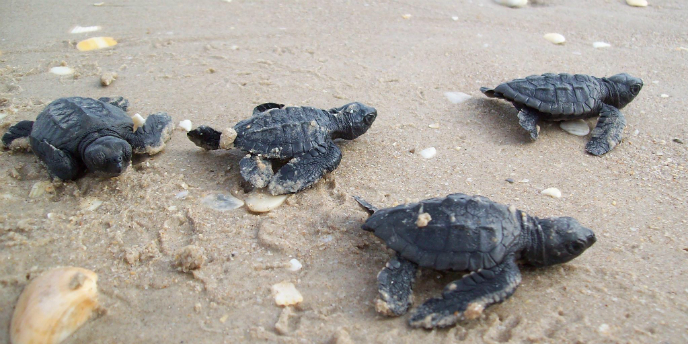
Four newly hatched Kemp's ridley sea turtles crawl on the beaches of Padre Island National Seashore as they are released into the wild. NPS Photo.

Four newly hatched Kemp’s ridley sea turtles crawl on the beaches of Padre Island National Seashore as they are released into the wild.
NPS Photo.

This is Passport to Texas

Since 1970 Kemp’s Ridley sea turtles have been on the endangered species list. The NPS, TPW and other partners developed a plan to assist their recovery, including the creation of a secondary nesting site [the primary being in Mexico] at the Padre Island National Seashore [PINS].

The numbers are moving in the right direction, but we’re not up to the milestones that are outlined in the recovery plan to even down list the species to threatened, much less to get it off the list entirely.

Dr. Donna Shaver oversees sea turtle science and recovery at Padre Island National Seashore. Dr. Shaver says this year’s annual survey identified 352 nests—from Galveston down to Mexico.

We’ve had more found at PINS and more found in the state of Texas this year than in the last two years combined. So, we’re very excited about it.

Decades of conservation are paying off, or are we just getting better at finding sea the turtle nests?

We do think that we’re seeing an actual significant increase compared to when I started and only one nest would be found every two or three years. And now, here to find more than 300 in Texas during a year, is a big accomplishment for conservation and recovery of the species.

The Wildlife and Sport Fish Restoration program supports our series, and funds diverse conservation projects throughout Texas.

For Texas Parks and Wildlife…I’m Cecilia Nasti

Ways we Protect the Kemp’s Ridley Sea Turtle

Tuesday, August 29th, 2017
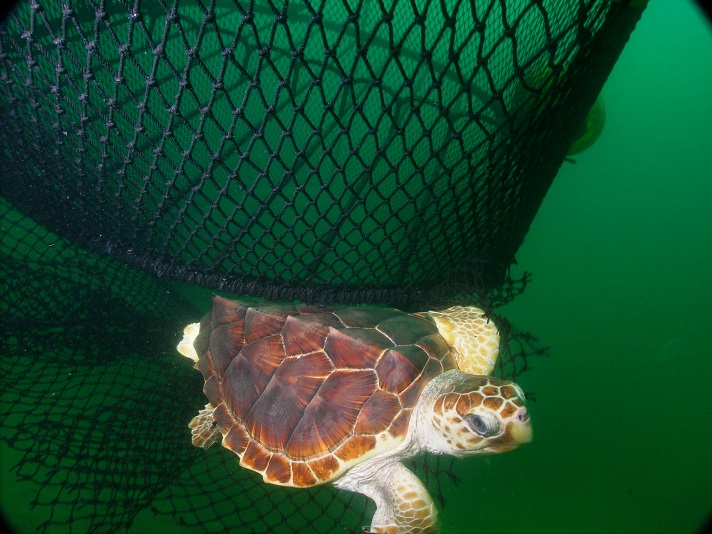
A loggerhead turtle escapes from a trawl net equipped with a turtle excluder device (TED). Image courtesy of NOAA.

A loggerhead turtle escapes from a trawl net equipped with a turtle excluder device (TED). Image courtesy of NOAA.

This is Passport to Texas

Nature ebbs and flows. A good example is the critically endangered Kemp’s Ridley Sea Turtle. Conservation groups implemented a recovery plan that facilitated exponential growth of the animal’s population.

The population modelers had predicted that exponential increase in the recovery plan would continue – but it did not. So, the expectations written in the plan are not exactly what the population has done.

Even so, Dr. Donna Shaver says the numbers are moving in the right direction. She oversees sea turtle science and recovery at Padre Island National Seashore. One thing that’s helped them is the mandatory turtle excluder devices used by shrimpers.

Turtle excluder devices were developed to shunt sea turtles out of the next while retaining shrimp in the shrimping net. And they’ve been very effective in doing that.

Seasonal area closures have also benefited the turtles.

Texas Parks and Wildlife instituted one when they revised their shrimp fishery management plan close to 20 years ago – taking into account, of course, the responsibilities to help manage the shrimping industry as well as endangered species.

Tomorrow: hard work pays off for the Kemp’s Ridley.

The Wildlife and Sport Fish Restoration program supports our series, and funds diverse conservation projects throughout Texas.

For Texas Parks and Wildlife…I’m Cecilia Nasti

The Making of an Endangered Species

Monday, August 28th, 2017
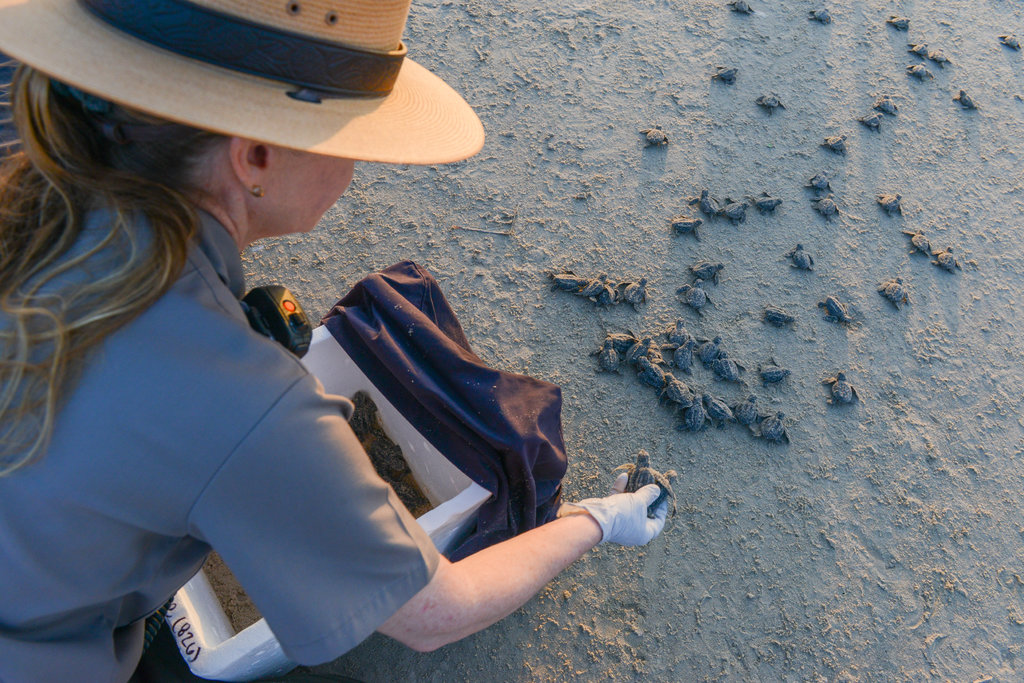
Donna Shaver, chief of the Sea Turtle Science and Recovery Program at Padre Island National Seashore, releases Kemp's ridleys hatchlings onto the beach. Photo: New York Times.

Donna Shaver, chief of the Sea Turtle Science and Recovery Program at Padre Island National Seashore, releases Kemp’s ridleys hatchlings onto the beach. Photo: New York Times.

This is Passport to Texas

The Kemp’s Ridley Sea Turtle is the world’s most critically endangered sea turtle.

And most nesting in the US by this species occurs in Texas.

Although a native nester in Texas, their primary nesting beach is in Mexico. Dr. Donna Shaver oversees sea turtle science and recovery at Padre Island National Seashore.

The National Park Service along with Texas Parks and Wildlife and other partners had been working since the 1970s to form a secondary nesting colony of endangered Kemp’s Ridley Turtles right here at Padre national Seashore.

They developed the secondary site as a safeguard against potential extinction and other catastrophes. Their population was nearly decimated in the 1940s.

The biggest threats over time – the largescale taking of the eggs from the nesting beach in Mexico. They were sold in markets as a supposed aphrodisiac. There was also loss of nesting turtles taken for food and then also the skin to make leather products. Then, though time, the loss of juveniles and adults incidental to fisheries operations; primarily shrimp trawling, but also some hook and line captures and other types of fisheries.

How we’ve protected Kemp’s Ridley Sea Turtles in Texas tomorrow.

The Wildlife and Sport Fish Restoration program supports our series, and funds diverse conservation projects throughout Texas.

For Texas Parks and Wildlife…I’m Cecilia Nasti

Buy a License, Feed the Hungry & Help a Veteran

Monday, August 7th, 2017
You can help support Hunters for the Hungry and Fund for Veterans at the time you buy a hunting or fishing license.

You can help support Hunters for the Hungry and Fund for Veterans at the time you buy a hunting or fishing license.

This is Passport to Texas

When licenses go on sale August 15, Texas hunters and anglers may donate to one of two worthy non-profits.

You can make the voluntary contribution of either one dollar, five dollars, ten dollars or twenty dollars to either the Fund for Veterans Assistance, or to help feed Texas families with a donation to Hunters for the Hungry.

Justin Halvorsen is revenue director at Texas Parks and Wildlife, and says donating is voluntary and easy.

It’s through any one of our sales channels. Either online, over the phone, at a retail agent, or any one of our parks and wildlife locations.

The agency keeps close tabs the donations.

And then, at the end of every month, it’ll go into a separate pot, and we’ll send it along to those respective entities [nonprofits].

The program debuted last season and Texans were generous; Texas Parks and Wildlife distributed, $193-thousand to the Fund for Veteran’s, and $106-thousand to Hunters for the Hungry. You may ask: is my donation tax deductible?

That is a great question. And there will be a receipt that gets printed as part of this that specifically says that this is a donation to the Veteran’s Fund or Hunters for the Hungry. And then, really, it’s up to the individual and their tax preparer to make that ultimate decision.

Request an itemized receipt from retailers, and find more information on the TPW website.

That’s our show… Funding provided in part by Ram Trucks. Guts. Glory. Ram

For Texas Parks and Wildlife…I’m Cecilia Nasti.