October 6th, 2016
Participate in the Texas Pollinator Bioblitz this month and #savethepollinators.
This is Passport to Texas
Calling all citizen scientists. We want you to participate in the Texas Pollinator BioBlitz, October 7th through 16th.
[We have] two goals in mind: to increase awareness about pollinators, and about the habitat that they require.
Johnnie Smith is Texas Parks and Wildlife Conservation Education Manager. Pollinators include bees, butterflies, beetles, moths and other critters that move pollen while foraging.
If you participate in the pollinator bioblitz, you’re going to have an opportunity to observe pollinators at a site that you visit, like your local zoo or aquarium or nature center. And observe the pollinators that are there. Grab a picture of the pollinators you find, and you can post them onto Instagram. We’re asking all of the participants to use the hashtag #savethepollinators.
State parks offer pollinator observation opportunities, too. And, you can also post findings, on iNaturalist.org. Texas Parks and Wildlife’s website, has pages dedicated to the Pollinator Bioblitz.
Where people can learn what pollinators might be in their area. Links to what might be blooming in your area right now—that’s hosted out of the Wildflower center—and then also, to be aware of habitat you have that supports pollinators. And if you don’t have habitat in or near your home, school library… We’re encouraging people to try and get organized in planting pollinator habitat.
The Texas Pollinator BioBlitz is October 7 through 16. Participating is as easy as stepping outside.
The Wildlife Restoration program supports our series.
For Texas Parks and Wildlife…I’m Cecilia Nasti.
Posted in Botany, Citizen Science Projects, Conservation, Habitat, Monarchs, Pollinators | Comments Off on Texas Pollinator Bioblitz
October 5th, 2016
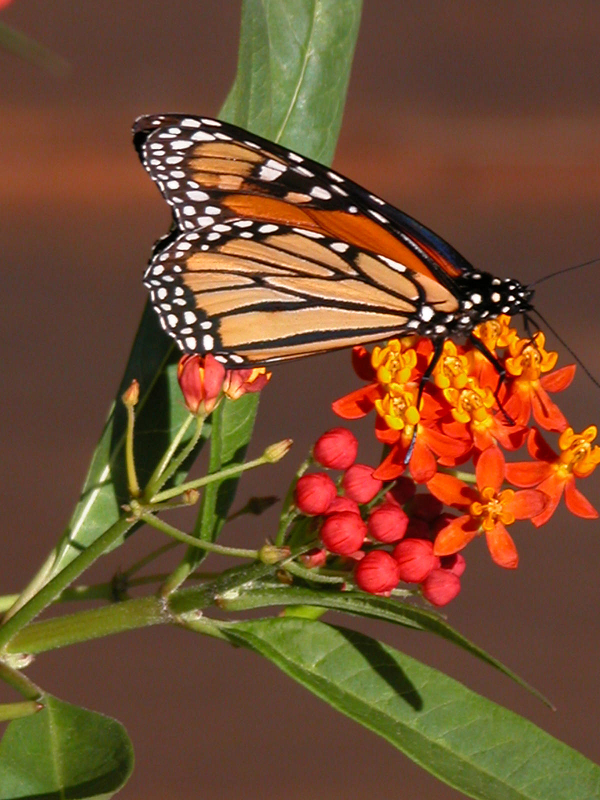
Monarch on milkweed.
This is Passport to Texas
Habitat loss along its migration route may be one reason the Monarch butterfly is in decline. While feeding on nectar, Monarchs pollinate wildflowers along their route, which benefits our ecosystem.
There are two primary ways that habitat supports pollinators.
Johnnie Smith is Texas Parks and Wildlife Conservation Education Manager.
And one is, the adult pollinators oftentimes feed on nectar of flowers. So, flowering plants that are a food source for the pollinator is very important. But also, is the food source that the pollinator’s larvae rely on as they’re growing up and becoming an adult. And so, that is just as important as the flowering plants that support the adults.
For Monarchs, native milkweed is an important plant. By cultivating them in our yards, along with other nectar and larval plants, we can all play a part in their survival.
There is no effort that is too small to be counted worthy. And there’s no spot of land that is too small to contain pollinator habitat. So, we really want to empower everybody—that they can make a difference. Right where you stand. Right where you live—you can create pollinator habitat, and help turn around this negative trend with the monarchs.
Tomorrow: the Pollinator Bioblitz, an event to build awareness to help all pollinators.
The Wildlife Restoration program supports our series.
For Texas Parks and Wildlife…I’m Cecilia Nasti.
Posted in Botany, Conservation, Habitat, Migration, Monarchs, Pollinators | Comments Off on Monarch Malaise
October 4th, 2016
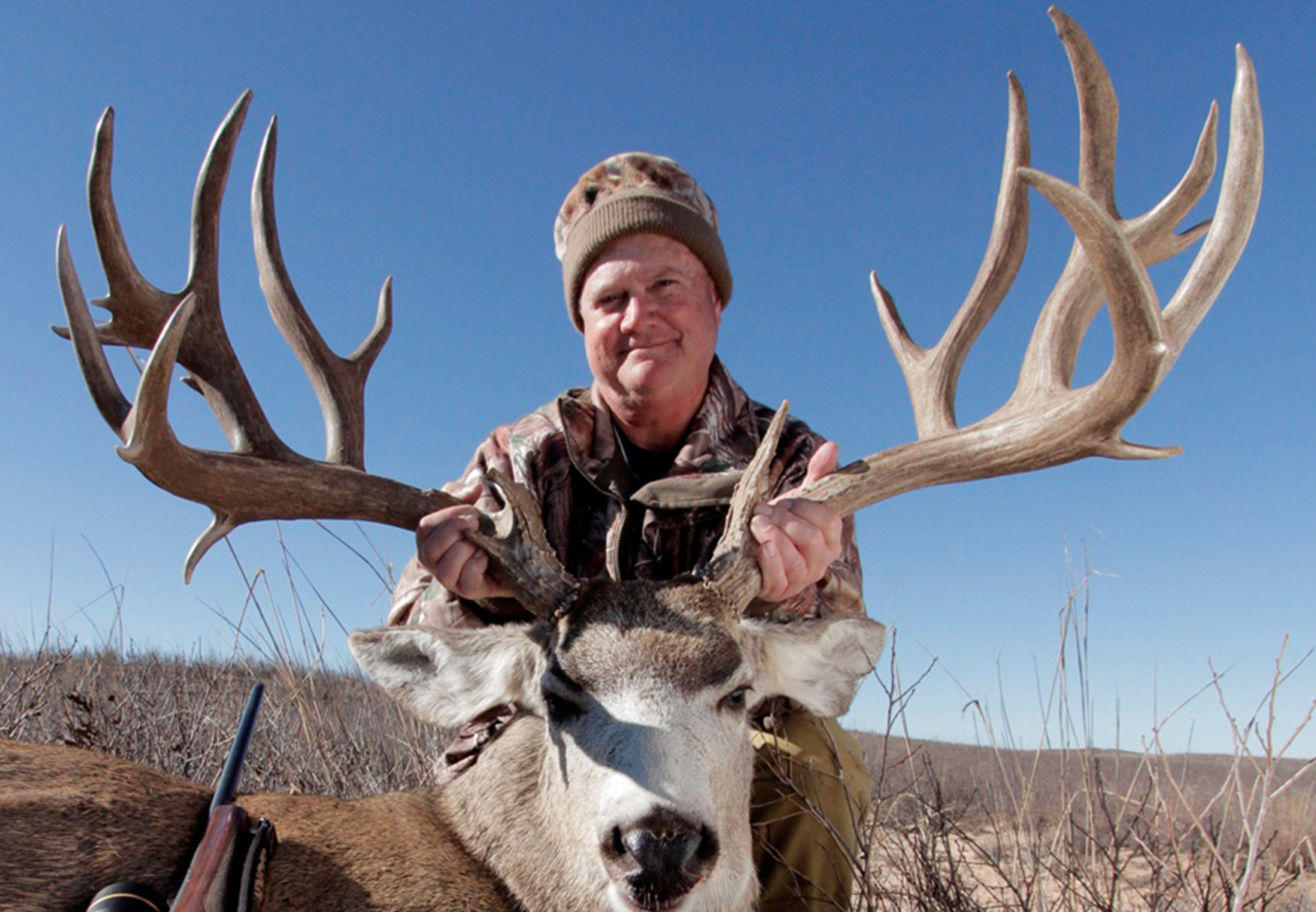
Steve Knowles with his mule deer.
This is Passport
For years Steve Knowles of Georgetown, Texas entered Texas Parks and Wildlife’s Big Time Texas Hunts Drawing, without…ever…winning.
I always considered it basically a donation for all the good work that TPWD does. And that’s why I’ll continue to enter, despite not having a lot of success, for as long as I can get out and have the opportunity to hunt.
Then he received a call last October saying he’d won the Ultimate Mule Deer Hunt.
If I could not win the Grand Slam, then the Ultimate Mule Deer hunt was the one that I did want to win, because I had never really been mule deer hunting. I was pleasantly surprised.
In December, Knowles brought down a 19-point Mule Deer with a 37-inch outside spread on the Yoakum Dunes Wildlife Management Area; biologist Brandon Childress was his guide.
He had spotted the deer for the first time the day before. And he said, ‘Okay, we’re going to see if we can go find this deer again.’ And then as soon as we drove in early in the morning, we were able to get a glass on him. And it took us a good two hours to get to the point where we were close enough to the deer that I could actually take a shot. We were our hands and knees sometimes crawling in the sand, Ducking behind sand dunes. That’s what makes the whole hunt fun. And that’s what I’ll remember about the hunt.
Big Time Texas Hunts offers nine premier guided hunt packages on private ranches and wildlife management areas in Texas. Online entries are $9. And$10 by phone and at license retail locations. Deadline to enter is October 15. Find all details on the Texas Parks and Wildlife website.
For Texas Parks and Wildlife…I’m Cecilia Nasti.
Posted in Big Time Texas Hunts, Hunting | Comments Off on Hunting Mule Deer with Big Time Texas Hunts
October 3rd, 2016
Big Time Texas Hunts.
This is Passport to Texas
Know what 9 bucks could get you? A chance to win a Big Time Texas Hunts package.
These are premier guided hunts for a lot of the wildlife species across the state. Everything from mule deer to alligators to wild hogs…and, of course, really nice whitetail deer also.
Justin Dreibelbis, director of private lands and public hunting, says hunters may put in for as many of these hunt packages as they wish.
They’re all premier guided hunts. It’s all inclusive: you have lodging, food, and guides that understand the area, terrain and animals you’ll be hunting. And a really exciting package that we have is the Texas Grand Slam; it’s four separate hunts for mule deer, pronghorn antelope, whitetail deer, and desert big horn sheep, which not many people get to hunt.
All hunt packages take place on premier ranches and WMAs, and some allow winners to bring hunting companions who are at least 8 years of age.
Actually, their companions get to hunt as well. However, on the Grand Slam Hunt, they have a non-hunting guest that can accompany them.
Entries are $9 online and $10 over the phone and at license retailers. Submit entries by October 15. Find complete details on the Texas Parks and Wildlife website.
That’s our show… Funding provided in part by Ram Trucks. Guts. Glory. Ram
For Texas Parks and Wildlife…I’m Cecilia Nasti.
Posted in Big Time Texas Hunts, Hunting | Comments Off on Big Time Texas Hunts
September 30th, 2016
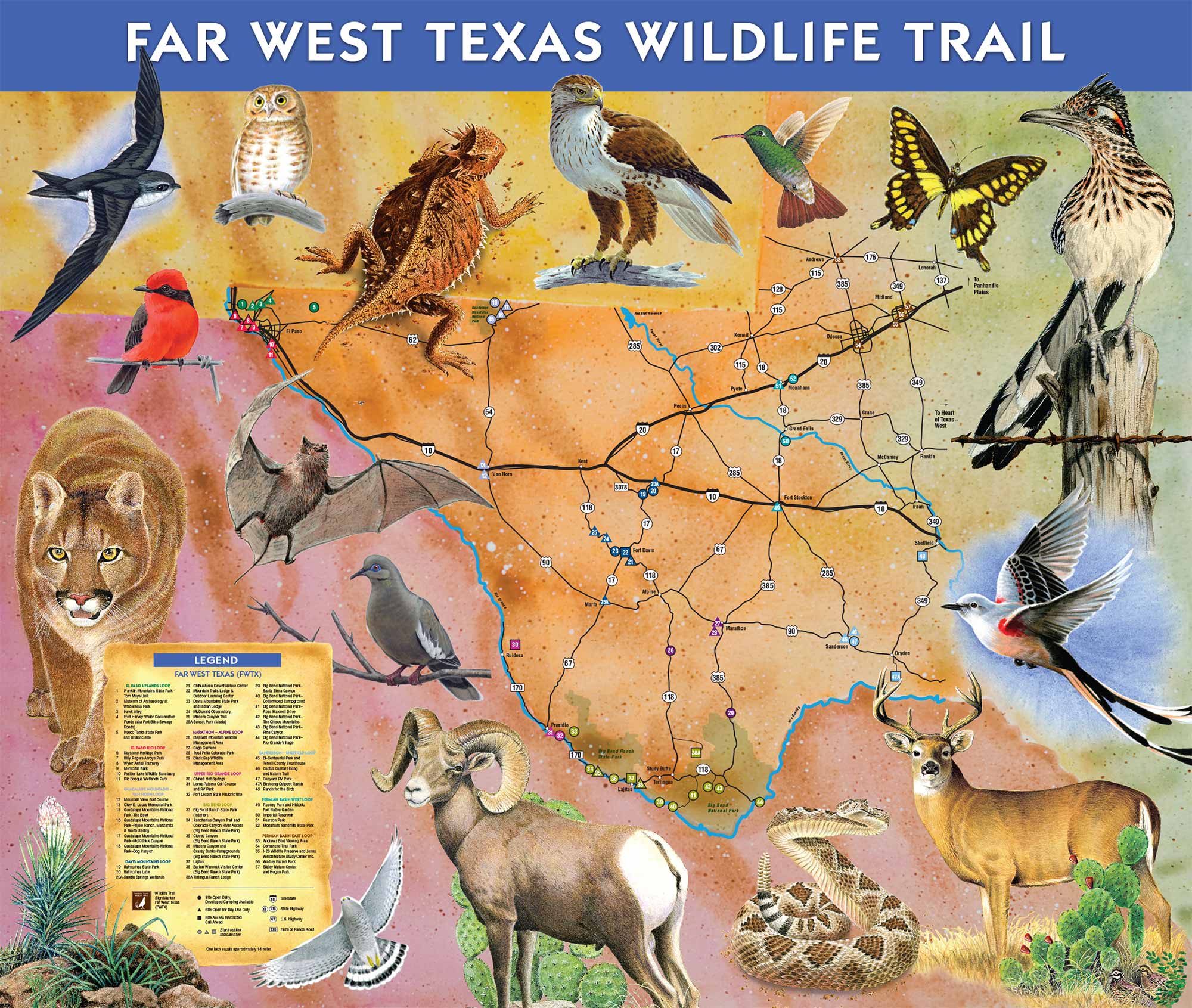
Far West Texas Wildlife Trail map
This is Passport to Texas
Texas Parks and Wildlife non game ornithologist, Cliff Shackelford says you don’t have to travel to the Rio Grande Valley to see a wide variety of birds this winter.
We have the wildlife viewing trails all across Texas. These are hot spots that you can find easily that might be close to you or near where you’re going. And they’re available for people to go and look at birds [and other wildlife].
Find the wildlife viewing maps on the Texas Parks and Wildlife website. Cliff says Texans can plan a winter birding “staycation” with minimal planning.
You can attract a lot of winter birds to your backyard. You can do something as simple as putting out a bird feeder and a birdbath. Or better, creating a wildscape, which is gardening for backyard wildlife. And we do that in our yard and we get so many white-throated sparrows that stay the winter with us because we have provided them with the cover that they need. We have a lot of berry giving shrubs, so we get a lot of cedar waxwings, and American Robins wintering with us. So, you can attract a lot of things in your backyard and have a really good time.
Find birding information and the wildlife viewing trail maps on the Parks and Wildlife website.
The Wildlife Restoration program supports our series, and funds diverse conservation projects in Texas.
For Texas Parks and Wildlife…I’m Cecilia Nasti.
Posted in Wildlife | Comments Off on Wildlife Trail Maps


 Passport to Texas is a
  Passport to Texas is made available by: