October 15th, 2015
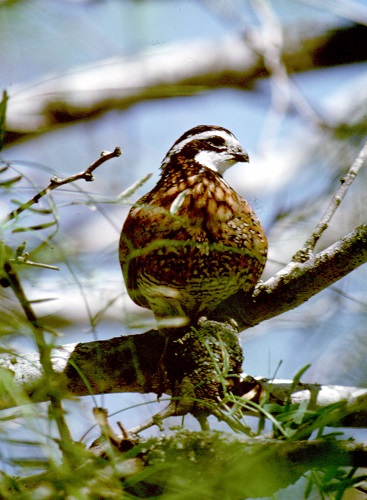
Bobwhite Quail
This is Passport to Texas
Late winter through early summer rainfall created ideal breeding conditions for quail in most parts of Texas.
14-We’re getting reports from all over from our staff that they’ve not seen this many quail in several years in some places–in other places, in decades. We’re talking about a species that has the potential to boom. And I think in some part of the state that’s what we’re seeing.
Before this, quail were in decline throughout much of the state, says upland game bird program leader, Robert Perez. Currently, large broods of chicks in all age classes dot the landscape.
07-This tells us that the window of opportunity was wide [due to abundant resources], and that when bobwhite hens had a nest failure, they were able to start again.
Perez is quick to point out that drought, alone, is not the cause of quail decline. Habitat loss is another factor.
23-And that’s where Parks and Wildlife has gone to great lengths to work with partners and landowners and wildlife cooperatives to bring quail back. And it’s important to remember that the rangelands of south Texas and the rangelands of the Rolling Plains, up into the Panhandle–quail are there because its big open spaces, and the land use is [mostly] compatible with bobwhite quail. And when the weather is great, we see that response. But, in other parts of the state,
we’ve really lost a lot of the available habitat.
Find information about quail restoration on the Texas Parks and Wildlife website.
The Wildlife and Sport Fish Restoration Program supports our series.
For Texas Parks and Wildlife…I’m Cecilia Nasti.
Posted in Conservation, Habitat, Quail, Wildlife, Wildlife and Sport Fish Restoration Program | Comments Off on Quail Going Gangbusters
October 14th, 2015
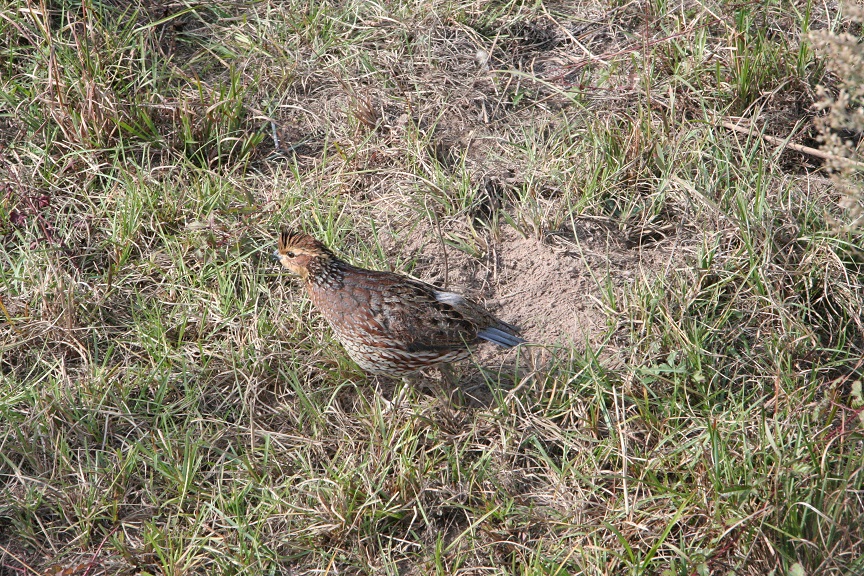
Bobwhite quail
This is Passport to Texas
Quail’s short life span makes them vulnerable to extended drought.
07-During dry years there’s just not enough moisture to hatch out eggs, and there aren’t enough insects to really feed chicks and raise a brood.
Robert Perez is upland game bird program leader at Texas Parks and Wildlife.
16-So, they shrink down on the landscape and then they’re waiting on rain. How long do quail live? Their average lifespan is only several months. A better way to look at it is: each year’s crop–everything that’s produced in the summer–by the following spring, anywhere from 70 to 80% will be gone. They will be consumed, basically.
Texas eventually got some rain; the timing of the rainfall was as important the rain itself.
26-Late winter there was enough moisture to produce the forbes: all the plants that quail need to eat during January and February; those were available pretty much everywhere, and that gets those birds into breeding condition. And then as we moved into spring, it continued to rain. There was a flush of vegetation, lots of insects, soil moisture. And it kept raining intermittently: off and on, off and on, off and on–all the way up to about the second week of July for most of the entire state.
And that created a huge window for quail to breed, which, hunters in most areas of the state will notice when the season opens at the end of the month, says Perez.
The Wildlife and Sport Fish Restoration Program Program supports our series.
For Texas Parks and Wildlife…I’m Cecilia Nasti.
Posted in Conservation, Habitat, Quail | Comments Off on Quail on the Rebound
October 13th, 2015
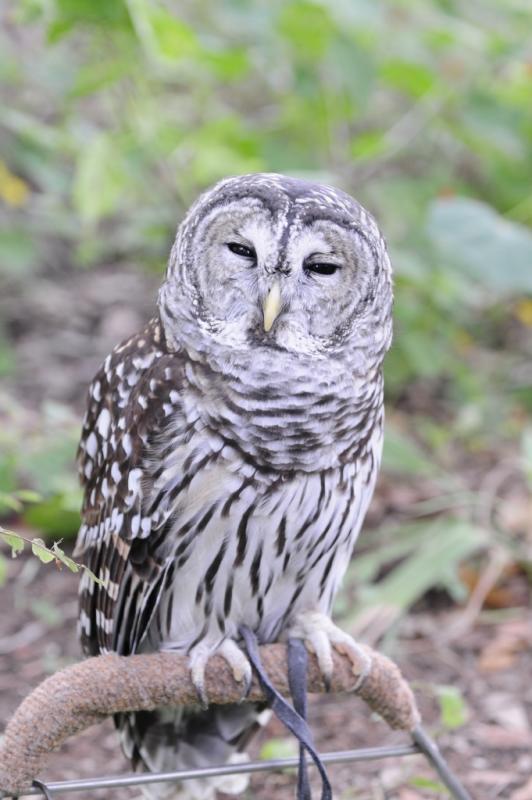
An owl waiting for his new home.
This is Passport to Texas
What would you call a wooden box intended for owls?
02- It would be called an owl box.
I really need to start making these questions harder. Ornithologist, Cliff Shackelford says man-made owl boxes are a “stand in” for what nature provides.
07-What these owls would do is look for a cavity in a tree–a hollow in a tree–and that’s what this box is replacing.
The Barn Owl and Eastern Screech Owl are two wide-ranging owl species in Texas, with different needs.
15- They use different size boxes. The Barn Owl is much larger than the Eastern Screech Owl. And you can go online on the Parks and Wildlife website; we have blueprints on how to make these boxes for these birds. Or you can just go online [to other sites] and find other blueprints and make them [the nest boxes] to your
liking.
Owls make some people nervous because they are raptors and have strong hooked beaks and sharp talons, but Cliff Shackelford says, fear not.
14-The good thing about owls: they’re good neighbors to have because they eat a lot of rodents. Screech Owls eat a lot of roaches. The wood roaches. The big ones that are outside. So, it’s good to have owls, because they’re keeping these things that we consider pests in check.
Cliff says owl boxes work best in areas where you have good tree cover. I have a link where you can find the measurements for nest boxes and bird houses
appropriate for common species at passporttotexas.org.
For Texas Parks and Wildlife, I’m Cecilia Nasti.
__________________________________________________
Dimensions for Owl Nest Boxes
Barn Owl
Baby Barn Owls.
Floor – 10 inches by 18 inches
Depth – 15 to 18 inches
Entrance height above floor – 4 inches
Entrance diameter – 6 inches
Recommended height above ground – 12 to 18 feet
Screech Owl
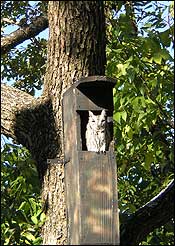
Screech Owl in a nest box.
Floor – 8 inches by 8 inches
Depth – 12 to 15 inches
Entrance height above floor – 9 to 12 inches
Entrance diameter – 3 inches
Recommended height above ground – 10 to 30 feet
Posted in Birding, Habitat, Nest Boxes, Owls | Comments Off on Owl Nest Boxes
October 12th, 2015
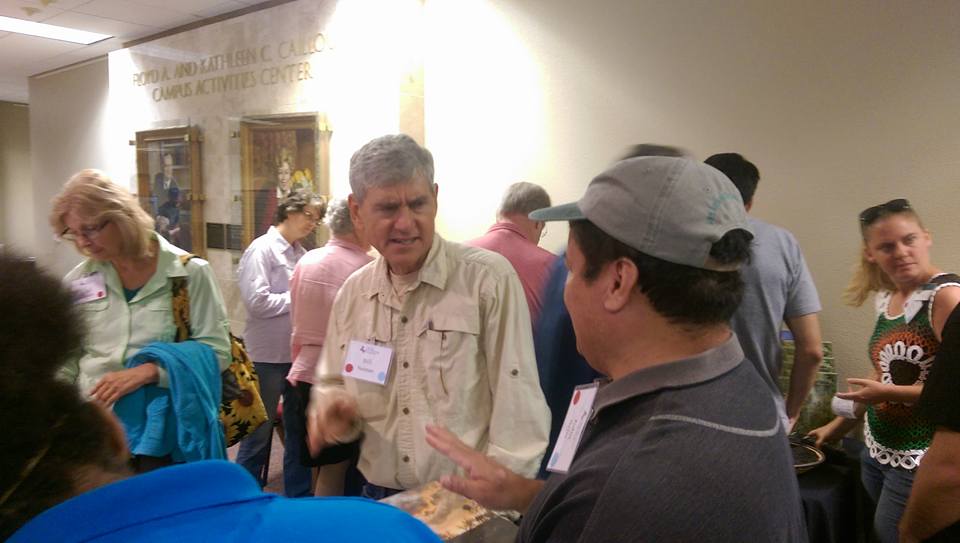
Bill Neiman talking to attendees of the Pollinator Pow Wow, Kerrville, Texas, September 2015. Photo: Cecilia Nasti
This is Passport to Texas
Bill Neiman [NEE-man] started saving native seeds and plants when he realized Texas had been losing its indigenous flora to development.
11- He’s truly a visionary in this area. And there were a few people around the state, and he and his wife Jan-in the mid to late 80s-made it a point to seek out these people.
Camille Wheeler wrote about Neiman for Texas Parks and Wildlife magazine. Neiman, who owned a landscaping business, watched non-native plants die without daily watering, when so-called native “weeds” thrived with nothing.
10-He just immediately made the connection: these non-natives are water hogs. He started looking for other people like him.
He found author and native landscaping expert, Sally Wasowski. They met in 1985 when Neiman attended a native plant conference where she gave the keynote.
18-She was challenging the audience. She said: where can we find native plants, and who can be trusted to grow them? And Bill Neiman–he didn’t even know he was going to do this–he just sprang to his feet and shouted out: I will do it! I have a nursery; I’m in Flower Mound, Texas and I’m converting the whole thing to native plants.
There’s more to this fascinating story, Seeds of Hope, by Camille Wheeler; find it in the October issue of Texas Parks and Wildlife magazine.
That’s our show for today… Funding provided in part by Ram Trucks. Guts. Glory. Ram
For Texas Parks and Wildlife…I’m Cecilia Nasti.
Posted in Botany, Conservation | Comments Off on TPW Magazine: Seeds of Hope
October 9th, 2015
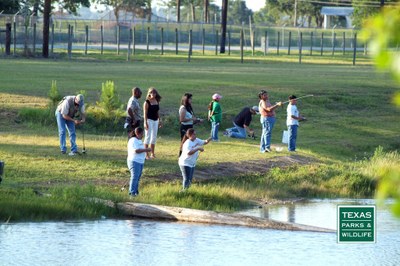
Enjoying outdoor recreation.
This is Passport to Texas
Barriers that prevent people from engaging the outdoors are as diverse as the individuals, themselves. The Texas Co-Op Grant program from Texas Parks and Wildlife enables non-profits to chip away at those walls.
16-This grant program has been around for almost 20 years. And, it was designed to get underserved audiences involved in Texas Parks and Wildlife programs, activities and outdoor recreation opportunities.
Cappy Smith coordinates the program, which has $1.5 million dollars available in 2016 for reimbursement grants. She explains.
18-They [the non-profits] have to have some of their own resources available to fund the program. Let’s say that they are buying new mountain bikes. So, they buy those mountain bikes and then they submit the documentation to us. And then what we do is we reimburse them for that expense.
Grants range from $5,000 to $50,000. Cappy Smith says the Co-Op grant program provides assistance to those needing help writing their proposal.
11-We do offer Co-Op grant writing classes. The workshops are free, and we invite people to come to those. We go through the application step-by-step.
Find submission deadlines, workshop schedules and other information about the community outdoor outreach grants program on the Texas Parks and Wildlife website.
For Texas Parks and Wildlife…I’m Cecilia Nasti.
Posted in Co-op outreach grants | Comments Off on Helping the Helpers Get People Outside


 Passport to Texas is a
  Passport to Texas is made available by: