When journalist, Richard Louv, coined the phrase, Nature Deficit Disorder in his book Last Child in the Woods, he intended it to be “tongue-in-cheek. But it struck a nerve.
04-It has entered the language since then. Actually, several languages.
Louv was the keynote speaker at the annual Children in Nature Conference in in April.
21- To show you what I know about marketing, I argued with the publisher on whether that should be in the subtitle. But as I thought about it, I thought we’re not going to have a big conversation about this issue without that kind of approach. So, it’s not a known medical diagnosis; maybe it should be. It is, though, a metaphor for what we’ve known was going on for a long time.
What was going on for a long time was estrangement of youth from the natural world.
10-The activities that kids considered important–nature was sliding on that scale very quickly, and that started about 30-35 years ago. At an accelerating pace.
Since Last Child in the Woods publication in 2005, the Children in Nature movement has grown around it.
19-If children have less and less experience with nature, who will be the future stewards of the earth. Yes, there will always be environmentalists and conservationists, but increasingly–if we’re not careful–they will be carrying nature in their briefcases and not in their hearts. And that’s a very different relationship, and I don’t think it’s sustainable.
For Texas Parks and Wildlife…I’m Cecilia Nasti.
Posted in Children in Nature | Comments Off on Is Nature Deficit Disorder a Real Thing?
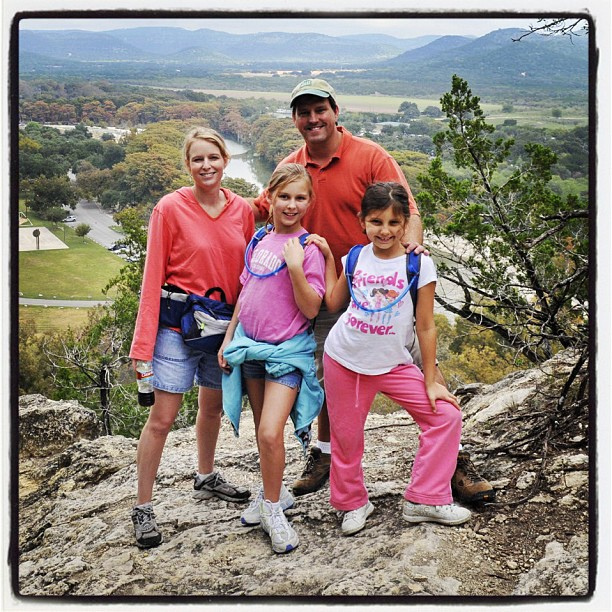
Spend time with Dad outdoors this Father’s Day, June 21.
03-You never know what’s going to happen outside; it’s the wide open spaces.
Ernie Gammage is former Outreach and Education Director for Parks and Wildlife.
10-One of the things that I remember from my childhood is having the opportunity to fish with my dad. And it’s just such a quiet, special time. I mean, I can still visually see everything that we did back then.
Sharing the outdoors with dad on his special day will make lifelong memories.
08-A lot of the distractions of the work-day world, family obligations, and so forth are put aside and it’s just you and somebody that you love, somebody that you respect.
As we like to say: Life’s Better Outside.
12-I think spending time outdoors with your son or your daughter, or whoever it is, is an opportunity, especially for fathers that already spend time in the outdoors, to pass on some of the things they love and value to their kids.
That’s our show, which I dedicate to the memory of my father who during summers when mom worked weeknights, cobbled together picnic meals from leftovers, then loaded his 7 rambunctious kids and a couple of bikes into a station wagon–that had seen better days–and took us to the nearby forest preserve for al fresco dining and exploration. Thanks, Dad.
Funding provided in part by Ram Trucks. Guts. Glory. Ram
Vultures get a bad rap: maybe it’s because they aren’t “pretty birds”, or because they eat road kill. Texas Parks and Wildlife non-
game Ornithologist, Cliff Shackelford, says they deserve our respect as they are a helpful, interesting species.
15-Vultures have a role to play, what we call “ecosystem services”. These are benefits to us; it’s unfortunate that our cars hit animals, but think about what’s left behind. The vultures are cleaning up all the mess and we have to commend
them for that.
How do vultures eat decaying carcasses and not get sick?
08- Vultures don’t get sick because they have certain bacteria and other flora in their guts that help them break down these
carcasses.
Although a migratory species, vultures live year-round in Texas. When road kill freezes up north, those vultures
travel south.
10- Because of our location, we not only host a lot more vultures in the winter season, we see a lot more passing
through in the spring and fall migration.
Vultures are social birds and roost together, preferring tall structures that allow an easy entrance and exit.
09-They like cell phone towers, rocky outcrops and ridges, an old tree that’s standing up really high. They like the tallest roof
in the area.
Yet, they nest on the ground under fallen trees, and are excellent parents. Now that you’re better acquainted, we
hope you’ll view vultures in a new light.
For Texas Parks and Wildlife…I’m Cecilia Nasti.
Posted in Birding, Wildlife | Comments Off on Vultures: Nature’s Clean Up Crew
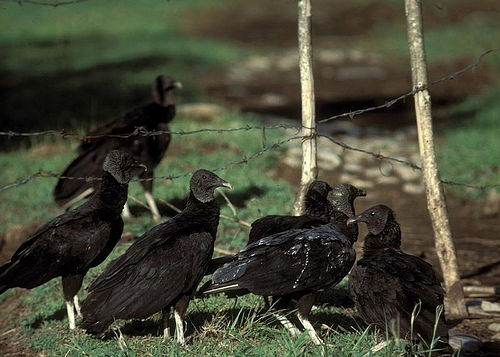
Some people call them buzzards, but Cliff Shackelford says the correct ornithological name for the large black birds that dine on road kill is: vulture.
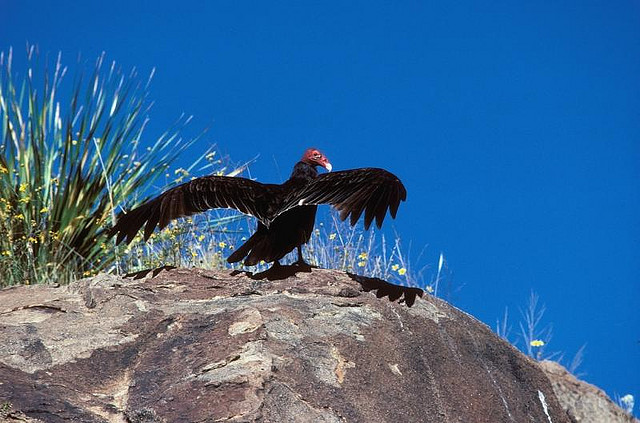
03–We have the turkey vulture and the black vulture.
Shackelford is a non-game ornithologist with Texas Parks and Wildlife.
11- And the best way to tell them apart when they’re perched and sitting on that dead deer carcass on the roadside, is: look at the color of the head on the adults. The black vulture has a gray head and the turkey vulture, a red head.
Vultures circle high above the land in search of a meal.
21- The turkey vulture uses the sense of smell, and they’ll smell their prey. The black vulture, though, uses sight, they’ll look for prey, but they’ll also cheat. They’ll also look for where the turkey vultures are circling–[and decide] I’m going to bump in line. And with their numbers, usually the black vulture can overcome the turkey vulture and get the first little bites.
Other interesting facts: vultures defecate on their legs to cool off–using evaporative cooling; and, when threatened, they vomit.
15-This is a defensive mechanism. They don’t have fangs like a rattlesnake; they don’t have claws like a bobcat. So, their best defense is to throw up what’s in their stomach that was lying on the road for the last three days. And guess what? You’re going to turn away; it’s a great defense.
We learn more about this big bird tomorrow.
For Texas Parks and Wildlife…I’m Cecilia Nasti.
Posted in Birding, Wildlife | Comments Off on Texas Vultures
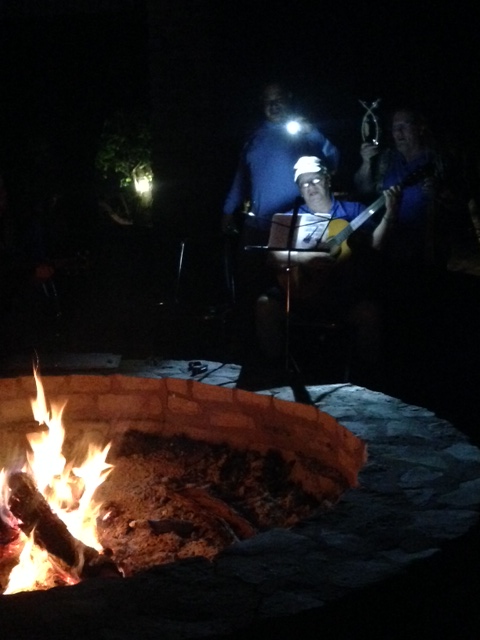
Campfires at state parks enliven your overnight camping experience. Yet, Terry Erwin says before building a blaze–ensure the site is suited for the purpose.
19-When you want to build a fire you certainly have to find a location to build it. You want the ground or the level where you’re going to build the fire to be dry. You clear the leaves away and if possible, gather some rocks to make a fire ring that will contain that fire.
Erwin is and avid outdoorsman and former Hunter Education Coordinator for Parks and Wildlife. Unless authorized by the park manager, he says you may not collect firewood at the park. Therefore, campers must pack in what they need.
23-Start with a bird’s nest of material so if you put your spark in there, gather some cedar bowls or cedar bark and when you spark it, you can blow on the spark and that will enhance the fire. Start with little sticks and graduate to bigger sticks until you add twigs, grass and bark shavings and things like that on the fire to get it started. Then you can add the larger sticks and get it going at that point.
Extinguish your campfire by drenching it with water, and repeat this step until all embers are dead. Alternatively, cover the embers with a thick layer of soil.
That’s our show…Funding provided in part by Ram Trucks. Guts. Glory. Ram


 Passport to Texas is a
  Passport to Texas is made available by: