November 13th, 2014
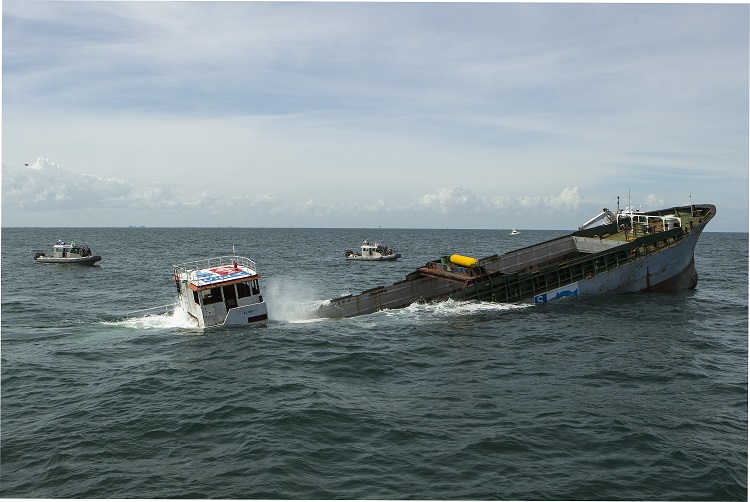
Reefing the Kinta off the coast of Corpus Christi
This is Passport to Texas
The Gulf of Mexico bustles with marine life with no place to call home because the floor of the gulf is…
01—Mainly mud and sand.
Dale Shively, with the artificial reef program at Texas Parks and Wildlife, says using a variety of materials, the agency creates hard substrate, habitat, for these species.
10—By putting down concrete, or steel, or a ship – that gives these organisms a place to attach and to grow. And then from there, they create this reef environment…
The reef attracts fish, thus improving angling and diving opportunities. In Mid-September, Texas Parks and Wildlife sunk the freighter Kinta in 77 feet of water, 8 miles off the coast of Corpus Christi. Shively explains what makes a ship right for a location.
12—We want a ship that’s complex and that has a lot of interest to divers, and would be beneficial for marine life. [It needs to be] clean of environmental hazards, but of the right size to fit in particular reef sites.
The Kinta fit the bill, and has a new home on the gulf floor, where marine life has already discovered it.
20—Divers have gone down just a few hours after it was on the bottom and saw fish –so they found a home immediately. But as far as organisms actually growing and attaching to it, that will take a few months. But I would say in six months it will be pretty well covered, and within a year you have a pretty significant reef.
The Wildlife and Sport Fish Restoration program supports our series.
For Texas Parks and Wildlife…I’m Cecilia Nasti.
Posted in Fishing, Land/Water Plan, Saltwater, SFWR | Comments Off on Angling: Near Shore Reefing of the Kinta
November 12th, 2014
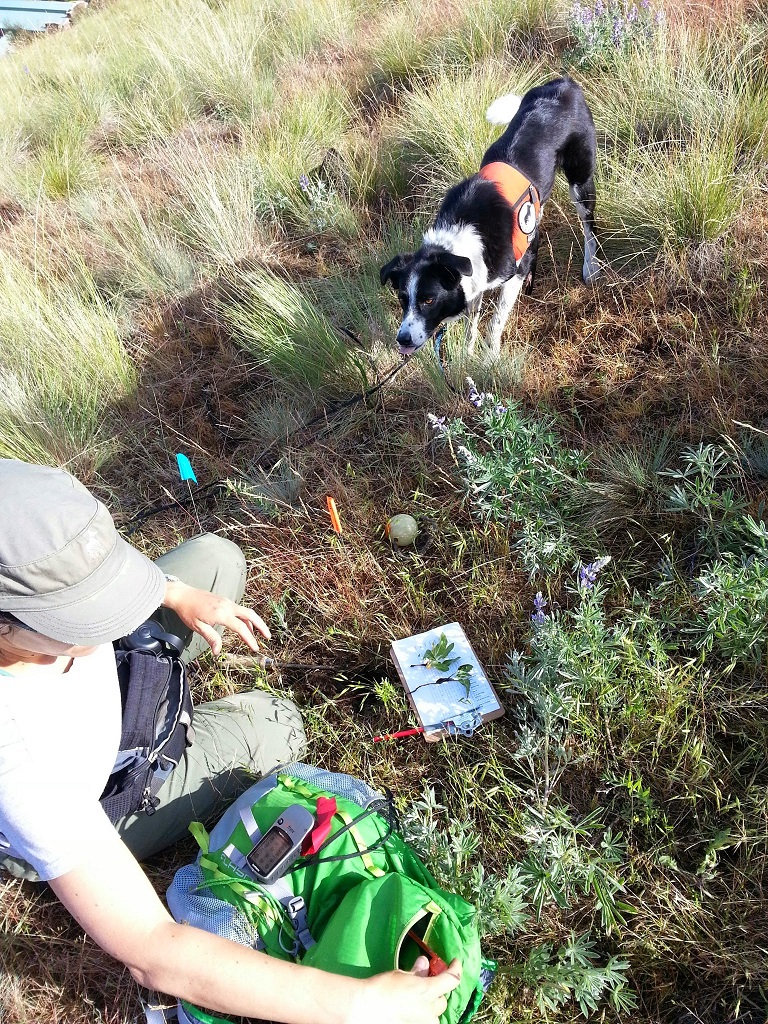
Dalit Guisco and Seamus finding Dyers woad (an invasive plant from Eurasia) in Montana.
This is Passport to Texas
Using their keen sense of smell (often to locate scat), trained conservation detection dogs assist with monitoring endangered wildlife, defining wildlife corridors and helping to eradicate invasive species.
06—Almost all of our work is in partnerships with non-profits, or agencies or sometimes universities.
Pete Coppolillo is Executive Director of Working Dogs for Conservation in Montana.
13—It’s really cost effective because you can find information about a lot of animals without having to fly a helicopter around and dart them and capture them and do things like that.
Lab analysis costs are decreasing, too, making it easier to obtain more information from scats. Yet, some successes have nothing to do with wildlife.
29—I’ll give you one example: there’s a weed here in Montana called dyers woad that has infested large parts of Utah, and then it appeared here. For a long time, the expectation was we’ll never get rid of it [because one plant can set 10,000 seeds]. Because dogs are so good at finding it, and because they can find it before it flowers or sets seed, we are close to eradicating that plant in a place called Mount Sentinel. You know, it’s a really powerful, scientifically rigorous tool, and it opens the door to doing things we hadn’t dreamed of.
You can learn more about conservation detection dogs, and see pictures of the dogs, Working Dogs for Conservation.
For Texas Parks and Wildlife…I’m Cecilia Nasti.
Posted in Conservation, Wildlife | Comments Off on Conservation: Dogs Sniff Out Invasive Weeds
November 11th, 2014
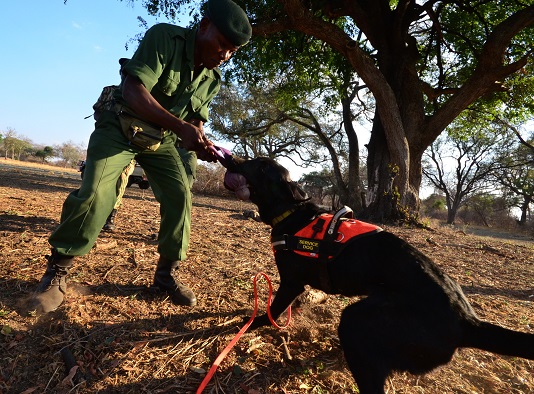
A scout from the South Luangwa Conservation Society, Godfrey Mwanza, and Steven (the black lab). Both are in training to stop ivory smuggling out of the Luangwa Valley of Zambia.
This is Passport to Texas
Working Dogs for Conservation in Bozeman, Montana trains dogs to help researchers in the field.
05—One in fifteen hundred dogs that we screen has what it takes to be a conservation detection dog.
Some of the program animals are rescues. Pete Coppolillo, Executive Director, says they train the dogs to detect everything from scat, to live animals, to invertebrates, and even invasive weeds.
12—We select for high drive so that they’ll want to do it and work really hard at it. And we also select for dogs that are toy obsessed – that are really excited about a specific toy. And that’s their reward, and that’s also how we train them.
At the time we spoke, Working Dogs for Conservation had just deployed animals to Africa to help fight the illegal ivory trade. Pete told me how they used toys to train the dogs for that assignment.
22—The ivory dogs were trained by hiding ivory with their toy. So, they’ll come in and they’ll sniff around and they’ll begin to associate the scent of ivory with their toy. And as soon as they discover the toy is sitting right behind the ivory, and they get a big whiff of ivory and then they get their toy – and so they get their reward. And then, gradually we separate the toy from the ivory; they learn as soon as they find it they get their toy and their reward.
Tomorrow: some positive results of working the dogs. Learn more about these dogs at Working Dogs for Conservation.
That’s our show for today… Funding provided in part by Ram Trucks. Guts. Glory. Ram
For Texas Parks and Wildlife…I’m Cecilia Nasti.
Posted in Conservation, Research | Comments Off on Conservastion: Dogs with the Right Stuff
November 10th, 2014
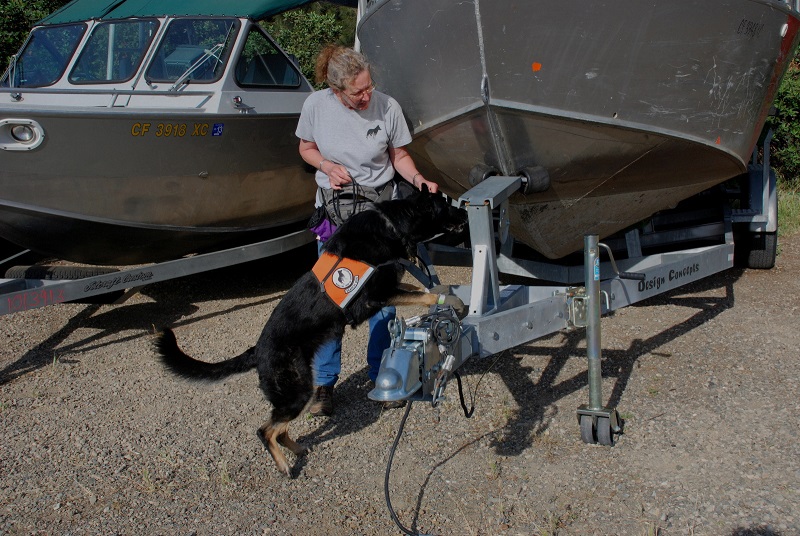
Alice Whitelaw and Tia, inspecting boats for zebra mussels in California
This is Passport to Texas
Most dogs like to work. And Pete Coppolillo is hiring. He is Executive Director of Working Dogs for Conservation in Bozeman, Montana. Since the mid-1990s, his organization’s trained dogs as a non-invasive alternative method for collecting data on hard to find wildlife.
05—By non-invasive, I mean we don’t have to capture them, we don’t have to handle them, we don’t even have to see them.
Then, just how are researchers using dogs?
06—So, the idea is we train a dog to find their scat, usually, which to non-biologists is a polite word for poop.
By detecting scat, the dogs help researchers determine the range, sex, and diet (among other things) of certain wildlife species. Pete said they first trained dogs to sniff out grizzly bear and wolf scat, but didn’t stop there.
28—Dogs can do everything from scat to live animal work to invasive weeds. Even invertebrates, like Emerald Ash Borer; they can find their larvae or their eggs. And, [we] even [use the dogs to detect] aquatic invasives like zebra and quagga mussels – to inspect boats. Because, the mussels can be in cracks, or inside, where a visual inspection can’t see them. Or the dogs can even detect the veligers, which are microscopic larvae that we can’t see.
Not all dogs are suited to this work. Learn more about these dogs at Working Dogs for Conservation.
More on that tomorrow. The Wildlife and Sport Fish Restoration program supports our series and funds diverse conservation projects in Texas.
For Texas Parks and Wildlife…I’m Cecilia Nasti.
Posted in Conservation, Endangered, SFWR, Threatened, Wildlife | Comments Off on Conservation: Conservation Detection Dogs
November 7th, 2014
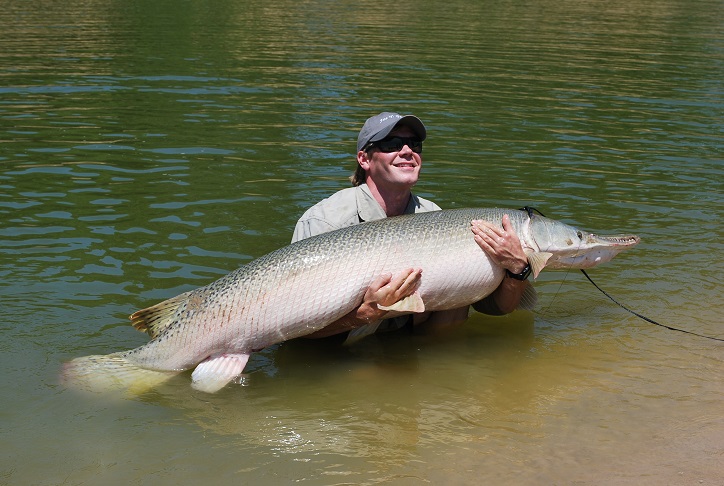
Alligator Gar in the Trinity River
This is Passport to Texas
Alligator gar, virtually unchanged from prehistoric times, is attracting an enthusiastic 21st Century following.
04—The species in recent years has become very popular amongst anglers and bow fishers.
David Buckmeier is a fisheries scientist for parks and wildlife. To fish for gar, you have to know where to find them.
21—Most alligator gar are found in coastal rivers along the eastern part of the state; rivers like the Trinity are very, very well-known for their alligator gar populations. They’re also found in our coastal bays. They’re an interesting species in that they can go back and forth—maybe not into full salt water like in the gulf—but definitely in the bay systems. And they can go back and forth into the river and into those upper parts of those bays.
The alligator gar is the largest freshwater fish in Texas and gives anglers a good fight.
16—Yes, they actually fight quite well. As you can imagine, any fish that weighs 150 or 200 pounds has a lot of power. So, they do fight; they actually jump quite a bit. They’ll completely clear the water. There’s some variations; some of them are more sluggish than others. But, they’re very entertaining and that’s the reason, I guess, for the popularity.
Anglers may keep one of these big fish per day. Learn more about freshwater fishing at the Texas parks and Wildlife website.
The Wildlife and Sport Fish restoration program supports our series.
For Texas Parks and Wildlife…I’m Cecilia Nasti.
Posted in Fishing, Freshwater, SFWR | Comments Off on Fishing: Big Fish with Big Fight — Alligator Gar


 Passport to Texas is a
  Passport to Texas is made available by: