January 30th, 2019
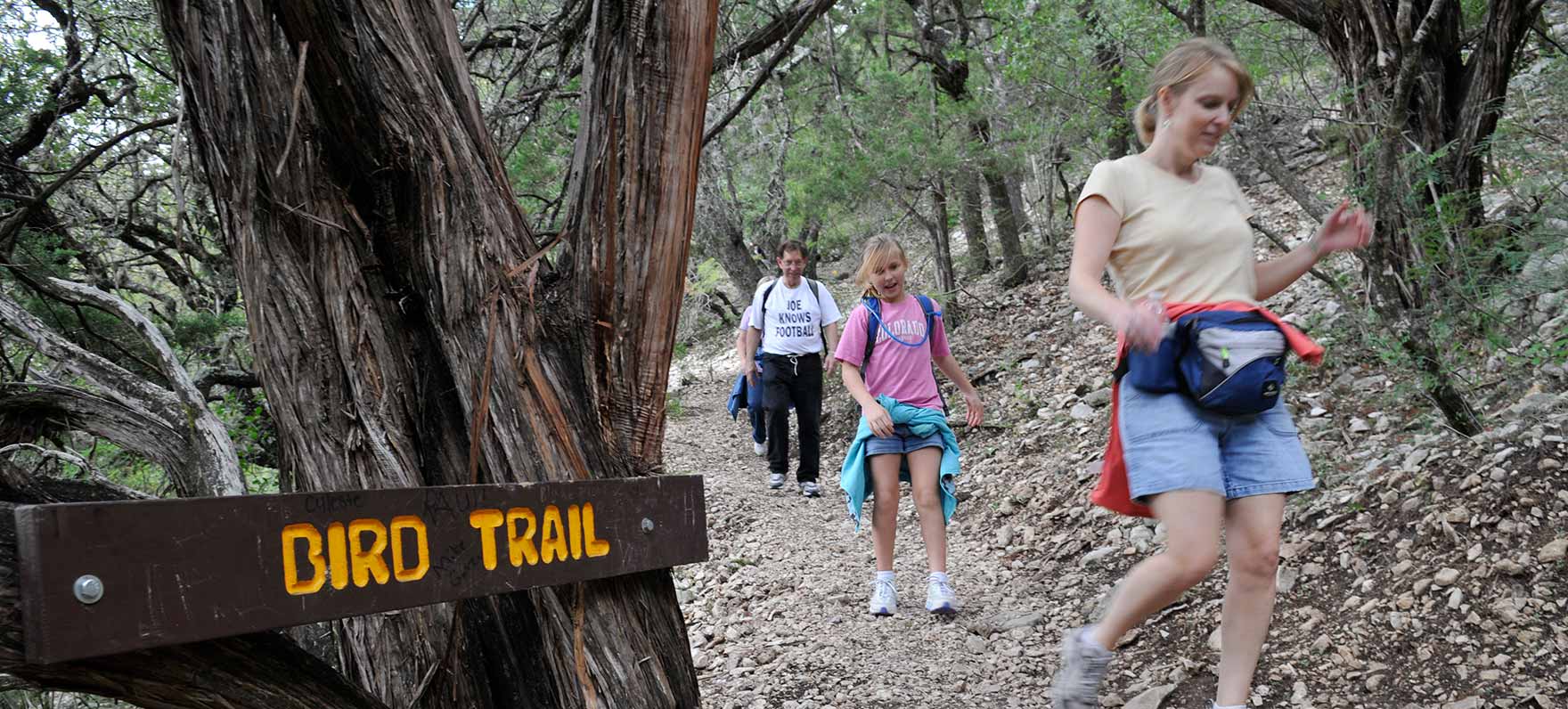
A family hike at Garner State Park is more fun when your feet don’t hurt from ill-fitting shoes.
This is Passport to Texas
Your feet take you on outdoor adventures. And the greatest kindness you can show them is to wear shoes that fit properly.
Sean Bibby is the community outreach coordinator for Whole Earth Provision Company in Austin. Before that he was one of their shoe guys. He shares tips on getting the right fit for your adventurous feet.
[Sean] All size tens are going to fit differently from brand to brand, for example. You can feel the difference when you’re walking five miles in them. And that is a big deal. So, you want to pick something that fits right at first and that consistently supports your foot in the arch, the heel the width of the toe box, the height of the toe box…the ankle support.
[Cecilia] And so how should a well-fitted shoe feel on one’s foot?
[Sean] Combined with the right socks—that’s a huge part of this—you don’t want to have any slipping around. You don’t want you heels sliding up and down too much. You don’t want your toes moving forward when you’re going downhill. Hiking downhill is often what gets people in trouble in a new pair of shoes. And so you want your foot to be generally locked in with not too much movement. You want to make sure you find a brand that works with the volume of your foot. Um, you want to be able to take your shoes off after four hours of wearing them the first day and not have any big hot spots.
Time spent outdoors is more fun when your feet don’t hurt.
That’s our show. We receive support in part from RAM Trucks…built to serve.
For Texas Parks and Wildlife…I’m Cecilia Nasti
Posted in Hiking | Comments Off on The Right Shoe for Outdoor Adventures
January 29th, 2019
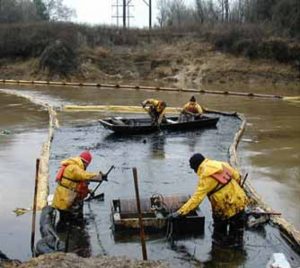
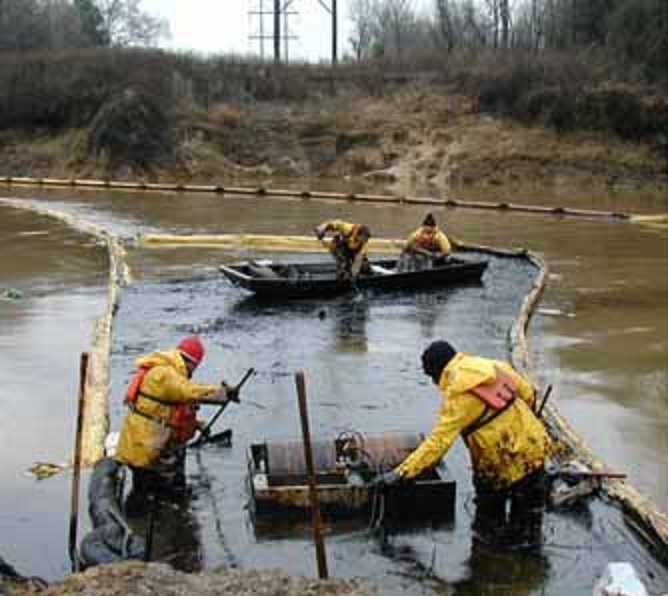
Spill on Sabine River with containment booms
This is Passport to Texas
If thousands of fish were to wash up dead on the Texas coast, biologists from Texas Parks and Wildlife Department’s Kills and Spills Team would be dispatched to the scene.
The Kills and Spills Team is a program in the Resource Protection division of the department, and is responsible for responding to fish kills, wildlife kills, oil spills and hazardous chemical spills. The goal is to protect fish and wildlife from impacts caused by man-made pollution
While large fish kills attract the most attention, uncovering sources of ongoing low-level pollution is just as important.
Some of the most common fish kills that occur near communities are often small—sometimes associated with leaking sewer lines or overflowing manholes. These are segments of the waste-water collection and transport system that can fail. But not all fish kills are caused by pollution. It’s not uncommon to see dead fish when temperatures suddenly drop. Although the majority of fish kills we see are due to natural causes, pollution may be a factor.
TPWD encourages the public to call anytime it sees dead fish in the water and along shorelines. Doing so allows the agency to send out biologists to assess the situation.
The Sportfish Restoration supports our series
For Texas Parks and Wildlife…I’m Cecilia Nasti.
Posted in Conservation | Comments Off on TPWD Kills and Spills Team
January 24th, 2019
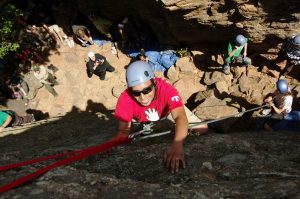
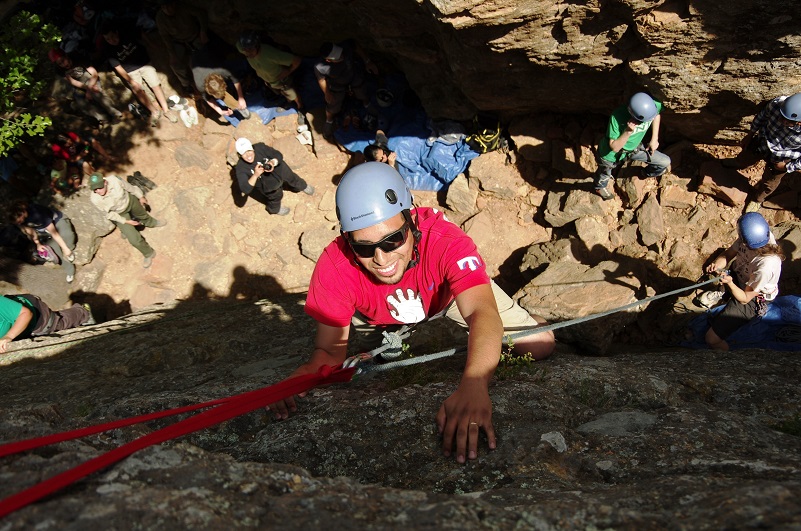
Rock Climbing at Lake Mineral Wells State Park
This is Passport to Texas
Some of Texas’ best rock climbing spots are in our state parks, including Hueco Tanks, Lake Mineral Wells and Enchanted Rock.
As the sport’s popularity has increased, so, too, has the potential for overuse and abuse of these natural resources. Over time, the practice of “clean climbing” has gained traction among devotees of the sport, who are committed to preserving the integrity of the rocks they scale.
Clean climbing is climbing without items—such as bolts—that get left behind. It takes more effort and thought, but those who engage this practice find it fulfilling.
When you do a clean climb, you ensure that those who come after you do not see signs of a previous climb. It’s similar to Leave No Trace.
This method of climbing involves more of a commitment, and works best with multiple climbers. When employing this style, the first climber is responsible for placement of protection gear like camming devices and slings. The climber who follows then removes those items on their way up.
Clean climbing is another way to enjoy unspoiled nature and not spoiling it for those who come after you, either.
That’s our show…we receive support in part from RAM Trucks…build to serve.
For Texas Parks and Wildlife…I’m Cecilia Nasti
Posted in State Parks | Comments Off on Clean Climbing
January 23rd, 2019
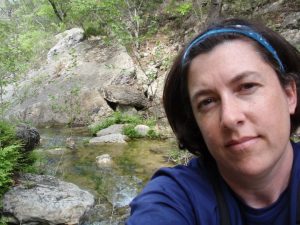
Eco-therapist, Amy Sugeno. Image from her Facebook page.
This is Passport to Texas
Did you know that spending time outdoors may be the cure for people who are anxious about spending time outdoors?
There are ions that come up out of the soil and tend to have these effects—like calming the nervous system.
Former TPWD biologist, Amy Sugeno is a licensed clinical social worker and eco-therapist. She says medical researchers studied earthing, which involves direct skin contact with the surface of the Earth. Among its benefits, researchers found it produced feelings of well-being.
Something as simple as gardening without gloves. Barefoot walking is kind of becoming more popular. You can just sit in your backyard, take your shoes and socks off, and just put your feet onto the grass, or onto the ground.
Anxiety about spending time outdoors is common.
Back when I was working for Parks and Wildlife and would take groups of children out, it would not be uncommon for a child to say, well wait a minute, are there skunks out here? Are there snakes out here? And I would be surprised because I’m so used to being out in the field. But it would remind me that there are anxieties for people.
Other anxieties develop around whether one has the necessary skills to stay safe outdoors. Eco-therapist Amy Sugeno addresses the topic of outdoor anxiety and how to manage it during a segment in our new long-format podcast called Under the Texas Sky.
Find it at underthetexassky.org or wherever you get your podcasts.
For Texas Parks and Wildlife…I’m Cecilia Nasti
Posted in Children in Nature, State Parks | Comments Off on Overcoming Outdoor Anxieties
January 22nd, 2019
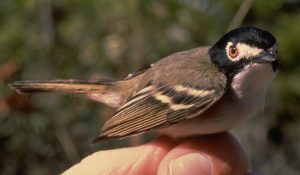
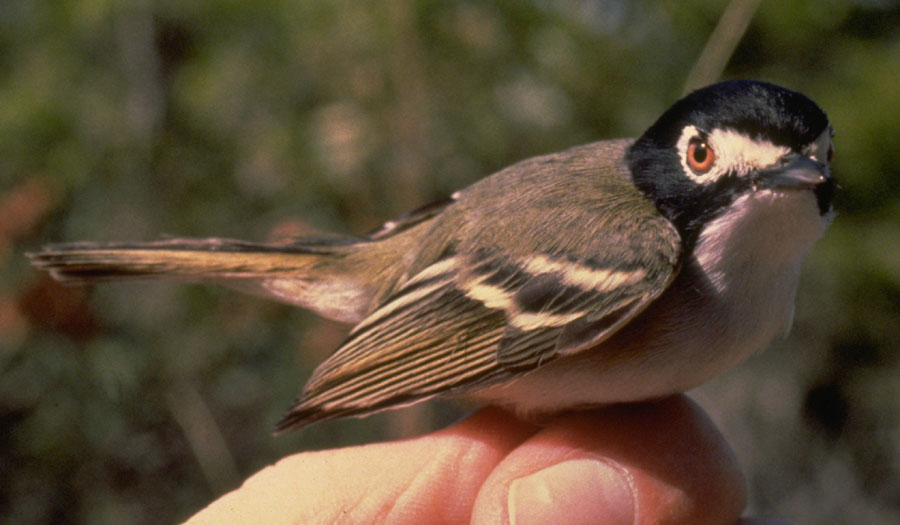
This black-capped vireo male is a passerine species.
This is Passport to Texas
In the Texas Hill Country, biologists are keeping track of a Texas treasure: the Black Capped Vireo.
I stop in my tracks every time I hear one [vireo] Up…there’s that bird. Right there!
Jeff Foreman is a Wildlife Biologist at Mason Mountain WMA. For many years the black cap was an endangered species, but over the past 30 years this little bird has made a big comeback.
Healthy nesting habitat is very much required for the vireo’s sustainability. They really like these low shrubs with spaces in between. They can fly in and around and catch insects.
Historically vireos thrived in the scattered shrubs and open grassland that stretched across Central Texas. But with European settlement came grazing by cattle, goats and sheep.
…sometimes the populations of those livestock weren’t kept in check. They just ate the homes out from under the vireo.
Fire suppression, white-tailed deer, and the brown-headed cowbird, also played parts in reducing the vireo’s population. It was listed in endangered 1987. The good news is, it was delisted in April of last year.
Find out how biologists worked this magic the week of January 27 on the TPW TV series on PBS. Check your local listings.
The Wildlife Restoration program supports our series.
For Texas Parks and Wildlife…I’m Cecilia Nasti.
Posted in Birding, Conservation, TPWD TV | Comments Off on TPW TV: Black Capped Vireo



 Passport to Texas is a
  Passport to Texas is made available by: