November 14th, 2013
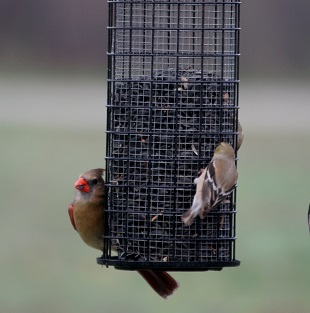
Fiches at feeder, Goliad State Park
This is Passport to Texas
Fall and winter offer bird-watching opportunities – especially in your own backyard when you hang feeders outside your windows for up close viewing.
05—There is no place better in the world for attracting birds than right here in Texas.
Mark Klym, an avid birder, oversees the Wildscaping program at Parks and Wildlife. Common feeder fare is the black oil sunflower seed, which attracts various species, including cardinals, finches, and sometimes chickadees.
06—And watch the way they feed. Some of them will actually sit and break the seed right there on the feeder and eat it.
If you’re new to feeder-watching, some of the behavior you observe may seem perplexing.
15—We get people who are frustrated all the time; they say, ‘how come that bird comes in and throws half the food out?’ Well, what they’re doing is, a bird like a chickadee or titmouse, they don’t have a bill that’s designed to crack that seed. So they’ve got to go back to the branch and bang it on the tree to break it.
But what are they doing when they hurl seed to the ground?
07—They’re actually weighing the seed to make sure there’s enough weight there to make sure it’s worth their while to fly back to that branch before they get their meal.
Now you know. Find additional information about birds on the Texas Parks and Wildlife website.
That’s our show… For Texas Parks and Wildlife…I’m Cecilia Nasti.
Posted in Birding | Comments Off on Birds: Odd Behavior at the Feeder
November 13th, 2013

Gas Well Fire, image theexaminer.com
This is Passport to Texas
A gas well blowout in 2011, in a remote area of Village Creek State Park in East Texas, burned acres of brush and trees; including newly planted native longleaf pines, part of a reforestation effort by Texas Parks and Wildlife.
06— It was a huge fireball, with several hundreds if not thousands degrees; it cooked a huge area.
David Riskind, director of the natural resource program for state parks, says the agency came to a damage claim settlement with the drilling company, and is using the funds to develop a restoration plan…
32—And implement that restoration plan on the type of site and soils which would have been occupied naturally by longleaf pine. So, here we are; we’ve begun to restore the site. We’ve tried to put back the site in its natural condition, using natural contours, that we got from our own experience and also from the topo maps that we have available before the site was site prepped for timber production. And, we’ve begun phase one of the restoration of this – about 180 acre – longleaf pine restoration project.
Longleaf pines were nearly logged to extinction, and with them, the plants and animals that call that habitat home. With this restoration, the agency hopes to see an eventual revival of the forest, flora and fauna.
For Texas Parks and Wildlife…I’m Cecilia Nasti.
Posted in Conservation, State Parks | Comments Off on Habitat: Bad News/Good News for Longleaf Pines
November 12th, 2013
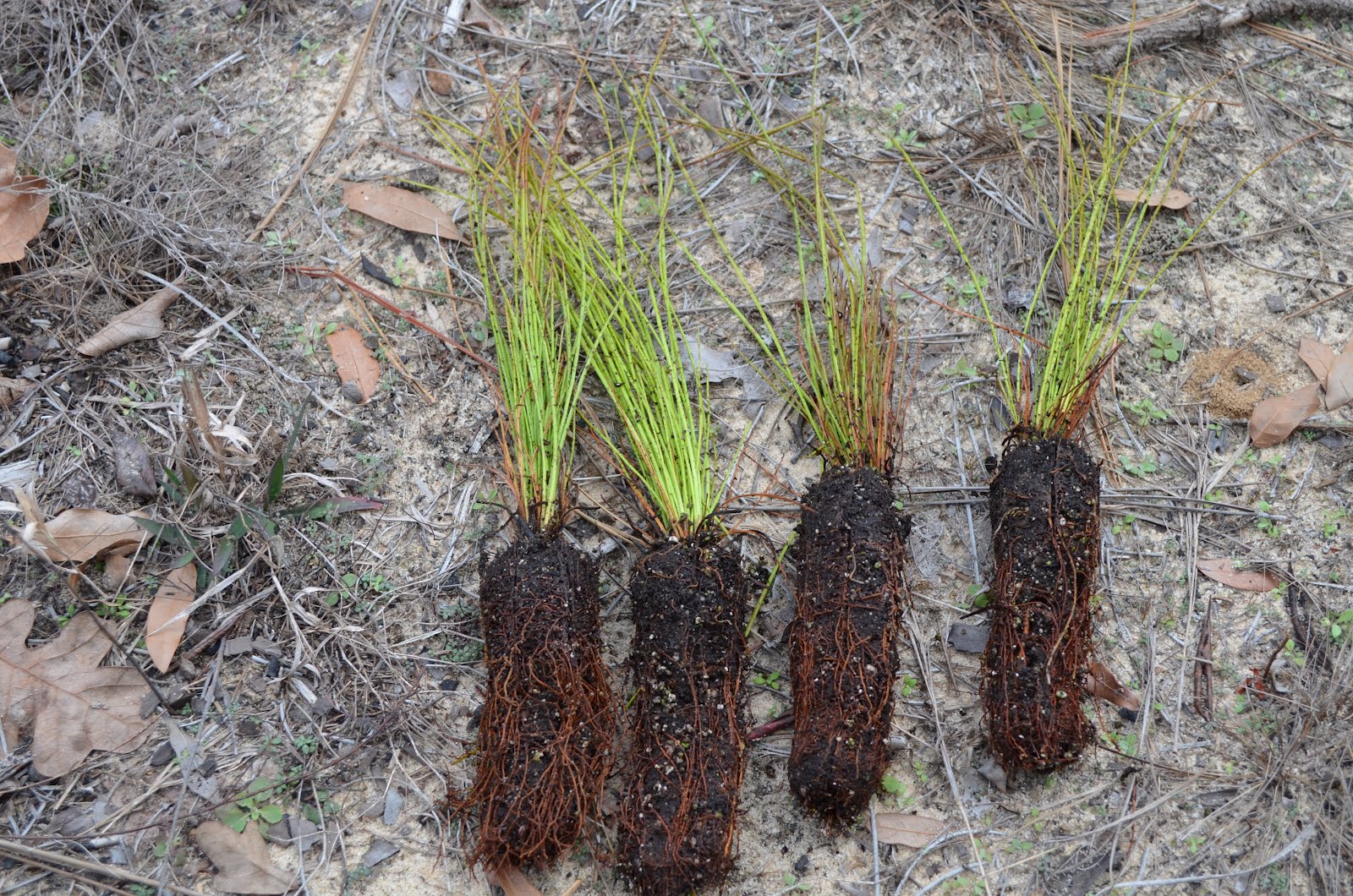
Longleaf pine Seedlings photo from naturejournals.blogspot.com
This is Passport to Texas
A reforestation project underway in East Texas will see the expansion of a stand of native longleaf pine trees at Village Creek State Park.
09— There’s no other state park that has longleaf pine in it. And only the Roy Larsen Sandy Lands Unit in the Big Thicket has a good stand of longleaf pine.
Davis Riskind is director of the natural resource program for state parks. He says the agency acquired property for the reforestation project from The Conservation Fund.
32—And our objective here on most of the state park land is to restore natural habitats. We had a special circumstance occur, in the process of acquiring the property from the conservation fund. There was an outstanding gas drilling right. So, we accommodated that; we worked with the gas company; we found a site that was suitable in the tract, out of the way for them to pursue their rights to explore for gas. The good news is they hit a huge gas well. The bad news was – the well blew out.
David Riskind says a huge fireball cooked a huge swath of land, taking some of the longleaf pine seedlings with it.
Tomorrow: How bad news turned into good news for the longleaf pine reforestation project.
For Texas Parks and Wildlife…I’m Cecilia Nasti.
Posted in Conservation, State Parks | Comments Off on Habitat: Restoring Longleaf Pines in East Texas
November 11th, 2013
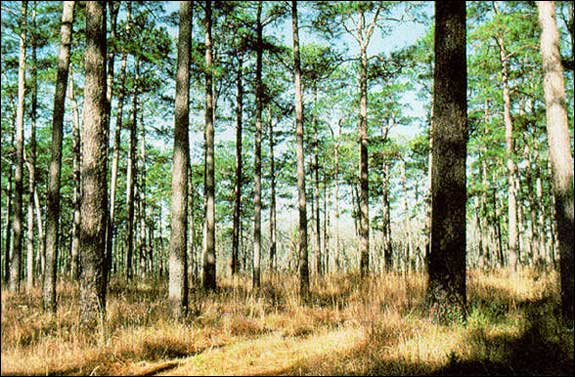
Longleaf Pine Forest
This is Passport to Texas
While we’re familiar with native loblolly pines, the longleaf pine – another native – has struggled for a century.
07— It’s a very, very desirable timber tree. Consequently, by the turn of the last century, it was almost all timbered.
Davis Riskind is director of the natural resource program for state parks.
33—So, there’s very little old growth longleaf pine; it grows on dry upland sites, sandy soils. Or, some of these sites can be very, very wet – they vary from wet to dry. And only longleaf pine is an adapted native species. Of course, what’s happened is, most of the pine has been timbered and has been replaced by exotic species. Slash pine, for example, or even loblolly pine, which used to grow mostly in bottomlands in wet sites. But now it’s a very common fast growing timber tree. So, essentially the habitat has been lost.
Riskind says more than just the trees have been lost.
10—Well, essentially all the wildflowers [associated with that habitat have been lost], a lot of bog plants; orchids, pitcher plants and things like that. And it’s a very open stand, and it usually has a lot of grasses and quite a few of our rare species.
Tomorrow, David Riskind returns to talk about an effort to reforest longleaf pines in an east Texas state park.
For Texas Parks and Wildlife…I’m Cecilia Nasti.
Posted in Conservation, State Parks | Comments Off on Habitat: Loss of Longleaf Pines in Texas
November 8th, 2013
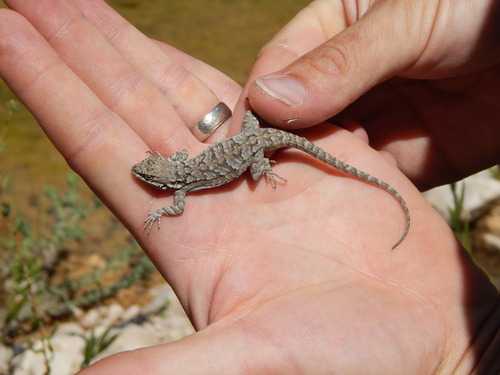
Big Bend Tree Lizard, image by Michael Smith
This is Passport to Texas
Next time you observe an amphibian or reptile share it with Herps of Texas (HOT) online at iNaturalist (http://www.inaturalist.org/projects/herps-of-texas).
10 — We chose to go with the platform iNaturalist, because it is accessible, and at the same time, allows us to capture the data we need for our database.
Cullen Hanks manages the Texas Natural Diversity Database at Texas Parks and Wildlife. He says identifying the species before posting it online isn’t necessary.
26—By doing so, it encourages the community to help them validate that observation by figuring out what the species ID is. iNaturalist covers what kinds of species? You can post any species of plant or animal to iNaturalist. You can post something even if you don’t know what species it is. For example, if you see a lizard and you don’t know what species of lizard it is, by posting it, the community will help you identify that species.
This crowd-sourced information helps Cullen map known herp populations across the state.
12—And we found this is a great platform that allows people to share these observations that they’re seeing out there, but it also – by setting up a project – it allows us to capture the data we need so that those observations have value to conservation.
Learn more about Herps of Texas on iNaturalist in an article by Cullen Hanks in the November issue of Texas parks and Wildlife Magazine.
For Texas Parks and Wildlife…I’m Cecilia Nasti.
Posted in Wildlife | Comments Off on Tech/Wildlife: iNaturalist


 Passport to Texas is a
  Passport to Texas is made available by: