July 11th, 2013
Texas Water Smart
This is Passport to Texas
Despite recent rains in some parts of the state, Texas continues to suffer from withering drought conditions, which could worsen as summer continues.
While we can’t control Mother Nature, we can control our water use by developing water-conscious habits – especially when it comes to our lawns and gardens, where most home water use and waste occurs.
A new effort called Texas Water Smart provides water-conserving guidelines to help Texans reduce their water use.
Texas Water Smart tips include: Water your lawn or garden in the morning when temperatures are cooler to minimize evaporation. Adjust sprinklers so you water only your lawn and not the driveway or street.
Use a broom instead of a hose to clean your driveway and sidewalk. Install a rain sensor on your irrigation system so it won’t run when it’s raining. When necessary, replace ornamental plants with water conscious varieties…and periodically check outdoor faucets, sprinklers and hoses for leaks.
These simple acts can save thousands of gallons of water annually for your household, and for Texas. Plus, it helps keep more money in your pocket…and that’s no drop in the bucket. More tips at texaswatersmart.com.
Support provided by Ram Trucks. Doing what’s right and good regardless of the degree of difficulty — takes guts. Those are the people who build Ram trucks. RAM.
For Texas Parks and Wildlife…I’m Cecilia Nasti.
Posted in Conservation | Comments Off on Conservation: Texas Water Smart
July 10th, 2013
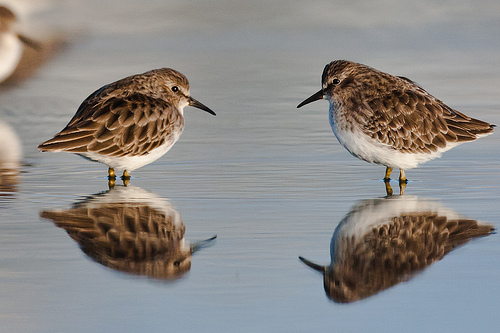
Two Least Sandpipers, Image Creative Commons, Mike Baird
This is Passport to Texas
It may be summer in Texas, but the August/September issue of Texas parks and Wildlife magazine is focused on fall. Editor, Louie Bond.
61— Well, you know, there’s that hint of fall in the air in August nights, and certainly in September, and I think our two features in this fall issue are so appropriate. The first is about two incredible birders. Now, I participated in my first Great Texas Birding Classic this year, and it was very exciting, but it was nowhere near the caliber of these two guys: David Shackelford and Phil Rostron, who have each seen over 8-thousand birds. They are both in the top 10 lists of birders. And Russell Roe, our managing editor, writes a very compelling look at these two very different birders who have achieved this great milestone. And then, our own Dyanne Frye Cortez has taken on what I like to do. I remember when I moved to the country I went out and picked dewberries until my hands were purple and my legs were bleeding scratched. So, she shares with us the best way to harvest agarita, prickly pear, dewberries and Texas persimmons, and all those great wild Texas fruits – and what to do with them after you’ve harvested them. So, I hope you’ll go on a little fall outing with us and read this issue.
Thanks, Louie.
The August/September issue of Texas parks and Wildlife magazine is available on newsstand or by subscription. Learn more at tpwmagazine.com.
For Texas Parks and Wildlife…I’m Cecilia Nasti.
Posted in TPW Mag | Comments Off on TPW Magazine: August / September Preview
July 9th, 2013
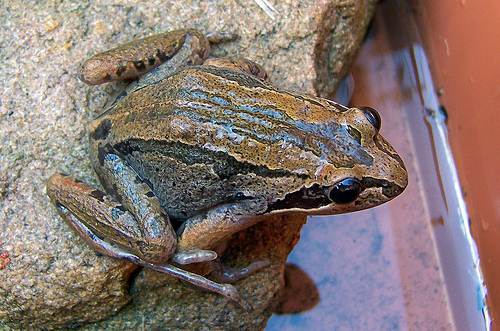
Brown Striped Frog, Image Creative Commons, Brenda Starr
This is Passport to Texas
[Chorus of frogs]
Have you ever been frogging?
06 — It’s what we call when you just get out at night and you start listening for frogs and see what’s living out there around you.
Lee Ann Linam coordinated Texas Amphibian Watch for Parks and Wildlife. Frogging involves volunteers who collect information on amphibian species they hear.
10 — When we suggest that folks do something kind of unusual like that, we like to give them some guidelines to keep them safe, and to keep the frogs safe, and to respect the rules around them. So, that’s what the rules of frogging are for.
Volunteers must obtain permission before accessing privately owned land. Of utmost importance is the safety of the amphibians.
23 — Amphibians are sensitive to things like insect repellents that contain deet, which many of them do. Things like sunscreen and other chemicals that might be on your hands. And so we always say to people, before handling frogs, make sure that you wash your hands, keep your hands moist. And then the other thing we say is to go ahead and wash up afterwards because some frogs have compounds on their skin that protect them from being eaten.
And those compounds can be irritants. We have a link to the complete rules of frogging at passporttotexas.org.
The Wildlife and Sport Fish Restoration program supports our series… and provides funding for diverse conservation project throughout Texas.
For Texas Parks and Wildlife…I’m Cecilia Nasti.
Posted in Conservation, Wildlife | Comments Off on Conservation: The Rules of Frogging
July 8th, 2013

Franklin Mountains State Park
This is Passport to Texas
Catch a segment on the Texas Parks and Wildlife PBS TV series that puts you in the seat of a mountain bike on the trails at Franklin Mountains State Park: Producer Abe Moore.
48 – I went out there, and didn’t know what to expect as far as Franklin Mountains. But it’s actually mountains with hardcore mountain biking trails right in the city limits of El Paso.
Within city limits, this entire park here is about 26-thousand acres; over a hundred miles of trails from beginners on up to advanced.
And there’s some really technical trails there if that’s what you’re looking for. What does that mean? Technical is like serious drop in elevation, single track, with some turns and some moves to the left and moves to the right. They have that there.
You don’t even get a chance to just sit back and just peddle and relax; you’re always having to think about something: not to hit the rock, not to hit the cactus, not to fall off the cliff.
Danger Will Robinson.
Yeah, it was definitely an adrenaline rush going in. Some of the guys that I talked to when I went out there. You could see they were big burly guys; the ladies, too, for that matter. They could handle their business when it comes to mountain biking.
Thanks, Abe.
This show airs the week of July 14 on PBS stations; check your local listings.
That’s our show for today…with funding provided by Chevrolet, supporting outdoor recreation in Texas; because there’s life to be done.
For Texas Parks and Wildlife…I’m Cecilia Nasti.
Posted in TPWD TV | Comments Off on TPW TV: Franklin Mountains Bike Trails
July 5th, 2013
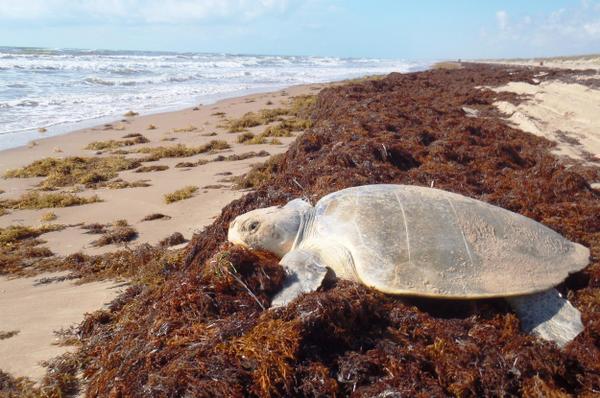
Kemp’s Ridley resting on Sargassum; Image © Joseph Scarola
This is Passport to Texas
The arrival of brown colored algae, called sargassum, to Texas beaches is nearly as predictable as the return of the swallows to Capistrano, but not as welcome.
07 – It shows up on the beach, late spring through early summer, and it can be a nuisance to your average partygoer.
Paul Hammerschmidt, with Coastal Fisheries, says tons of it washes up on the Texas coast from the North Atlantic, hindering beachgoer access to the water. Yet, sargassum is far from being a mere nuisance. It provides habitat for other living things.
13 – There are many animals that only live in the sargassum weed in the Sargasso Sea. It also is a nursery area for a whole lot of game fish like Mahi Mahi, Marlin, Sailfish, that type of thing.
On shore, Hammerschmidt says beachcombers discover shells and sea beans in the slimy tangle, as well as live animals. Cities and counties that obtain permits may move the seaweed to help rebuild sand dunes. If you get a hankering to bring home some Sargassum, it does make a good garden fertilizer – with one caveat.
07 – One thing you really do have to do is rinse the saltwater off of it. You don’t want that saltwater in your garden; that’s just not healthy for your garden.
The Wildlife and Sport Fish Restoration program supports our series, and funds the work of saltwater fisheries in Texas.
For Texas Parks and Wildlife…I’m Cecilia Nasti.
Posted in Saltwater | Comments Off on Nature: The Value of Sargassum


 Passport to Texas is a
  Passport to Texas is made available by: