April 25th, 2013
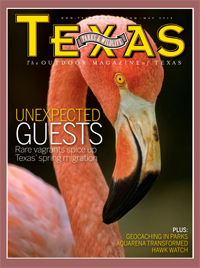
TPW Magazine May 2013 Issue
This is Passport to Texas
Sometimes, for reasons we cannot explain, birds end up in Texas that don’t belong here. They’re called vagrants.
16— Basically a vagrant is defined as a bird that strays far outside its expected breeding, or wintering, or migrating range. In other words, it’s a bird that shows up unexpectedly because it’s not supposed to be here.
Noreen Damude, retired from Texas Parks and Wildlife, is a birder, and wrote an article about vagrant bird sightings, called Unexpected Guests, for the May issue of Texas Parks and Wildlife magazine.
31— One of the ones that struck me is the Stygian Owl. It has a very large range in Central and South America, but it’s very hard to see even where it’s supposed to be. And it was seen in Benson Rio Grande State Park in 1996; this young boy and his parents were just going through the park, and he saw this little ‘fuffing’ in a mesquite tree. And he discovered it. He was a kid! That was very exciting.
We’ll have more with Noreen Damude on vagrant bird sightings in Texas tomorrow.
Support provided by Ram Trucks. Doing what’s right and good regardless of the degree of difficulty — takes guts. Those are the people who build Ram trucks. RAM.
For Texas Parks and Wildlife…I’m Cecilia Nasti.
Posted in Birding, TPW Mag | Comments Off on Birding: Vagrant Species, 1
April 24th, 2013
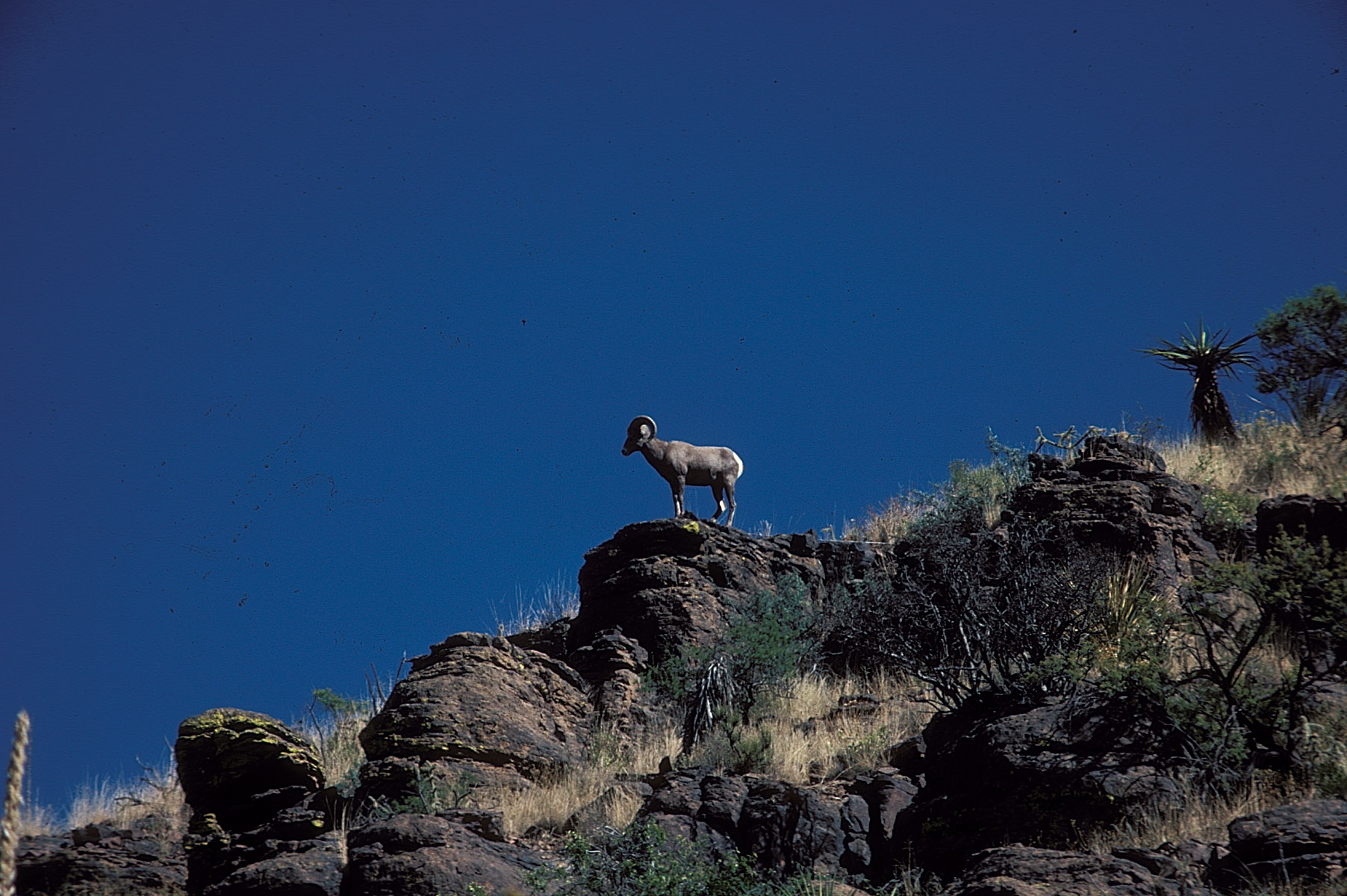
Bighorn Sheep © Texas Parks and Wildlife Department
This is Passport to Texas
This year marks the 50th anniversary of Texas Parks and Wildlife, and we’re looking back at major milestones, including the success of our Desert Bighorn Sheep restoration program.
11— We have sheep in about eight mountain ranges right now. State numbers are up about 13-hundred or so – we’re halfway there. Our goal being about 25-hundred to 3-thousand animals in all of their historic range.
That included 15 mountain ranges in the Trans Pecos. Froylan Hernandez, Desert Bighorn Sheep Program Leader, says over the decades, TPW, with the support of landowners and other conservation partners, relocated sheep from other states to Texas.
06 — Essentially they’re still the same sheep, however, they have real subtle differences in sub-species that occur out here.
Texas Parks and Wildlife keeps a close watch on the animals to better understand what they require to live fully. One way they do that is by fitting certain sheep with radio tracking collars, from which he gathers data.
17— Research is a huge component of any restoration program, because that is how we learn; it helps us understand the biology of the animal, and it helps us better manage for the animals. It’s very unnatural for them to be running around in the wild with a collar around their neck. But, that’s exactly how we learn, and we better manage for them.
Learn more about Desert Bighorn Sheep Restoration on the Texas parks and Wildlife website.
The Wildlife and Sport Fish Restoration program supports our series and funds Desert Bighorn Sheep Restoration in Texas.
For Texas Parks and Wildlife…I’m Cecilia Nasti.
Posted in Conservation, SFWR | Comments Off on Conservation: Bighorn Sheep Restoration, 2
April 23rd, 2013
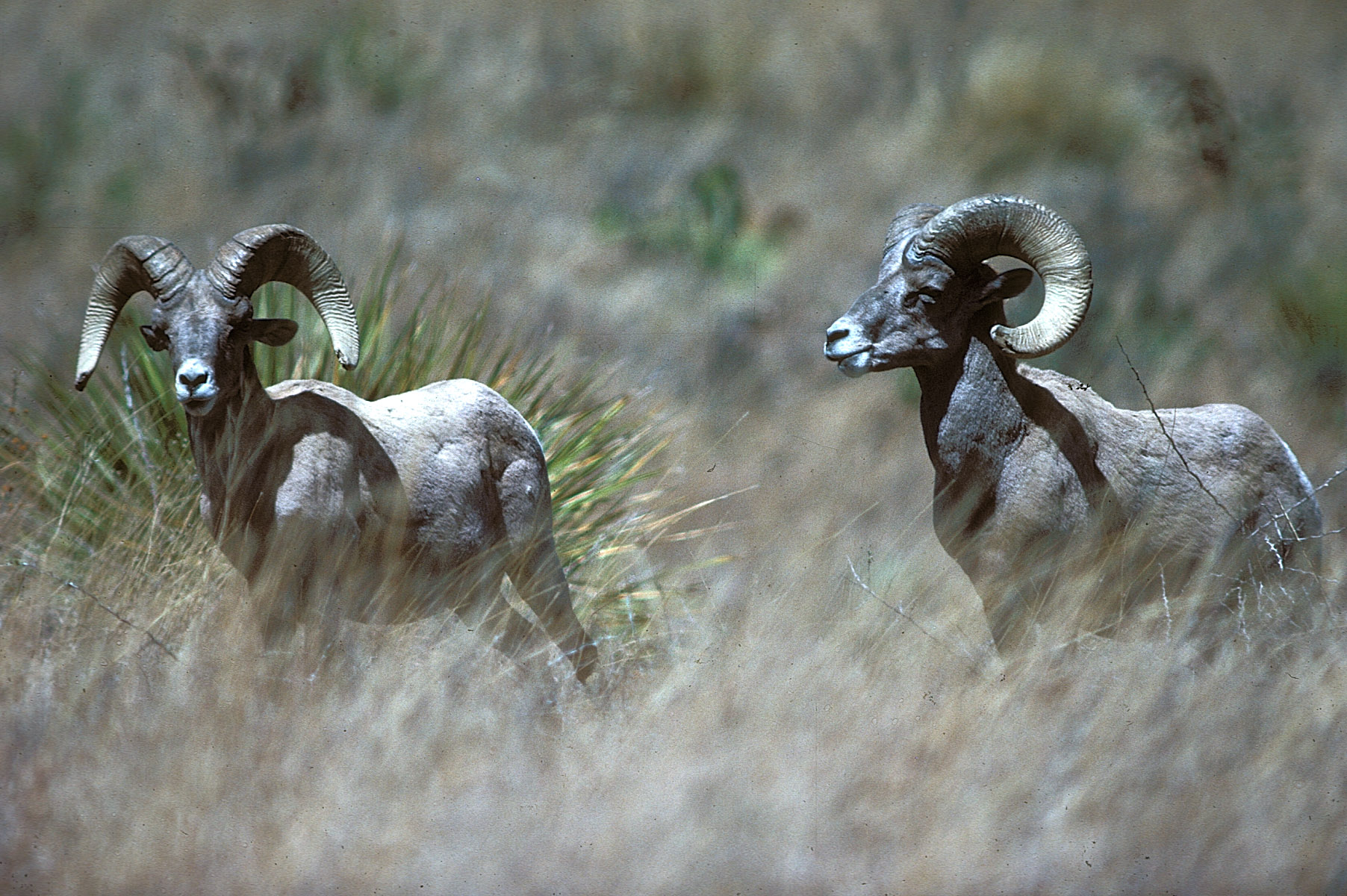
Bighorn Sheep © Texas Parks and Wildlife Department
This is Passport to Texas
In the late 19th century, upwards of 3-thousand native desert big horned sheep roamed the Trans Pecos region of Texas. By the mid-20th century, they were gone.
07— It’s commonly agreed that the introduction of domestic sheep and goats, [with their] diseases, net wire fencing, and unregulated hunting played a big part [in their demise].
Froylan Hernandez is the Desert Bighorn Sheep Program Leader for Texas Parks and Wildlife. He is quick to say, there’s no ill will toward the domestic livestock industry.
06— I’m just merely stating the facts of the Bighorn’s demise. We need to live in harmony with the domestic livestock industry.
Native Texas Bighorn Sheep no longer exist despite active restoration efforts of the species that began in the late 1940s and early 50s.
09— So we started introducing sheep from other states; primarily Nevada, Utah, Arizona, some from Baja California, Mexico. So the efforts started way back when.
Restoration of Desert Bighorn Sheep involves relocation, monitoring, data collection and analysis. The sheep historically appeared in 15 mountain ranges in the Trans Pecos.
07— Our goal is to get them back to the critical habitat – to those mountain ranges, and for them to number about 25-hundred. So, we’re kind of halfway there.
More on Desert Bighorn Sheep Restoration tomorrow.
The Wildlife and Sport Fish Restoration Program supports our series and funds Desert Bighorn Sheep Restoration in Texas.
For Texas Parks and Wildlife…I’m Cecilia Nasti.
Posted in Conservation, SFWR | Comments Off on Conservation: Bighorn Sheep Restoration, 1
April 22nd, 2013

McKinney Falls State Park, Austin, Texas
This is Passport to Texas
Business owners understand what it takes to keep the doors open. Our State park Guide Bryan Frazier tells us about a business that’s raising funds to help Texas State Parks keep their gates open.
59 – For the second year in a row, Whole Earth Provision Company stores (and they have outdoor clothing and outdoor gear, and they have eight different stores in metropolitan areas all over Texas) of their initiative, they have agreed to make state parks the beneficiary of a fundraising drive for the entire month of April, for donations taken by cashiers when patrons check out. And, for every $20 donation that people make, they’ll get a free five dollar gift card for anything that cash will buy: from fees or state park store merchandise. That’s at Whole Earth Provision Company for the entire month of April.
On the 13th & 14th, Whole Earth Provision Company sponsored the Banff Mountain Film Festival at the Paramount Theater in Austin. And all proceeds of the tickets of that film festival went to benefit Texas State Parks. This is the second year in a row that Whole Earth offered this very generous donation and fund drive to help Texas State Parks.
Thanks, Bryan.
Find additional information at texasstateparks.org.
That’s our show for today…with funding provided by Chevrolet, supporting outdoor recreation in Texas; because there’s life to be done.
For Texas Parks and Wildlife…I’m Cecilia Nasti.
Posted in State Parks | Comments Off on State Parks: Fundraiser for Parks
April 19th, 2013

Image from www.westtexasweekly.com
This is Passport to Texas
April 22, 1970 marked the first celebration of Earth Day, the goal of which was to highlight the needs of the planet, and to encourage citizens to care for it.
Let’s celebrate the planet every day by tailoring personal behaviors to benefit Mother Earth.
And what you do at home can have a big impact on the world outside your door. Just one simple act can have a meaningful impact statewide. Let’s consider water.
Instead of leaving the water running while brushing your teeth– wet your brush and then turn off the faucet until it’s time to rise.
By doing this, you could save up to 3 gallons of water a day, or up to 1095 gallons of water a year. That is per person in your household, if everyone joins in.
As water is, and will continue to be, an issue of concern in Texas for years to come, if every citizen of the state carried out this one simple act, we could potentially save more than 28 billion gallons of water a year statewide.
That translates to more than 85-thousand acre feet of water. An acre-foot equals about 326–thousand gallons, which is enough water to meet the water needs of an average suburban family of five for 18 months.
That’s just one simple act. What other simple acts can you perform to celebrate Earth Day all year long?
That’s our show for today… For Texas Parks and Wildlife…I’m Cecilia Nasti
Posted in Education, Events | Comments Off on Conservation/Environment: Earth Day


 Passport to Texas is a
  Passport to Texas is made available by: