September 20th, 2012
_free-tailed_bats_in_flight--~thomas_kunz,_boston_university.jpg "Mexican Free-tailed Bats")
Mexican Free-tailed Bats
This is Passport to Texas
Since the winter of 2006, White-nose Syndrome has killed more than 5.7 million bats in Eastern North America. The culprit is a fungus called Geomyces destructans.
14—The fungus can be present on the bat and in the environment before it actually evolves into the full blown disease. And right now we’ve got 19 states and 4 Canadian provinces with the disease and an additional two states with just the fungus present.
Katie Gillies is the imperiled species coordinator at Bat Conservation International.
17—This is what they call a sacrophilic fungus, which basically means it’s cold-loving. And so the environment has to be cold, and it generally has to be humid, too. And then you also have to have that host present on which it can grow. And so, it just happens to be the trifecta for cave hibernating bats.
Texas bat populations are free of white nose… for now. Temperatures may be too warm for it to survive, but Gillies says it is hard to make a “blanket statement” about the fungus in a state the size of ours.
26— I think most people are concerned, primarily, in north Texas, where we do have the cooler temperatures and the right humidity levels that could be conducive to it. You know, most of these big caves [in Texas] are used by Brazilian free-tailed bats who do not hibernate. So, we don’t really think that it is going to affect those species of bats, but we don’t know what role they could play in possibly transferring the fungus to other caves.
Tomorrow: Where did this fungus originate?
For Texas Parks and Wildlife…I’m Cecilia Nasti.
Posted in Wildlife | Comments Off on Wildlife: White-Nose Syndrome Update
September 19th, 2012
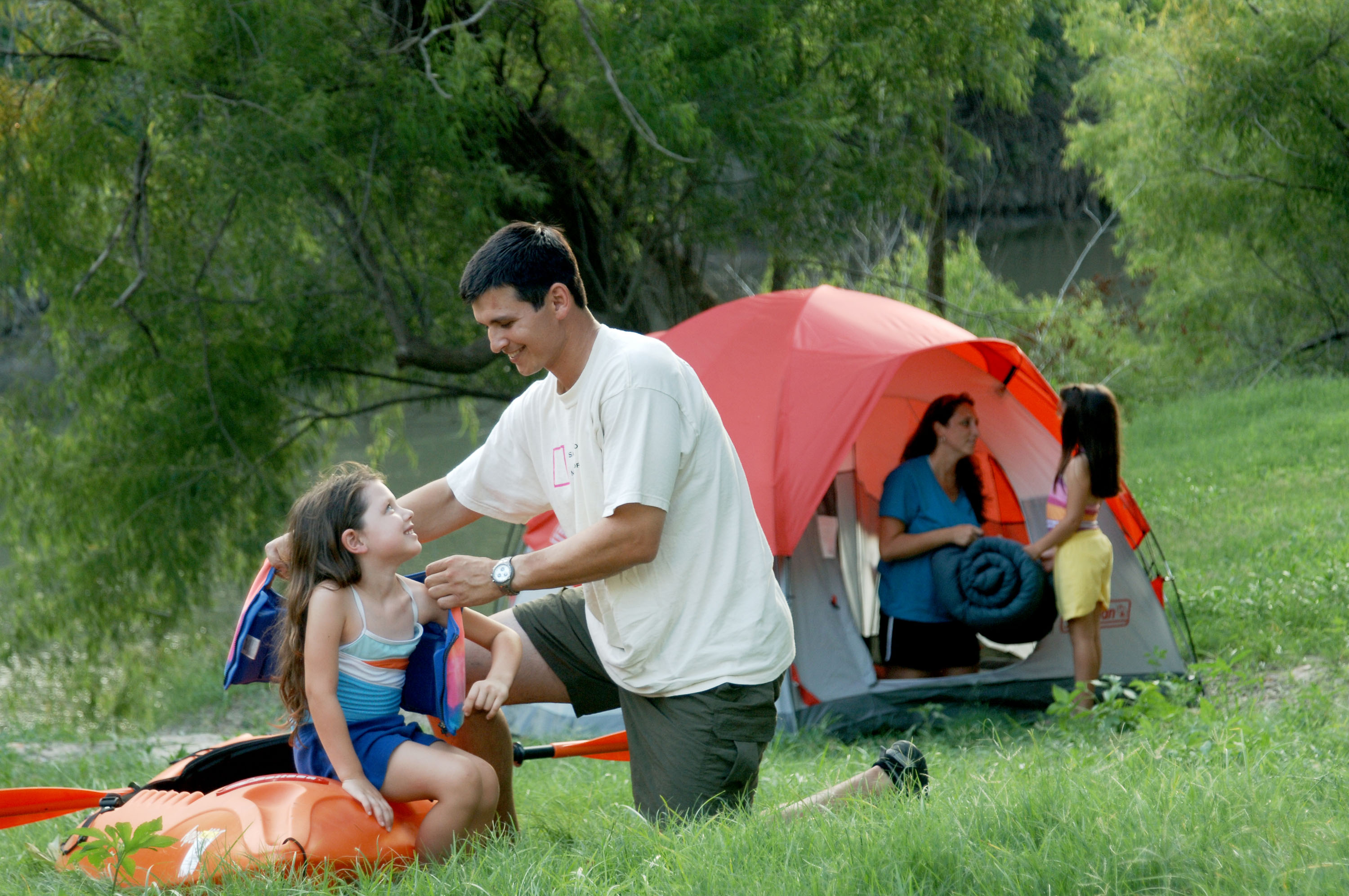
Texas Outdoor Family Goliad State Park
This is Passport to Texas
After a summer hiatus, the Texas Outdoor Family Program is back in full swing. Our state park guide, Bryan Frazier, says it offers an affordable educational weekend of outdoor learning for the whole family.
54—We’ve got a full schedule right now on the website, that goes into December. We provide the tent, expertise, the Texas Parks and Wildlife volunteers tht are trained will be out there. All people need to bring is food and a sleeping bag and that’s it. But up to six people, for $65, for an entire weekend can learn how to safely start a fire, set up and take down a camp, how to do geocaching, how to do all kinds of outdoor activities from fishing to kayaking to nature watching. We’re teaching families and groups and all kinds of people how to reconnect with the outdoors safely so that they on their own can go out and do it by themselves and really see what they’ve been missing. So, check out the website; there’s a programs link on texasstateparks.org, and find out everything about the exciting Texas Outdoor Family program.
Thanks Bryan
That’s our show for today…with funding provided by Chevrolet, supporting outdoor recreation in Texas; because there’s life to be done.
For Texas Parks and Wildlife I’m Cecilia Nasti.
Posted in State Parks | Comments Off on State Parks: Texas Outdoor Family Program
September 18th, 2012

Grilled Venison Loin, Photo by Cecilia Nasti
This is Passport to Texas
Food fads come and go. Currently, wild game is in the spotlight. But there’s nothing new about eating game, unless it’s how it’s gone mainstream.
Chef Jesse Griffiths is a hunter and angler living in Austin. This week his book Afield: a Chef’s Guide to Preparing and Cooking Wild Game and Fish, published by Welcome Books, hits bookstore shelves. It takes readers from field to plate. Jesse says this book is for “the 99%.”
18 – It’s mostly fishing from the shore. It’s mostly game that’s very plentiful: feral hogs and squirrels and rabbits and doves. We don’t go on pheasant hunts. We really tried to convey the point that this land is out there, and that everyone should have the ability to get out there and do this.
Jesse often hunts and fishes on Texas public lands, but stopped short of revealing his favorite places. Afield is an instructional book with stories of the outdoors that takes readers from the field to the plate.
23—I love having a connection with my own food. To sit down to a meal with vegetables that came out of our garden –and we live in a small house in town. And sit down to a meal of –what did we eat this week – a lot of venison. It’s the most important thing. I love knowing where my food comes from. I love the pride in seeing my two year old daughter eating venison, knowing that it’s really healthful for her. There’s really nothing better than that.
For Texas Parks and Wildlife…I’m Cecilia Nasti.
Posted in Hunting | Comments Off on Cooking: Field to Plate with Chef Jesse Griffiths
September 17th, 2012

Chef Jesse Griffiths, Photo by Cecilia Nasti
This is Passport to Texas
We have a culture of hunting game, but when it comes to eating it, many people pass. It’s too gamey, most say. Chef Jesse Griffiths is a hunter and angler, and eats everything he kills. He says game has a rich, unique flavor that’s perfectly palatable when properly prepared.
He chronicled a year of hunting, fishing and cooking in Afield: a Chef’s Guide to Preparing and Cooking Wild Game and Fish, published this month by Welcome Books.
24 – We just tried to present this book that was a guide to getting more out of fish and game for people. We wanted it to be a field manual, a recipe guide. And we put step-by-step photos and descriptions of how to break everything down from a crab to a deer. Just to teach people who are new to it, or maybe even more experienced with it how to utilize these animals more.
I spoke with Jesse in his Austin based commercial kitchen, where he told me the recipes in Afield are simple and recognizable.
18—There’s a lot of tacos in there, and there’s a lot of things like pot pies. Squirrel and dumplings. Things like that. very accessible. I just wanted people to see food that was recognizable and translate that into game, and then that way encourage people to get out there and have the confidence to get out there and have the confidence to do this themselves.
We’ll have more with Chef Jesse Griffiths tomorrow.
For Texas Parks and Wildlife…I’m Cecilia Nasti.
Posted in Hunting | Comments Off on Cooking: Afield with Chef Jesse Griffiths
September 14th, 2012
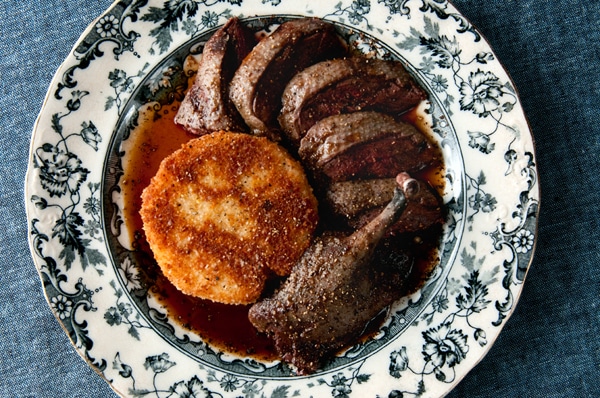
Roast Canvasback, Image by Holly Heyser
This is Passport to Texas
With waterfowl season on the horizon, and Chef Jesse Morris of Richardson, Texas, is here to help us enhance the flavor of these birds for the table.
14 – Typically when I harvest a duck, what I’ll do after either breasting it out, or plucking it, is I will put that in a very strong saltwater bath. And over the course of a few days, I will go from salt water to regular water.
Chef Morris alternates the saltwater with plain water for two to three cycles.
10—What that’s going to do is break down that meat – get it nice and tender – and it’s also going to help leach out any of the blood or anything like that, that may give it an off taste.
The website Killer Chefs, which Chef Morris curates, combines his love of hunting and angling with his passion for cooking. After the saltwater/plain water bath process is complete, fresh herbs help develop the flavor.
24—Sage and thyme and rosemary and oregano, using those in a marinade with olive oil, garlic, salt, black pepper – that’s going to give you some of the best flavor. It’s not going to mask [the flavor of] wild game. A lot of people start thinking ‘Oh, you know, I’m just going to put a ton of Louisiana seasoning on this so I can’t taste anything…’. You know, it’s great that you’re eating that [wild game], but you’re unable to really enjoy what you’ve done.
Find wild game recipes on the Texas Parks and Wildlife website.
The Wildlife and sport fish restoration program supports our series and celebrates 75 years of funding diverse conservation projects throughout Texas…
For Texas Parks and Wildlife…I’m Cecilia Nasti.
Posted in Hunting | Comments Off on Cooking: Ducks for Dinner


 Passport to Texas is a
  Passport to Texas is made available by: