August 30th, 2012
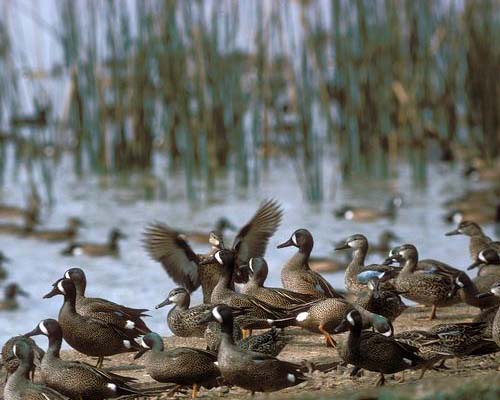
Blue-winged Teal
This is Passport to Texas
Fall hunting begins with dove season on September first, and continues with a 16 day early teal season, beginning September 15th.
10—Teal are an early migrant species of waterfowl that come through Texas — usually in September is when you see a big bunch of birds pushing through here. They’re one of the earliest migrant species that we have.
Dave Morrison is small game program director for Texas Parks and Wildlife. Of the three teal species found in Texas, the blue winged teal is most plentiful.
Before the creation of early teal season, Blue winged teal were not as available to hunters. Morrison says that’s because the “big duck” season started too late and ended too early for teal’s migratory habits.
Biologists monitor movement, survival rates and harvest rates of migratory species like blue winged teal through banding programs.
21—Years ago we started doing research on this, and saw that the band returns are very low for blue wings, and because they’re not available during the regular duck season — a lot of times they’re already through here and gone — and they’re one of the most populous ducks, as well as one of the ones that has the lowest band reporting rates, it makes sense biologically that you can take advantage for these birds. So that’s the reason why we have September teal season.
Tomorrow: how Mother Nature can play foul with early teal season.
The Wildlife and sport fish restoration program supports our series and celebrates 75 years of funding diverse conservation projects throughout Texas… For Texas Parks and Wildlife…I’m Cecilia Nasti.
Posted in Hunting | Comments Off on Hunting: Early Teal Season
August 29th, 2012
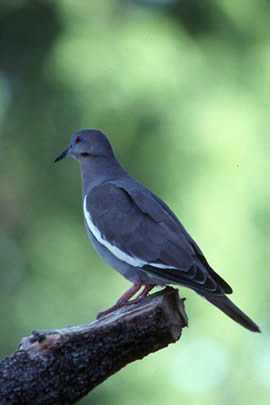
White Winged Dove
This is Passport to Texas
Corey Mason is Wildlife Regional Director for Region 3, and says once limited to South Texas, white winged doves are on the move.
60—You know, we find mourning dove and white-wing dove—both—all the way from Far West Texas in the trans Pecos Region into the Pineywoods of East Texas. And we’ve recently actually this year found new colonies of nesting white wing dove deep in East Texas. Why is that unusual? Historically, white wing dove were found along the lower Rio Grande Valley in South Texas, really associated with South Texas brush, some of the citrus groves in the 80s. But since that time, there’s been a huge range wide expansion of these birds all across the state. White wing dove can basically be found in any county in the state now. What do we attribute this movement of the white wings to? You know, a lot of it can be triggered back to a hard freeze in the eighties, kind of moved some of those birds. Kind of lost some of those types of nesting habitat; those birds adjusted and moved from that. So we kind of have two populations of white wings now. We have the historic south Texas—south of San Antonio—populations of white wing doves. And then we have north of that line, a population of white wing dove that are all across the state now, that are really kind of moving these transient movements from one urban population to the next. And from there spreading out and out and out. It’s really occurred over the last ten or fifteen years. And like I said, these birds can nearly be found pretty much anywhere in the state now.
The dove season opener is in the north and central zones is Saturday, September 1.
The Wildlife and sport fish restoration program supports our series and celebrates 75 years of funding diverse conservation projects throughout Texas…
For Texas Parks and Wildlife…I’m Cecilia Nasti.
Posted in Hunting | Comments Off on Hunting: White Winged Dove’s New Range
August 28th, 2012

This is Passport to Texas
As we round the corner into fall hunting, Texas Parks and Wildlife magazine offers a digital special, featuring hunting – from field to plate. Editor, Louie Bond,
64— Last spring, we had our first fishing digital special, and this fall, we follow it up with our first ever digital hunting special. And it is a combination of the magazine and a guide. So, this time we’re going to talk to Mike Cox about how to get kids out hunting. And he relates his first hunting experience with his grandfather, and then how he took his youngest daughter out hunting last year. And along with that gives us lots of tips to make it interesting and fun to go hunting with your kids. We’re also going to look at processing. What do after you finally get that big game kill? So, we’ll be looking at processing with Steve Lightfoot, and then we take it into the kitchen with three Texas chefs who are also anglers and hunters themselves. They show us how to really go all out foodie with your game and to really create some terrific dishes. We’re also going to take a look at Big Time Texas Hunts, which is a chance in a lifetime to go on a hunt for animals you’ll never be able to hunt any other time. And we’re also going to take a look at the dove and teal outlook for the fall hunting season. So, we hope that you’ll join us and learn everything there is to learn about Texas hunting this fall.
Thanks, Louie.
Look for the digital hunting issue online beginning August 15 at tpwmagazine.com.
The Wildlife and sport fish restoration program supports our series and celebrates 75 years of funding diverse conservation projects throughout Texas…
For Texas Parks and Wildlife…I’m Cecilia Nasti.
Posted in TPW Mag | Comments Off on TPW Magazine: Digital Hunting Special
August 27th, 2012

Cleburne State Park
This is Passport to Texas
Off the beaten path, Cleburne State Park – outside of the Dallas Fort Worth Metroplex – is a nearly hidden treasure. And one that our State park Guide Bryan Frazier says has received a face lift and some bridgework.
57— Cleburne State Park is about 580 acres. It’s off the beaten path just enough that a lot of people don’t know about it. And not only has it recently had millions of dollars of improvements, but now they’ve restored a CCC built bridge. What they’ve done is now they have made it a foot bridge instead of having vehicle traffic that goes across it. And this incredible structure that was built in the 1930s is still supporting everything you would need in infrastructure. They shored it up and cleaned it up…and it has all the signature CCC hand built bricks that are on there. And it’s probably 25 to 30 feet tall from the bridge to the creek bottom that it crosses. And now, the new road that goes around and by passes allows vehicle traffic into the park. It’s just one more part of the history of the CCC and Cleburne State Park. And you’ve got miles of hike and bike trails—it’s gorgeous scenery, great fishing in the lake. It’s a park that people need to check out.
Thanks Bryan
That’s our show for today…with funding provided by Chevrolet, supporting outdoor recreation in Texas; because there’s life to be done.
For Texas Parks and Wildlife I’m Cecilia Nasti.
Posted in Uncategorized | Comments Off on State Parks: Cleburne State Park
August 24th, 2012
The Edwards Aquifer
Eye on Nature
This is Passport to Texas
The Edwards Aquifer Recovery Implementation Program, or RIP, protects endangered and threatened species in the Edwards Aquifer.
Many of these species are no more than an inch long. The Comal springs riffle beetle is even smaller…only two millimeters long.
But Texas parks and Wildlife water resources branch chief, Cindy Loeffler, says preserving the species is crucial to the ecosystem.
16 — These are, you know, you’ve heard the cliché canary in the coal mine. If we want to truly protect natural resources, fish and wildlife, these unique ecosystems. These species are indicators of the health of those ecosystems.
Loeffler also says if the program protects the identified species, it will most likely save many more in the process.
16 — We have some species that there’s very little known about. And these are in a way the tip of the iceberg of the threatened and endangered species that are found associated with the Edwards Aquifer. There are many more species that are not listed that are found nowhere else.
Many of these species — like the San Marcos blind salamander and Texas wild rice — are found nowhere else in the world…. And pumping water from the Edwards Aquifer alters the habitat, putting these species in an unstable environment.
Learn more about threatened and endangered species on the Texas Parks and Wildlife website.
The Wildlife and sport fish restoration program supports our series and celebrates 75 years of funding diverse conservation projects throughout Texas… For Texas Parks and Wildlife…I’m Cecilia Nasti.
Posted in Conservation, Endangered, Threatened, Wildlife | Comments Off on Endangered: Recovery Implementaion Program


 Passport to Texas is a
  Passport to Texas is made available by: