November 2nd, 2018
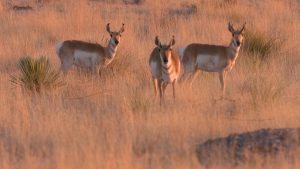
Billingsley Ranch
This is Passport to Texas
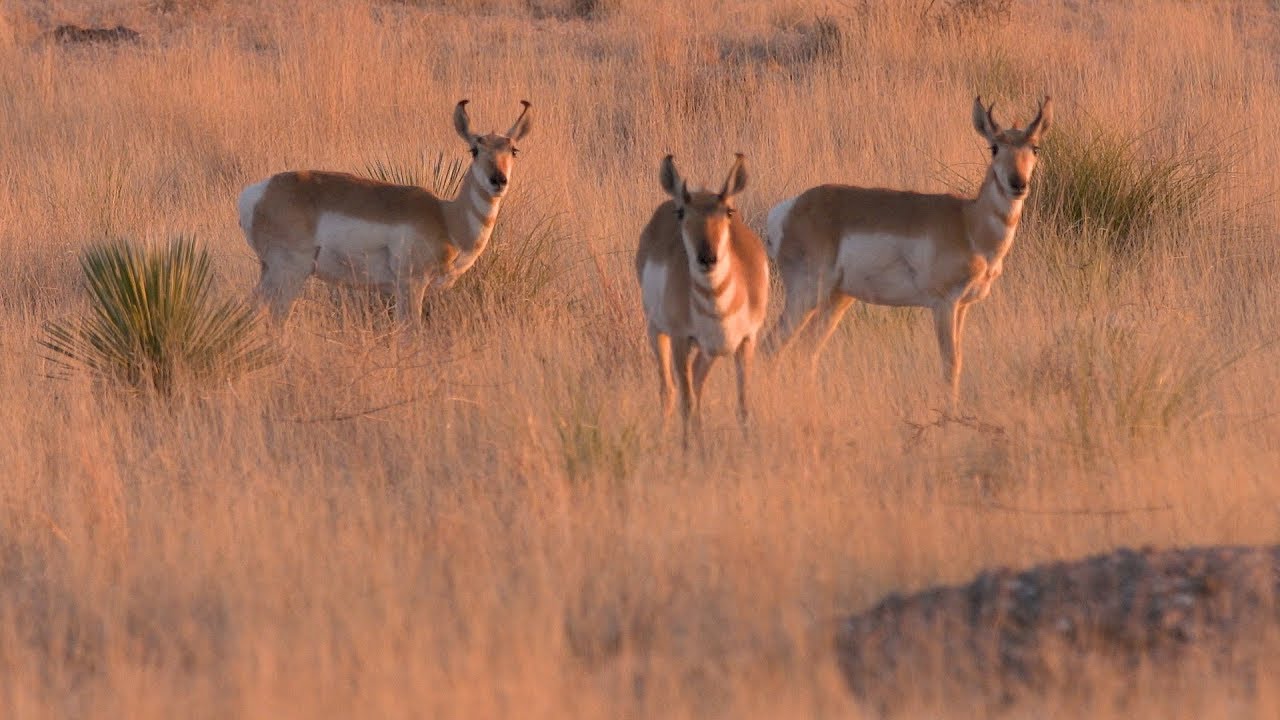
The Billingsley Ranch in the Trans-Pecos is made up of pristine Chihuahuan dessert grassland. Shortly after buying the ranch in 2008, Stuart Sasser said a wildfire set him back to square one.
And it came up through here and burned about seventy percent of this ranch. We were able then to start completely over with a new set of fences that were antelope friendly type fences. And build a new type of water system.
In an upcoming segment on the Texas Parks and Wildlife TV series, viewers see the ranch and meet, Sasser: a 2018 Lone Star Land Steward Award recipient. Michael Sullins is a Natural Resource Specialist with Texas Parks and Wildlife.
Stuart’s approach to management out here is not really all from a cattle production perspective. He has a holistic view of the place; he wants to improve it for the native wildlife.
Whitney Gann is a Research Scientist with Borderlands Research Institute. She says the ranch’s prime grassland habitat made it an ideal place to translocate pronghorn.
We’ve completed seven translocations since 2011, the Hughes Sasser ranch served as our release sight for pronghorn in 2016, and the results of these translocations is an upturn in the population, and so we’ve actually doubled our population size since 2012 to today.
A segment featuring innovations on the Billingsley Ranch airs the week of November 4 on the Texas Parks and Wildlife TV show on PBS.
The Wildlife Restoration program supports our series.
For Texas Parks and Wildlife, I’m Cecilia Nasti.
Posted in Conservation, Land/Water Plan, TPWD TV, Wildlife and Sport Fish Restoration Program | Comments Off on TPW TV — Billingsley Ranch
November 1st, 2018
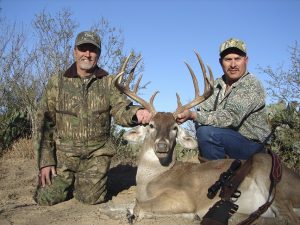
Trophy buck taken by Tom Roughton with guide Rene Garza.
This is Passport to Texas
As you round a bend during a hike, you spy a buck with large, flawless antlers. Your heart races; your breathing becomes shallow; your nerves tingle. Hunters call this: buck fever. And it’s caused by the sight of perfect antlers.
Nice smooth lines, tall tines coming off the main beams; very symmetrical one side to the other.
John Stein knows a thing or two about perfect antlers; he’s curator at the Buckhorn Saloon and Museum in San Antonio. Antler and taxidermy covered walls draw visitors to the saloon by the thousands.
Overall, in the collection, there’s over 12-hundred trophies that are on the walls –of all difference species.
Some hunters shell out big money to landowners to bag trophy animals on their property; money the landowner funnels into management and conservation. For 25 years, deer experts at the Kerr WMA have studied the genetic and nutritional aspects of antler growth in bucks, and shared the data with landowners; biologist, Gene Fuchs.
The information that we’ve gained from this study shows that through selection – by never allowing a buck that was a spike to ever breed a doe – we produced no spike antler yearling bucks two years in a row. And, the percentage of good quality antler yearling bucks has steadily increased.
Opening day for deer season in the north and south zones is November 3rd.
The Wildlife Restoration program supports our series and funds whitetail research in Texas.
For Texas Parks and Wildlife, I’m Cecilia Nasti.
Posted in Hunting, white-tailed deer | Comments Off on It’s Buck Fever Season
October 31st, 2018
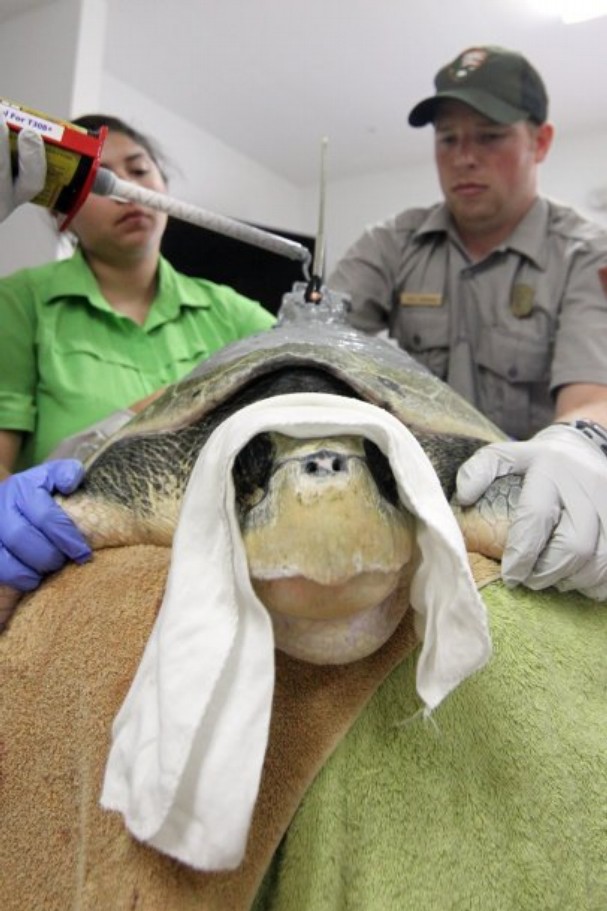
Sea turtle receiving GPS, Image courtesy Corpus Christi Caller Times
This is Passport to Texas
Understanding where wildlife goes provides valuable information to help manage species. Dr. Donna Shaver uses the newest GPS technology in tandem with satellites orbiting12-thousand miles above earth, to track endangered Kemp’s Ridley Sea Turtles on the Texas coast.
We’re conducting this tracking because we want to get an idea about the habitat usage by these adult females.
Dr. Shaver is with the National Park Service.
We want to see where they’re going in the marine environment, which is where they spend the vast majority of their life; where they’re going for migration as well as for foraging when they’re done nesting.
It takes Dr. Shaver and her team about three hours to prepare a turtle for tracking.
We have to sand the shell; we put down the first layer of epoxy, then we’ll affix the transmitter. Then when it’s on here solid, we will paint the surface to help prevent barnacles from adhering onto that area where it [the transmitter] has been applied.
Dr. Donna Shaver uses GPS and satellite technology to track endangered Kemp’s Ridley Sea Turtles, and you can
see a video of her in action on the Texas Parks and Wildlife YouTube channel.
We’re one step closer towards recovering the species someday so that it can be enjoyed by future generations.
That’s our show… For Texas Parks and Wildlife…I’m Cecilia Nasti.
Posted in Migration, Wildlife and Sport Fish Restoration Program | Comments Off on Technology and Sea Turtles
October 30th, 2018

Tree planting photo by woodleywonderworks via Flickr, Creative Commons
This is Passport to Texas
Trees are habitat for wildlife. And if you’re adding new trees to your landscape, you need to know the rules.
People frequently ask how close they can put a tree to the house, because shade on the house obviously is a huge energy savings. The general rule of thumb is you go no closer to the house than the eaves are high. So, if you measure up to the eaves of your house, and it’s ten feet high, then you need to get ten feet back from the house.
Scott Harris, a certified arborist in Austin, recommends planting only native specimens.
You always want to plant your trees at the exact level they were in the pot. Don’t dig a big deep hole, dig a big wide hole. Always use the same soil you took out to backfill. But, you can put your compost underneath the mulch, and then all of that organic goodness will dribble down in the way that nature intended.
By watering infrequently and deeply, we can help new trees develop extensive root systems.
If you just have a little bit of water in one area, that’s where the roots are going to go. But if you water very deeply, it’ll spread into the surrounding soil, and the roots will follow that moisture out.
Strong root systems help trees remain strong and withstand drought.
That’s our show…For Texas Parks and Wildlife…I’m Cecilia Nasti.
Posted in Botany, Habitat | Comments Off on The Rule of Trees
October 29th, 2018
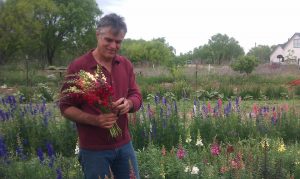
Scott Harris, when he also farmed flowers. Image from his Facebook page.
This is Passport to Texas
Now is an ideal time to plant trees throughout most of Texas…and you might wonder why.
Two reasons: the two most important constituents in tree planting—the people planting the trees and the trees. It’s just much easier on them.
Scott Harris is a certified arborist in Austin. Tree planting season in Texas begins in October and continues through March.
Getting the trees in the ground in the fall [and winter], they have the entire cool season, dormant season, to spread roots out before the big demands on roots and water start in the spring.
Just because a tree will grow in Texas, doesn’t mean it’s good for Texas. Harris advises that we exercise caution about what we plant in our yards.
The biggest thing to avoid is non-natives. Our natives have all of the features you would want, but they’ve spent thousands and thousands of years getting used to being here, and with all of the wildlife used to having them, too. It’s all a web, and you can’t tell which string you can pull out without upsetting things.
Tomorrow we’ll have a few tree planting tips to help you and your newly planted tree enjoy a long and happy life together
Our show receives support from RAM Trucks: Built to serve.
That’s our show…For Texas Parks and Wildlife…I’m Cecilia Nasti.
Posted in Botany, Habitat | Comments Off on Tree Planting Time in Texas



 Passport to Texas is a
  Passport to Texas is made available by: