TPW TV: Gulf Game Wardens

November 29th, 2010

This is Passport to Texas

Meet game wardens who spend their time enforcing law in the Gulf of Mexico this month on the Texas Parks and Wildlife PBS TV series. Alan Fisher produced the story.

67—Coming up the week of November 28th is a story called “The Gulf Wardens”. It’s basically a ride along with the game wardens who spend their time guarding the Gulf of Mexico. Sgt. James Dunks gets a crew of volunteer game wardens from the area to staff his boat, and go out on the gulf, and enforce the shrimp and fishery laws.

This is our shrimp patrol that we do for about two months straight—we do week-long shifts. We patrol the Gulf of Mexico for any type of shrimp violation or fishery violation, or basically anything else we come across.

What did you learn from your time on the boat?

It was an education They have very varied jobs. They’re out there checking shrimp boats, and making sure everyone is complying with the law, but they also never really know what they’re going to encounter.

And so, for people who are watching this segment, what do you want them to take away?

With the Gulf oil spill recently, I think people are more aware of how fragile our gulf resources are. So, it’s a neat opportunity to meet some folks who are out there protecting those resources.

Our show receives support from the Sport Fish and Wildlife restoration program, working to increase fishing and hunting opportunities in Texas.

For Texas Parks and Wildlife…I’m Cecilia Nasti.

Tips for Making Venison Sausage

November 26th, 2010


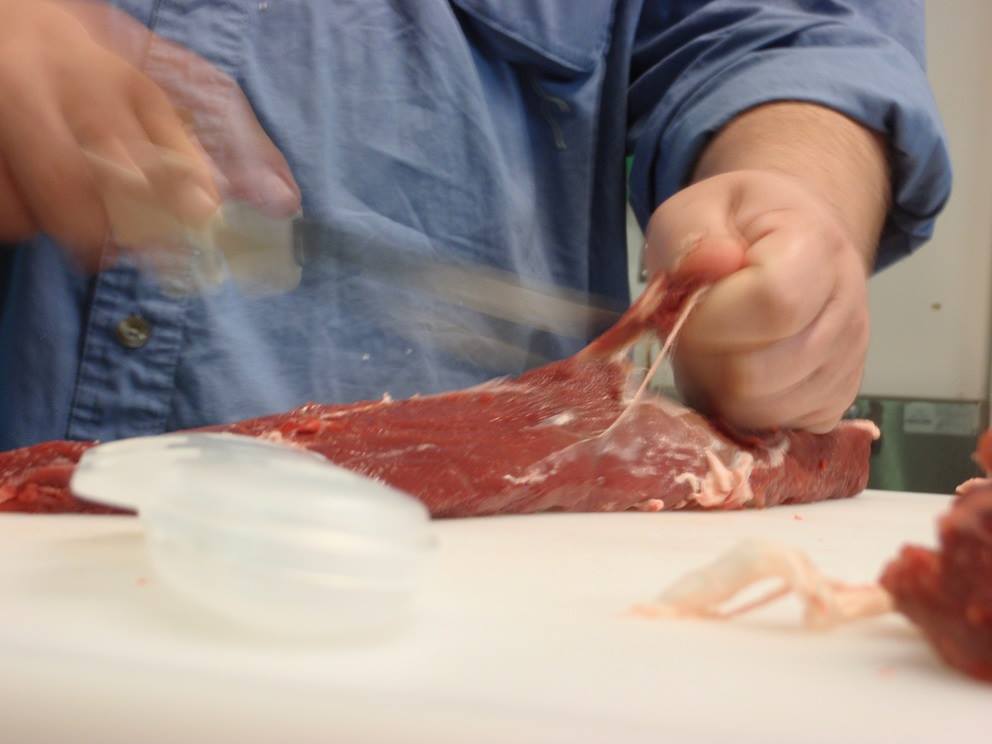
Processing venison at Feral Kitchen

Processing venison.

This is Passport to Texas

Sausage is an easy, tasty way to utilize the scraps and organ meat of large game animals like deer. The trick to making good sausage, says Jesse Griffiths, a hunter and chef who teaches people how to process and cook venison, is to keep everything cold—from the ingredients to the equipment.

You want the fat and the protein to remain separate, so when you mix it together, they’re going to bind together and form this cohesive mass; that’s going to greatly affect the texture of the sausage and keep the fat from leaking out of the sausage which is going to moisten the end product, and keep that venison really tender, and make the sausage a really nice texture—sliceable, and not crumbly or grainy.

And then, the one step in your recipe is where you put the chilled ground meat into your kitchen aide stand mixer, and mix it again with water. Could you explain why you do that?

You’ve got it ground to the point where you want it already. And now you want to bind those and make those stick together, like, literally become sticky. And by using the paddle attachment and by whipping it a little bit, you are creating a bind to the sausage, where the fat and the proteins are stuck together.

Cold water lowers the temperature and maintains the bind between the fat and the protein, and also reduces the likelihood of the fat separating out, and at the same time it distributes the flavorings—the salt and the seasons that are in the sausage—and makes them more homogeneous within the sausage.

We have a venison sausage recipe at www.passporttotexs.org. Our show receives support from the Sport Fish and Wildlife Restoration program, working to increase fishing and hunting opportunities in Texas.

For Texas Parks and Wildlife…I’m Cecilia Nasti.
___________________________________________________

Venison Jalapeno Summer Sausage
Chris Houston, Feral Austin

I make these into 1 lb logs using 1.5” fibrous casings, but it’s also fun to make larger ones that can be a real conversation piece at a party or bbq.  To take it up a notch, consider making your own mustard to accompany it.

Ingredients

  • 5 pounds meat – venison, feral hog, or a combination (at least 20% fat content – otherwise you’ll need to add fatback)
  • 2 tablespoons Kosher salt
  • 2 teaspoons cracked black pepper
  • 2 teaspoons mustard seed
  • 2 teaspoons garlic powder
  • 5 fresh jalapenos, seeded (unless you really like the heat)
  • 1 teaspoon Instacure #1

Directions

  1. Coarse grind the meat and fat through a ⅜” grinder plate.
  2. Grind half of the mixture through the same plate yet again.
  3. Stuff tightly into 1 ½” (or larger) Fibrous Casings
  4. Let cure in the refrigerator for 1-3 days then smoke until the internal temperature reaches 152 degrees.

I like to use hickory with this recipe, but oak works well too.

I start my smoker at 140-145 deg for 1 hour without water to dry the sausage.  Then add a water pan and smoke at 155 degrees for 1 hour.  Then increase the temperature to 175 until the internal temperature of the sausage reaches 152 degrees (about 2 hours).


No Waste Venison Cookery

November 25th, 2010

This is Passport to Texas

By now many hunters have ventured into the field at least once to track and harvest deer; for most hunters, the act isn’t about bringing home a trophy—it’s about spending time in nature and bringing food home for the table. It’s also about developing a connection with the food they eat, which is something hard to do with plastic wrapped cuts of meat on Styrofoam trays, stamped with “sell by” dates.

Harvesting your own meat may not be easy, but you definitely know what you’re getting.

Jesse Griffiths is a hunter and chef, and teaches classes on processing and cooking venison. He says oftentimes hunters unnecessarily waste meat.

19—I don’t think that people are utilizing as much as they could or should, which is really why I wanted to put on this class. I wanted to show people how, because it’s just not in our culture anymore to know how to do that. So, it is by no fault of most hunters. I think that they would. I mean, don’t throw the liver away. Now, if you’re going to make 30 pounds of sausage, if you don’t like the taste of liver, put it in there and you’ll get the nutrition.

If in the past you’ve left sausage making to the processor, perhaps it’s time to make your own. Tomorrow, Chef Griffiths offers tips on doing just that.

06—You’ve got it ground to the point where you want it already, and now you want to bind those and make those stick together—like literally become sticky.

That’s our show…with support from the Sport Fish and Wildlife Restoration program, working to increase fishing and hunting opportunities in Texas.

For Texas Parks and Wildlife…I’m Cecilia Nasti.

Which is the Tastiest Nut: Hickory or Pecan?

November 24th, 2010

This is Passport to Texas

Fall is harvest time in nature. It’s the time of year when foraging for native produce may provide us with a bountiful harvest, especially when it comes to nuts.

04—Once we get into fall that’s the time when a lot of nut trees produce.

Scooter Cheatham is a naturalist and co-author of The Useful Wild Plants of Texas, the Southeastern and Southwestern United States, the Southern Plains, and Northern Mexico, a multi-volume set of encyclopedias that details the various uses for native plants.

Native walnuts ripen in the fall, and grow wild throughout the state. The ubiquitous acorn is another edible native nut, but requires extensive processing to be palatable.

Of course pecans are a favorite around these parts, and figure prominently at the end of many Thanksgiving meals, when made into a sweet filling cradled in a flaky crust. Yet, as good as pecans are, Cheatham says there’s one nut better…its cousin the hickory.

08—A lot of people who’ve made Thanksgiving pies from hickory swear that hickory is better than pecan. They’re awfully good. I’ve made them and I’m convinced.

Learn about wild food, and never bite into anything you cannot fully identify. Acquaint yourself with these edibles by joining your local chapter of the native plant society. Or visit www.usefulwildplants.org for more information.

That’s our show for today… For Texas Parks and Wildlife…I’m Cecilia Nasti.

Foraging in Nature’s Grocery Store

November 23rd, 2010

This is Passport to Texas

Delicious traditional foods take center stage during holiday meals. And that food doesn’t have to come from a market if you know where to look and what you’re looking for. Savor the flavors of an earlier time in Texas when you forage for and cook with native produce.

10—I almost prefer fall over spring in certain ways because a lot of complex foods – the fruits and beans and seeds and things like that — really ripen in the fall.

Scooter Cheatham is a naturalist and co-author of The Useful Wild Plants of Texas, the Southeastern and Southwestern United States, the Southern Plains, and Northern Mexico, a multi-volume set of encyclopedias detailing the various uses for plants that grow around us. And fall is a great time to forage for some of the edible ones.

20—The Mexican persimmon’s a substantial fruit. Many grapes are still ripening, Mexican plums are ripening. Malvaviscus, Turks’ Cap’s…many species of grass. The seteriars are getting ripe now. That makes a really nice little seed cracker. Dallas grass of Paspalum dilatatum is ripening. Lynn’s made some really good crackers from those.

Before you start snacking on feral foods, make sure you’re 100% certain of what it is. Although you can eat any wild food once, if you don’t know what you’re eating, you may not get a second chance. Join your local chapter of the Native Plant Society to learn about native nourishment.

You can also log onto www.usefulwildplants.org for more information. Tomorrow…getting nutty about hickories.

That’s our show for today… For Texas Parks and Wildlife…I’m Cecilia Nasti.